Why We Must Support Today’s Young Environmentalists

C is for Carbon Footprint is a lovely book for young readers, presenting the facts on carbon footprints and climate change clearly, with easy solutions to help.
Each letter from A to Z contains a lesson, on how to help improve our planet, for ideas way beyond recycling. Beautiful artwork assists the reader, to imagine a better future.
Decrease your carbon footprint with these 26 tips to become a better environmentalists and improve your lifestyle.
The book begins with Sarah Lazarovic’s illustrated ‘Buyarchy of Needs‘:
- Use What You Have
- Borrow
- Swap
- Thrift
- Make
- Buy
Read more on no-dig gardening and humane slug/snail deterrents. If you live with animal friends, read up on pet-friendly gardens (some recommended flowers and fruit trees are not safe). Also avoid netting to protect food (just leave some for wildlife!)
Robert Donisch is an outdoor educator and teacher, who decided to use his knowledge and experience, to write an inspiring book for young readers, on how to help the planet.
Make a Difference in a messed up world!
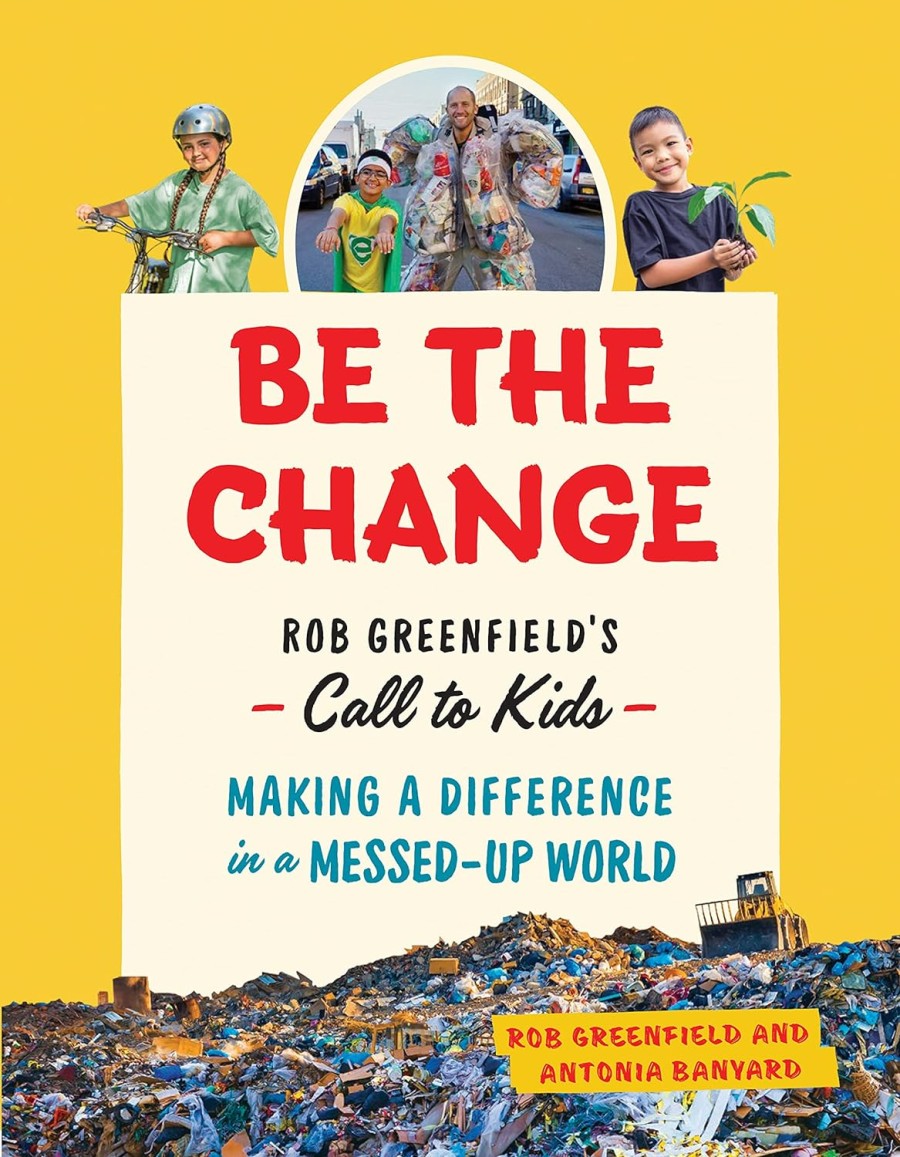
Be the Change is a guide for young readers, from activist Rob Greenfield. He’s walked around New York City (dressed in his own garbage), cycled (three times) across the USA on a bamboo bike, and survived for one year on foraged food.
The book features fun ideas to reduce environmental impact, with extensive teachings on reducing ‘stuff’, because ‘there is no away’ to throw it to! Plus readers will meet inspiring young environmentalists, including ‘minimalist teens’. For readers age 8 to 12.
You can also download a free teacher’s companion guide to the book.
I loved every page of this amazing book. Rob offers fun escapades that are also real-world ways to help a world that needs attention right now. Turns out, saving our planet is fun. I put this book down feeling fired up and full of hope. And you will too. Caroline Paul
The book version is out-of-print in the UK, but you can order the paper version from the North American publisher, if wished.

Rob Greenfield used to work in marketing, before deciding to simplify his life. Named the ‘Robin Hood of modern times’, he gives his media income to grassroots non-profits, so he does pay tax to pollute or buy weapons.
He gave up his affluent lifestyle, and cycled across the USA on a bamboo bike, drinking water from fire hoses and eating food from dumpsters. He gives away most of his income, so he pays no tax (to avoid funding weapons).
How he changed his life is quite inspiring, and maybe inspires others to do the same. He basically decided he was nowhere near living the life he wanted.
So he made a huge list of over 100 changes he wanted to make, then hung it in the kitchen, and made one positive change each week, so he changed his life completely in 2 years.
From eating more fruits and vegetables, cooking his own food, finding zero-waste alternatives to drinking filtered water. He shopped local, bought second-hand and shared with his community.
Young environmentalists connect climate issues
For many young people, the environment isn’t an abstract “planet” topic. It’s cold homes, high bus fares, and asthma on polluted roads. It’s also fairness, because the worst air often sits near schools and busy junctions.
That everyday link changes the tone of local debates. Instead of “save the world”, the message becomes “make the walk to school safer” or “help families spend less on energy”. Those goals are easier to agree on, even when people disagree on politics.
A simple example shows the point. A student group might campaign for a no-idling rule outside a primary school. They take photos, gather signatures, and share short videos from the pavement. As a result, drivers learn, the school updates signage, and the council enforces when needed. The win is small, but the health benefit is immediate, and the habit can spread.
They are skilled communicators and organisers
Young organisers often work with almost no money. Even so, they can build support fast. They know how to explain an issue in 20 seconds, then back it with clear facts when challenged. They can run a stall at a community fair one day, then speak calmly at a planning meeting the next.
Those skills look “soft”, but they’re measurable. Young people write to MPs and councillors, read planning documents, and learn how consultations work. They also recruit volunteers, organise rotas, and manage group chats without losing the plot. In addition, they practise teamwork across schools, faith groups, sports clubs, and estates.
Communities benefit beyond the environment. A teenager who learns to chair a meeting can later lead a tenants’ group. Someone who learns to check sources can tackle misinformation on any topic. When we support young environmentalists, we’re also supporting future civic life.
How to support young environmentalists
Young people don’t need adults to speak for them. They do need adults to stop others talking over them. That can be as simple as saying, “Let them finish”, or “That’s their point, not mine”.
Real influence also means real seats. Invite youth reps onto council climate panels, school governor meetings, and local business sustainability groups. Don’t make it token.
Share the agenda in advance, explain acronyms, and build in time for questions. Also, credit ideas properly, especially when a young person’s work leads to a policy change or a funded project.
Most youth groups don’t need a huge grant. They need small, flexible support that matches how they work. A printer. A meeting room. A safe way to store kit. A friendly adult who can help with forms, not control decisions.
Here’s a short menu that tends to make a real difference:
- Small grants for posters, room hire, and basic materials.
- Tools like litter pickers, refill station signage, or air quality sensors.
- Practical mentoring on risk assessments, press enquiries, and running events.
- Introductions to decision makers, such as councillors, headteachers, or estate managers.
- Exam-aware planning, so deadlines and big events don’t land in peak revision weeks.