The Stunning Colours of Nature: Blue
Blue is one of the rarest colours in nature (less than one in 10 plants are blue, and even less ratio for birds and other creatures).
Blue fruits and vegetables don’t really exist, as the anthocyanin compound with health benefits in blueberries and blackberries is actually purple.
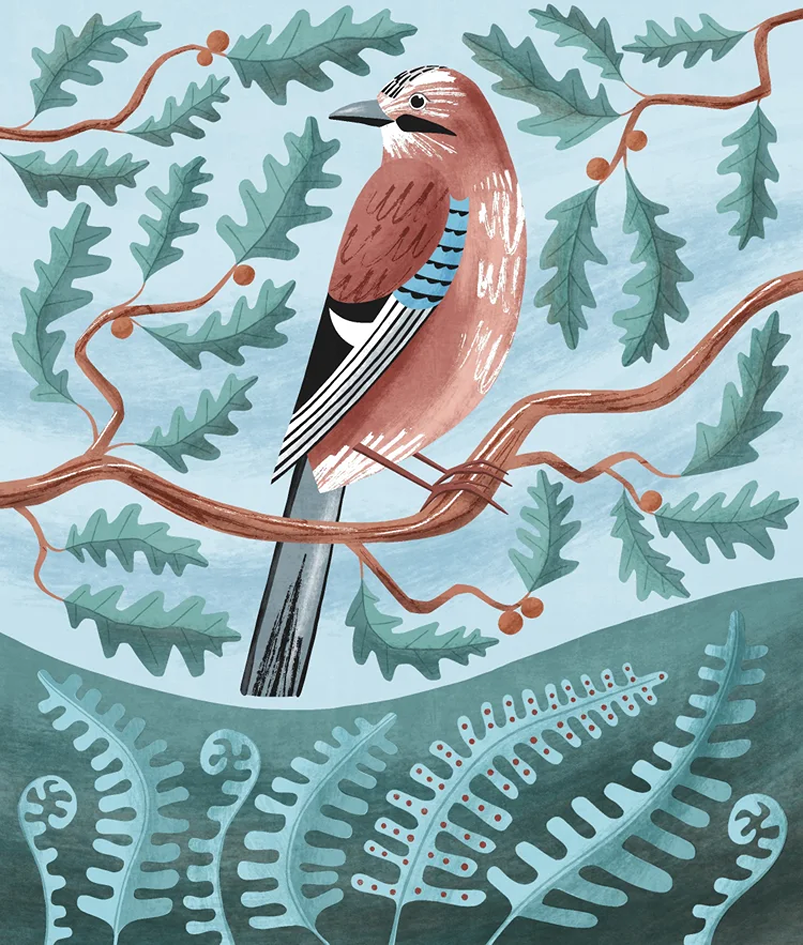
Beautiful Blue Jays (shy woodland birds)

Jays are one of England’s most exotic looking birds, simply because amid their brown bodies, they have beautiful bright blue patches, almost unique in bird world – along with black moustaches!
The blue colour though is not due to pigment in the feathers (they are brown), it’s from light scattering (a bit like polar bears have translucent, not white fur).
Read how to create safe havens for garden birds (jays are more likely to visit woodland) and how to stop birds flying into windows.
Jays are one of England’s eight species of crow birds. These are woodland birds, ‘noisy chatterboxes’ that you may hear screeching in the park, but are unlikely to see, as they often hide away.
What’s important (and quite funny) about jays, is that they are very forgetful. So they hunt for acorns, then store them away, often forget where they put some of them, so are almost single-handedly responsible for many of England’s beautiful oak trees that grow from their forgotten stash!
Oak trees (and acorns) are unsafe near pets, horse and livestock, so keep them well away.
Jays also eat other foods, including fruits, beetles and caterpillars (which is why we need to protect natural habitats for butterflies). They are also good at mimicking the calls of other birds, to deter predators.
All UK crows are protected under the Wildlife and Countryside Act. Report concerns to Crimestoppers Wildlife Crime (anonymous).
Bluebells (England’s woodland flowers)

Bluebells are one of England’s favourite woodland flowers, which often signal the arrival of the spring season. Many other wild flowers are blue including cornflowers, delphiniums and hydrangeas (though some spring flowers like crocuses, tulips, snowdrops and daffodils are not).
All bulb flowers are toxic to humans and pets, so keep them away from flower-nosey animal friends. Read more on pet-friendly gardens.
Bluebells are protected wildflowers (so you can’t pick them) which take years to grow from seed, so also need protection from footfall damage (so don’t walk on them). Half of the world’s bluebells are found in the UK, often in woods that transform to a ‘carpet of blue’ each spring.
The sticky bulb sap was used in book-binding (and glue for arrows). The starch in the bulbs was also used to make stiff Elizabethan ruffs and collars.
Pollinators like bees and butterflies adore bluebells, as do hoverflies (these are harmless flies that look a bit like bees, which also are pollinators and natural pest controllers). Unlike bees and wasps, they have just one pair of wings, and can’t sting.
Many ancient bluebell woods in England are also home to migrating birds, who travel thousands of miles to breed (including blackcap, wood warbler, nightingale and chiffchaff).
There is a silent eloquence
In every wild bluebell
That fills my softened heart with bliss.
That words could never tell.
Anne Brontë
Blue-Footed Booby Birds (from the Americas)

The blue-footed booby bird is not native to England (found from Mexico to Peru). ‘Booby’ is apparently the Spanish word for silly! But this is no silly bird, it’s a clever bird whose habitat we need to protect.
Blue is a rare colour in the animal kingdom, so you can imagine how proud this bird is of his bright blue feet! When he wants to attract a partner, he performs a mating dance, and shows off his feet. Whoever has the most blue tootsies, gets the girl!
Despite their comical appearance on land, blue-footed booby birds are skilful underwater hunters, their colour coming from the carotenoids from catching fish in their diet (just like flamingos are pink, due to eating shrimp).
They are able to dive at high speed, due to air sacs in their brains that cushion impact. Their nostrils also seal shut underwater, so they can breathe through their beaks. Isn’t nature wonderful?
Chefchaouen (Morocco’s ‘Blue City’)

Morocco is a land far away, but there is a lot to learn from this ancient country, just like anywhere else (and likewise lessons everywhere else can learn from England). Chefchaouen is known as ‘the blue city’, as all houses and shops are painted different shades of blue.
Donkeys remain a main form of transport in Morocco. So donate to The Donkey Sanctuary, which uses funds to help rescue, medically treat and educate people who use donkeys for work or transport abroad.
Barbary macaque monkeys are native to Morocco, known for their female-led structure (while the dads carry babies). They live here in the Atlas mountains and also in Gibraltar. They need help from habitat loss and illegal wildlife trade. Read more on how to help prevent wildlife crime.