Bamboo alloy pencils (never need sharpening)
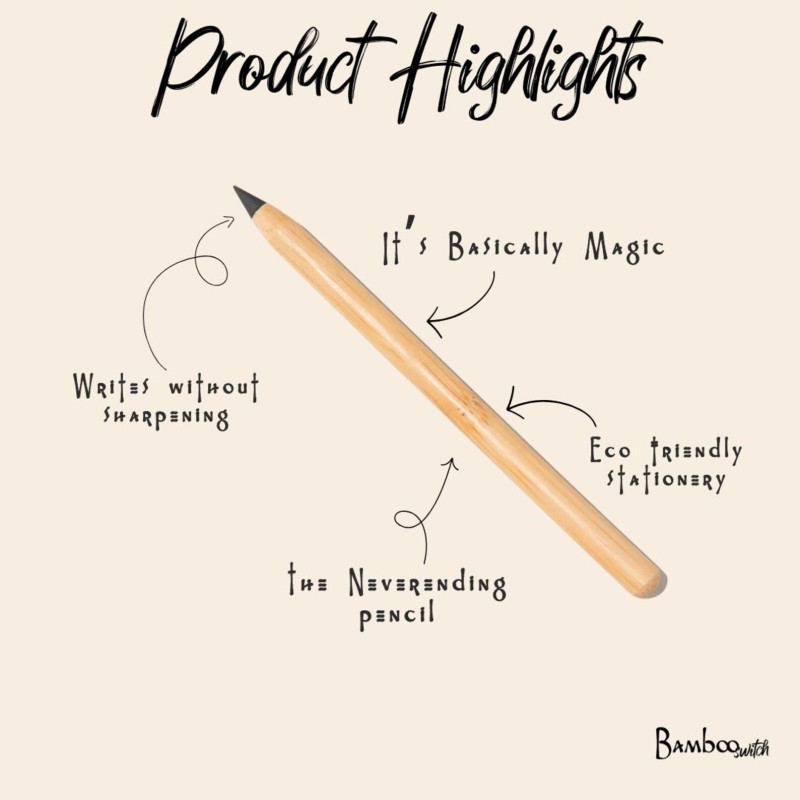
Bamboo (the world’s fastest-growing grass) is not local (it’s usually imported from China). But if sea-freighted, bamboo grows far quicker than wood, so helps to save trees. Industrial bamboo is not the same as fresh shoots, eaten by pandas.
These bamboo alloy pencils ship from the USA, but are expected to last a lifetime. One pack includes 10 pencils (can be erased with a regular eraser, not included). These pencils don’t smudge.
Bamboo pencils are light yet hardy, and have a nice slightly woody scent. Whereas trees take decades to grow and harvest, bamboo plants are back to where they were, within weeks or months of being harvested. So have a far lower carbon footprint.
Switching to eco friendly pencils is one of the simplest ways to help the planet. Whether you sketch, take notes, or just love a good crossword, these pencils add a happy, green twist to your everyday routine.
Keep pencils away from young children and pets, and never litter them (they end up in the sea, and you will know how it hurts, if you ever accidentally stabbed your hand with a pencil or pen.
Most plantable pencils use seeds from abroad (not native species) and many flowers, herbs and onions are toxic to pets. Only use them if made with native seeds, and for pet-free homes/gardens.
Why choose eco-friendly pencils?
Millions of pencils exist across England, whether for drawing, sketching or just scribbling notes in offices, the kitchen or at school. But was with most things, this comes with environmental consequences.
Years ago, most pencils contained lead (which were toxic to all creatures including us). But today most pencils are made from soft cedarwood (easy to sharpen). However, this has caused mass deforestation, with around 82,000 trees cut down each year to make the world’s 14 billion or so pencils.
Add to that the toxic paints used to colour the nibs and outside (and the plastic packaging) and you can see the issues. Plus when pencils are littered, their slim size means they get missed by filters, and often end up in the sea, where they can puncture and harm marine creatures, especially soft-bellied ones.
Cedar wood is usually from ‘sustainable forests’. But this still means great mono cultures of trees grown with pesticides. And most cedar is from California, so that’s a huge carbon footprint in shipping the wood here to make pencils that often people never use (one may be taken out of a pack, and the rest thrown in a drawer).
And due to the paints used to coat them, they don’t just break down (you can’t put them in compost bins). So that’s more landfill waste to last for hundreds of years.
Where to recycle plastic pencils and pens
Terracycle offers a free writing instruments recycling programme, sponsored by industry. Just order a box for your office, school or community then everyone can deposit unwanted pens, pencils, highlighters, correction fluids, felt-tips pens and erasers.
You can download a poster to display near the recycling box, and all items are sent off to be made into other things (like park benches).