The ‘Blue-Remembered’ Hills of Shropshire
Shropshire is (along with Northumberland) one of England’s least-populated counties. And one of its most beautiful. From ancient woodlands to many canals, this is a county of rolling hills, green meadows and clean rivers. Even the main town of Shrewsbury is charming, nothing like a ‘city’.
If out walking, follow the Countryside Code to keep all creatures safe. Keep dogs on leads near steep banks (and away from toxic spring bulbs).
Shropshire has more sheep than people!
Shropshire has more sheep than people! Pregnant sheep (and sometimes due to wool waterlogged from rain) can sometimes roll over onto their backs, and can’t get back upright, due to having four stomach chambers (so will die if not turned back upright).
If you see a sheep on its back, just firmly right it back, then stay with it, until rain has drained off, so it won’t happen again. Then inform your local farmer.
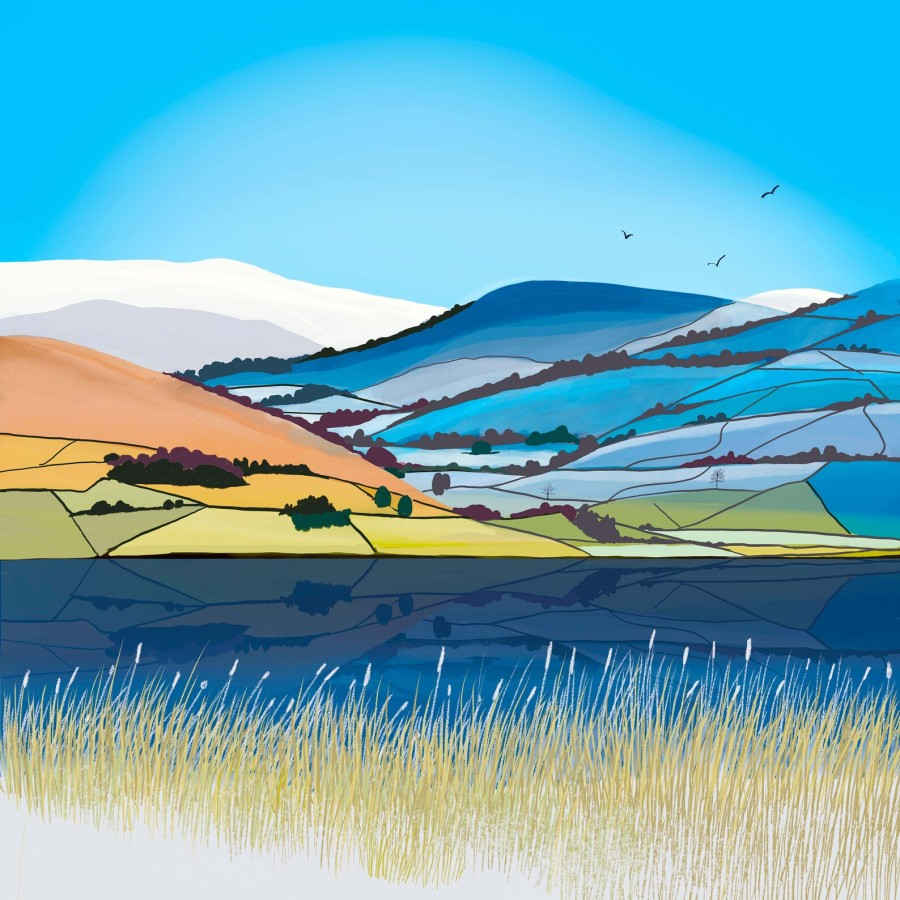
The phrase ‘blue-remembered hills’ is from a poem inspired by the rolling hills near the tranquil town of Clun and Bishop’s Castle (1.5 miles from Wales), which look blue in the distance and are filled with ancient hedgerows and wildflowers, with views over the Welsh border.
It’s believe the ‘blue’ is due to an atmospheric ‘mirage’ caused by the area’s coniferous trees.
Edward Housman was a poet who lived from 1859 until 1936. He only published two volumes of poetry in his lifetime. Born in Worcestershire, he studied classics at Oxford University and worked as a London clerk for 10 years, then taught Latin at Cambridge University.
He died in the city as a recluse, rejecting honours and avoiding the public acclaim that his poetry had given him:
Into my heart an air that kills
From yon far country blows:
What are those blue remembered hills,
What spires, what farms are those?That is the land of lost content,
I see it shining plain,
The happy highways where I went
And cannot come again.
The Shropshire hills brought to life
Once you leave the poem and step into the county, the phrase still makes sense. The Shropshire Hills National Landscape has a spare, open beauty. It is not grand in the way of Snowdonia or the Lake District. Instead, it feels measured, old, and companionable.
The views change quickly. One moment you are in a narrow lane with hedges and sheep. Then the road lifts, and the country opens into long ridges, broad moorland, and fields laid out like cloth. Market towns sit below the slopes, small and self-contained. Church Stretton, for example, rests between hills in a way that feels almost tucked in.
This is a place of contrast, but quiet contrast. Steep sides meet soft pasture. Open tops fall into wooded combes. Rock appears suddenly, then gives way to bracken and grass. Because of that, the hills stay interesting even when they are not dramatic.
Long Mynd, Caer Caradoc, and Wenlock Edge
Long Mynd is often the first image people have in mind. It is a wide sweep of heath and moor, with big skies and long ridgelines. On a clear day, the views feel almost loose and endless. You can look across farmland, over towns, and out towards Wales.
Caer Caradoc is different. It rises more sharply, with a strong ridge and a more rugged shape. From a distance it looks firm and self-contained, almost like a hill a child would draw. Up close, it has a stronger sense of climb and drop.
Then there is Wenlock Edge, which is not a single peak at all but a long limestone escarpment. Its wooded sides and edge-top views give it another mood entirely. It feels older, greener, and more sheltered.
Why the hills look blue at a distance
The blue effect is simple enough. Light scatters through air. Haze and moisture sit between your eye and the hill. As a result, far ridges lose detail and take on a cooler tint.
You can see it best in still weather, often in spring or early autumn, when the air holds a little softness. Evening can do it too. So can a bright morning after rain, when the light is clean but the distance stays slightly veiled.
That natural effect helps explain why the phrase feels so right. Blue is not just a colour here. It suggests distance, calm, and a kind of tenderness. The science tells you what happens. The poem tells you why it stays with you.
Ludlow (a medieval ‘foodie town’ in Shropshire)
Ludlow is a little town in southern Shropshire, that is known for being a ‘foodie place’. The town’s medieval streets are packed with independent delis, local bakeries and weekly markets.
Known for its medieval streets, poet Sir John Betjeman once described this place as ‘the loveliest town in England’ (he also adored Sidmouth in North Devon).
The town name is old English for ‘loud roaring hill!’ Here you’ll find almost 500 listed buildings and an 11th century castle (which once was the capital of Wales!)
Ludlow is one of the few towns in England (though the number is growing as councils increasingly refuse planning permission for new outlets) to not have a McDonald’s. Like Tavistock in Devon, here the local food is so good, that people simply would never dream of eating it!