Convert England’s 600,000 empty spaces into affordable homes
Did you know that there are around 600,000 empty properties in the UK? This is around three times more than the official homelessness figure. It doesn’t take a genius to work out that something is seriously wrong.
Squatting is not the answer. This does not give people stable homes, and usually costs tens of thousands of pounds in repairs to property owners, who then hand them over to property guardians, that rent them out cheaper to tenants. It’s like a constant merry-go-round.
Action on Empty Homes says the nearer figure is 1 million, if you include holiday homes. It works to retrofit empty homes so they provide affordable accommodation to those that need homes, rather than bulldoze green spaces, to build new ones. You can report empty homes to them.
Vacant properties also become eyesores, attracting antisocial behaviour. Broken windows, graffiti and overgrown gardens are signs that no-one cares, and this causes local properties to lose value.
There are enough empty homes in the wealthy county of Surrey, to house all England’s homeless people five times over.
This is not a political site and there are huge concerns with Andy Burnham’s government over building on wildlife land and drilling for oil and gas (neither is necessary, there are plenty of alternative solutions to fix both homelessness and high energy bills).
But he was on the money recently at Prime Minister’s Question Time, when he said that securing our country could only be with focus to not transfer defence spending from money used to prevent homelessness. When asked about this the next day, Kemi Badenoch’s answer: people can move to cheaper homes!
The whole reason why we have so much homelessness now (and indeed the main reason) is because salaries have not kept up with rent rises (a lot of landlords have had to massively increase rents to cope with big mortgage increases, due to Lizz Truss’ disastrous budget). Kemi was a fan at the time, but now thinks that people can just up sticks and find somewhere cheaper to live?
Make money spotting empty properties
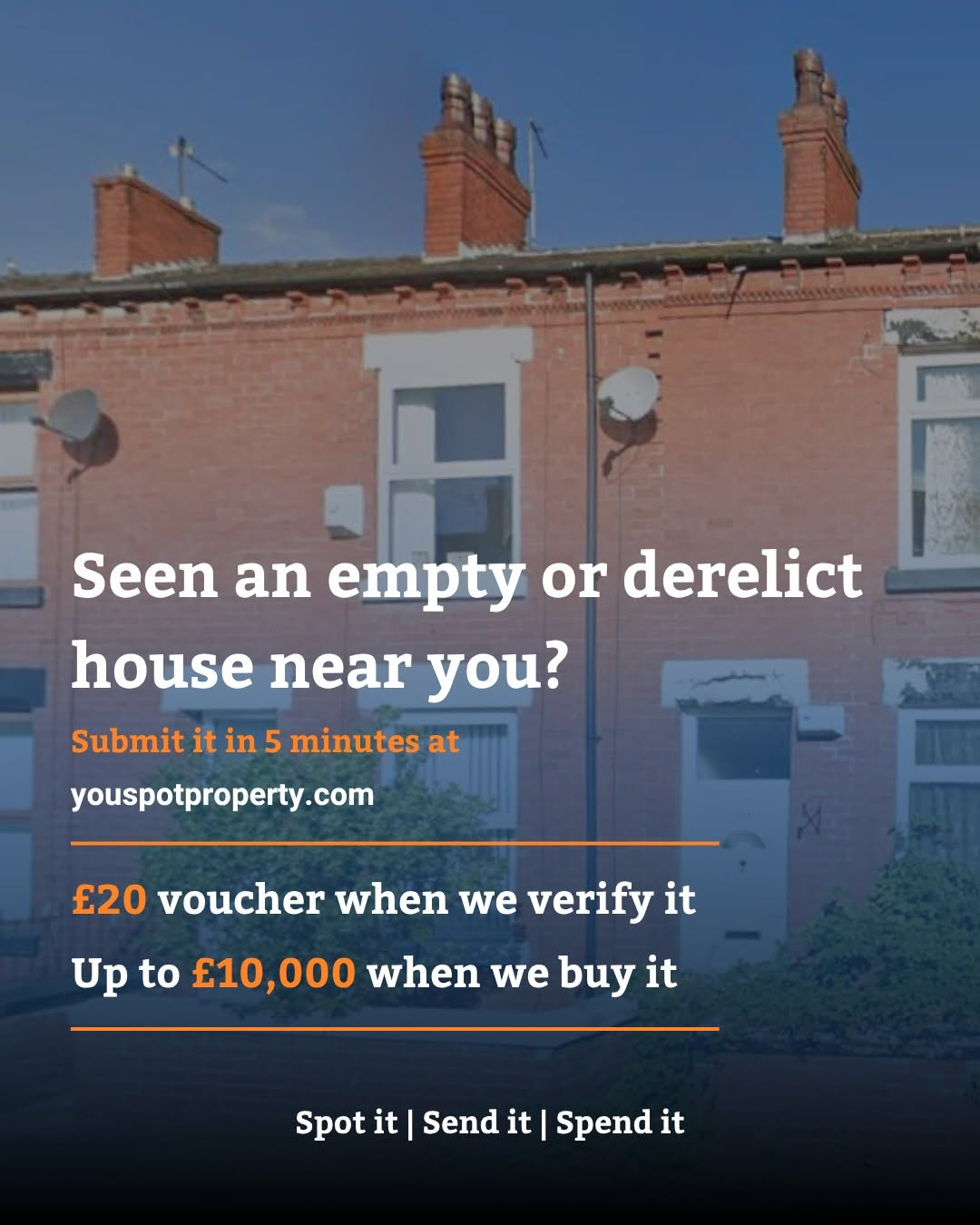
You Spot Property rewards you for spotting empty properties. If it meets their criteria, you get a £20 voucher. And if they sell it, you receive 1% of the property price (capped at £10k).
If you see a derelict eyesore, just take a photo and send to the address. For each property sold, the company donates £500 to a local charity.
I have now received 2 vouchers for M & S. And walk around with my eyes wide open. Anything that looks a bit scruffy is being reported. Who knows, I might even do this full-time. Mrs Charles
Why are properties in England left empty?
You might wonder why so many homes stand unused, when people need shelter. The reasons are usually:
- Absentee owners: Sometimes overseas investors buy properties and leave them idle, waiting for prices to rise.
- Inheritance issues: Families caught in legal disputes, may leave homes empty for years.
- Speculation: Owners keep properties empty, hoping to sell when the market peaks. The house becomes more like a lottery ticket, than a home.
- Disrepair: Major fix-ups are costly. Sometimes owners just give up.
Some councils now tax empty homes
Bolsover (Derbyshire) is one of the first towns to introduce an ’empty home tax’, to discourage people from buying second homes that sit empty most of the year.
Owners will have to pay more than one council tax if homes are not occupied for most of the year. This law does not apply to the Armed Forces, as some may have to leave homes empty, while serving abroad.
Seaside resorts that price out local people
Many popular seaside resorts have priced out local people, as wealthy outsiders buy second homes. Rich people from London buy homes in St Ives for two weeks surfing.
The Devon sailing town of Salcombe has developers building £1 million homes. Yet local people can’t afford to buy. Developers promise to build ‘affordable homes’, But not in the centre, which is where many local people grew up.
Again some councils are doubling council tax, or only letting people buy homes, if they are residents of several years.
Many want to close the loophole. Which means that holiday home owners can claim 100% tax relief, if they pay business rates (rather than council tax).