English Nature Poets (who still inspire)

The pretty town of Grasmere houses the former home and burial place of William Wordsworth, one of England’s most celebrated poets. It is a bit over-commercialised now (you can imagine – like Stratford-upon-Avon with Shakespeare, everything is ‘linked’ to Wordsworth for tourism income).
But William (and his sister Dorothy) did not just confine themselves to Grasmere. Interestingly, William campaigned a few hundreds years ago against the building of Windermere railway station, believing that the influx of tourists would ruin his beloved Lakes. He was right.
His sister was also very vocal, her and a fellow writer protesting against the the found house built on the Lake District’s largest island of Belle Isle, calling it a beautiful spot that now ‘deformed by man’, and resembling a tea canister.
Wordsworth’s final home of Rydal Mount is just a short hop away from Ambleside, one of the Lake District’s prettier towns, although again a bit overrun with tourists in summer. This town apparently has the country’s busiest mountain rescue team, due to inexperienced climbers frequently getting lost of stranded.
It does remain one of the few towns, where you can literally walk from the town centre, to discover a tumbling waterfall, right on your doorstep!
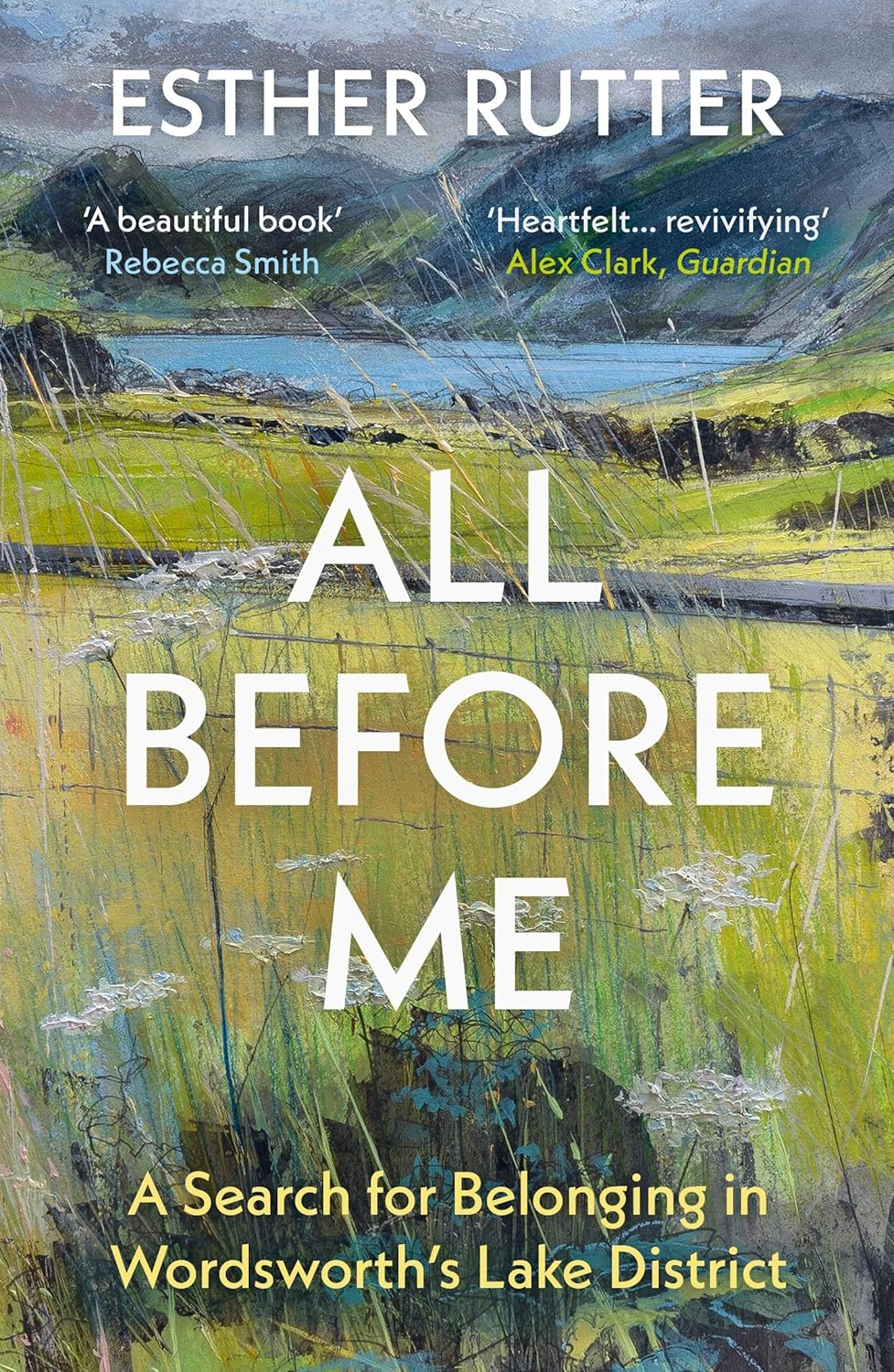
All Before Me is a very interesting and unique account, of how the Lake District helped to heal one woman from a serious mental breakdown.
While teaching in her early 20s in Japan, she suffered an acute breakdown, and was even section in a Japanese psychiatric institution, until she could be flown home under escort.
Back in England, Esther (though originally from Suffolk) was offered the chance to live and work at Dove Cottage in the lake District, the home of William Wordsworth and his sister Dorothy.
It was here that she began to heal. In the lives and writings of these literary siblings, she found an approach to living a life of peace and meaning, and also made lifelong bonds of friendship – and eventually love.
This book is a moving and absorbing account of the struggle to know oneself, and is intertwined with stories of the Wordsworth home and history.
Esther Rutter is a writer from Suffolk, who now lives in Scotland. She has previously worked at the Wordsworth Trust and Robert Burns Birthplace Museum. She also works as a scriptwriter and appears on BBC Radio 4’s Woman’s Hour.
I Wandered Lonely as a Cloud
This is Wordsworth’s best-known poem. Here’s a quick excerpt.
Not to be a party pooper, but know that like all bulbs, daffodils are unsafe near animal friends, so keep them clear if they like eating flowers!
I wandered lonely as a cloud
That floats on high o’er vales and hills,
When all at once I saw a crowd,
A host of golden daffodils;
Beside the lake, beneath the trees,
Fluttering and dancing in the breeze.
How John Keats’ Hampstead Home Still Inspires

John Keats (one of England’s favourite Romantic poets) found inspiration in Hampstead, and his house on Keats Grove continues to draw visitors who want to step into the poet’s world.
Originally built as a pair of houses, the poet resided in one half, and his friend Charles Brown (a literary critic) lived in the other.
Keats House gives us a close look at John’s life. Sharing not just his work but the calm beauty that shaped his writing. John’s illness from TB (caring for his seriously ill brother) meant that he died just 25.
Keats House is where John Keats wrote many of his best-known poems, including “Ode to a Nightingale” and “Ode on a Grecian Urn”. Living in this leafy part of Hampstead gave him space to think, write and recover from heartbreak and illness.
The setting helped shape his verse, and standing in the same rooms lets you sense the quiet that guided his words.
The house itself is a well-preserved piece of late Georgian design, built in 1815. Its light-filled rooms, elegant fireplaces and pretty sash windows show off the style of the period.
The lovely gardens are perfect for a stroll, and it’s easy to imagine Keats wandering among the flowers as he searched for new ideas. The house’s simple charm helps connect visitors with the past in a direct, heartfelt way.
The History of a Camden House (two poets)

Fitzroy Road is a leafy suburb of Primrose Hill, that is home to a two-times blue plaque house, a red-brick Victorian terrace, where two famous poets once lived, 100 years apart. This image shows Sylvia’s spirit returning. She is buried near Hebden Bridge in Yorkshire.
Sylvia Plath was an American poet, who moved in with her children following the separation from her husband (Ted Hughes, who would go on to become Poet Laureate in later years). It was there she wrote some of her best-loved poetry.
Despite being known more for her neurotic writings about humans, she also wrote some wonderful poems about pheasants, flowers and wild bears. All poets love nature!

There is a sad ending, while Sylvia was suffering from severe depression, during the famed bitter-cold winter of 1963. A stunning beautiful and talented women, she gave cookies to her children, sealed their bedroom doors with tape, and put her head in the oven. She was just 30 years old.
Sylvia is buried near Hebden Bridge in Yorkshire. And almost 50 years later, her son (a baby at the time) also committed suicide.
Also Resided in by W.B. Yeats
Irish poet W.B Yeats (the initials stood for William Butler) lived in the same house, almost 100 years earlier. His used his unique influence to to intelligently campaign for Irish independence, away from the violent nationalism gathering pace back home.
Another London poet’s house (Hampstead) was lived in by John Keats, the Romantic poet (same name, different man). He also died tragically young (age 25, from TB).