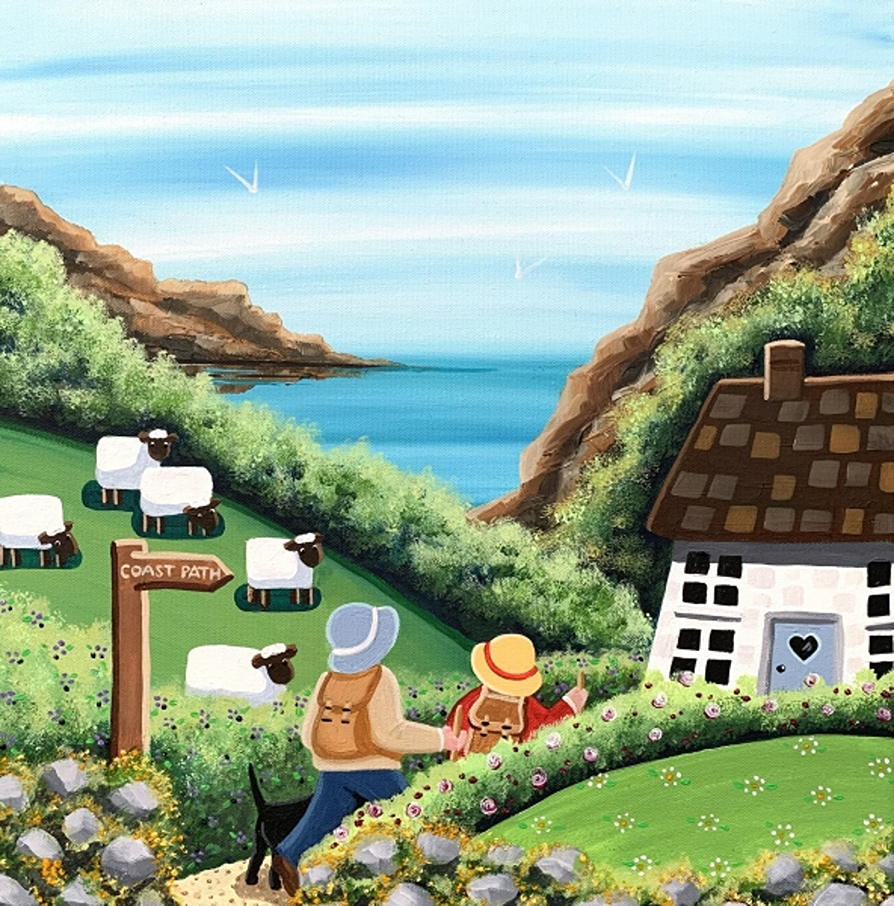
Sennen Cove, Cornwall (England’s most westerly village)

Sennen Cove is England’s most westerly village, just one mile from Land’s End in Cornwall (the most south-westerly point in England). Known for its clean turquoise waters, the shell and quartz fragments give a white sandy beach (you’d think you were in the Caribbean!)
Always follow the Countryside Code to keep all creatures safe. Keep dogs away from steep banks, mushrooms (and toxic plants/trees) and on leads near birds, barnyard friends and wild ponies.
At the coast, keep away from nesting birds and never walk on sand dunes. Learn how to keep dogs safe by the seaside (check beach bans before travel).
Steeped in legends of mermaids
Not surprisingly, this area has many legends of mermaids, the mysterious creatures of the sea. The Mermaid of Zennor was a beautiful woman with a mesmerising singing voice who frequented a local church, and is said to have lured local singer Mathew Trewhella to Pendour Cove, where they both disappeared into the sea.
A sad history of seine fishing
Seine net fishing is the kind that people are now trying to stop, due to it catching other creatures (seals, dolphins, whales and sharks). Whitesand Bay was once a major Cornish seine fisher, but now hopefully things are moving on, for the sake of all creatures.
Site of a dangerous shipwreck
In 2003, RMS Mulheim (a cargo vessel carrying over 2000 tons of plastic scrap) ran aground on the coast between Sennen Cove and Land’s End. The reason was unique (the chief officer had accidentally knocked himself unconscious after his trousers caught on a chair), and the ship drifted onto the (very dangerous) rocky shoreline.
Although no crew were injured, diesel soil leaks into the ocean, and resulted in a massive clean-up operation to help local birds and wildlife. The heavy ship eventually broke into two, and the rusted remains are still visible on the rocks, from nearby coastal paths.
It wasn’t the First Officer’s fault. But the fact that plastic debris was found floating up to 40 miles away (the local conservationists concern over ingestion by birds and dolphins), shows how important it is that we strive towards a plastic-free world.