The Surrey Hills and Box Hill (a stunning National Landscape)

Surrey is one of England’s most affluent counties, with many people living here, and working in nearby London. Perhaps more money has more clout, as it remains one of the most wooded areas of our country, with peaceful villages and rolling countryside.
If out walking, follow the Countryside Code to keep all creatures safe. Keep dogs on leads near steep banks (and away from toxic spring bulbs).
The Surrey Hills are a National Landscape (the new name for ‘Areas of Outstanding Natural Beauty’, so they thankfully now have more protection.
Box Hill offers quiet footpaths and panoramic views. And Leith Hill (the highest point in south east England) is topped by a tower, where on clear days, you can see as far as London. Wildflowers and rare beetles thrive in these chalky grasslands.
Near Albury, the Silent Pool is a legendary spring-fed pond surrounded by trees and bluebell woods. A nature trail circles the pool and leads to nearby Sherbourne Pond. You’ll spot kingfishers, ducks, and the occasional deer.
What makes the Surrey Hills so special?
The Surrey Hills have a kind of quiet range to them. You get chalk downs, old woodland, small farms, lanes, commons, and sudden viewpoints, often all within a short drive or walk. Because of that mix, a day here rarely feels flat. The ground rises, dips, narrows, and then opens again.
Box Hill sums that up rather well. It is famous, but not only because it is easy to reach. The views are the draw. From the higher ground, you can look across the North Downs and down towards the River Mole. On a clear day, the folds of the hills seem to keep going, pale and soft at the edges.
A protected landscape with famous views
A National Landscape is a protected area, chosen for its natural beauty. In plain terms, that means the land matters, not only for its looks, but for wildlife, farming, heritage, and public access too. Protection helps guide how places are managed, so the best parts are not slowly worn away.
Box Hill is one of the headline viewpoints in the Surrey Hills, and for good reason. It gives you a broad, open sense of the area in minutes. Still, it is not the only place worth stopping. The wider hills are full of smaller viewpoints, quieter woods, and field-edge paths that feel just as rewarding.
Wildlife, woods and chalk grassland in one compact area
The variety of habitats here is part of the appeal. Chalk grassland supports wildflowers and butterflies, while ancient woodland brings shade, birds, and a different pace. Then there are hedgerows, streams, and patches of farmland in between, which knit the whole place together.
In spring, bluebells can light up the woods with that brief, almost unreal blue. Summer brings butterflies over open slopes and warm grass. By autumn, the beech woods turn copper and gold, and the paths feel softer, quieter, slower. Even winter has its place here, because the bare trees can open up views you miss in leafier months.
You do not need to know every species to enjoy it. The point is s
The Chalk Ridges of North Downs Way
The North Downs Way National Trail slices across Surrey from Farnham to Oxted. Walkers and cyclists enjoy this long-distance path for its shifting views, chalk cliffs, and stretches through protected downs.
Dotted along the way are old churches, country pubs, and picnic sites with sweeping views of patchwork fields. In summer, butterflies dance across the wildflowers.
A Sandy Beach (in Surrey?)
Frensham Common and Little Pond covers 922 acres of dry and wet heath, woods, scrub and pond, and is a protected site for local birds, insects and reptiles. Often called ‘Surrey’s secret beach’, this is miles from the sea, but resembles a seaside resort.
Owned by the National Trust, this is reserved for wildlife, so no swimming allowed (for people or dogs). Barbecues and inflatable boats/rings are not permitted.
A Safe Haven for English Wildlife
The British Wildlife Centre is a haven for fox, deer, owls and otters, along with pine martens and red squirrels. Pine martens are natural predators of grey squirrels, and rewilding is one idea to save red squirrels.
It also is providing protected colonies for other endangered species like dormice and water voles, by using protected areas (rather than killing everything in site).
Simon’s Last Wish (Wildlife Aid’s new sanctuary)

Wildlife Aid (Surrey) is a major wildlife rescue charity that has helped hundreds of thousands of creatures. It was founded by former city broker Simon Cowell MBE (not that one, though he did say his name got restaurant reservations) who sadly died due to aggressive cancer in June 2024.
Need help? If within the catchment area, contact Wildlife Aid with a full description, and ideally send a photo or video via email or app, for them to assess the situation.
Learn how to help your local wildlife rescues.
A passionate and outspoken advocate for animal welfare (he did not like ‘TV entertainment shows about animals nor zoos), Simon himself was often attacked, but knew it was only because his patients were scared.
He was bitten by hedgehogs, gored by deer (one antler missed his jugular by around an inch) and one owl sunk his talons into Simon’s scalp.
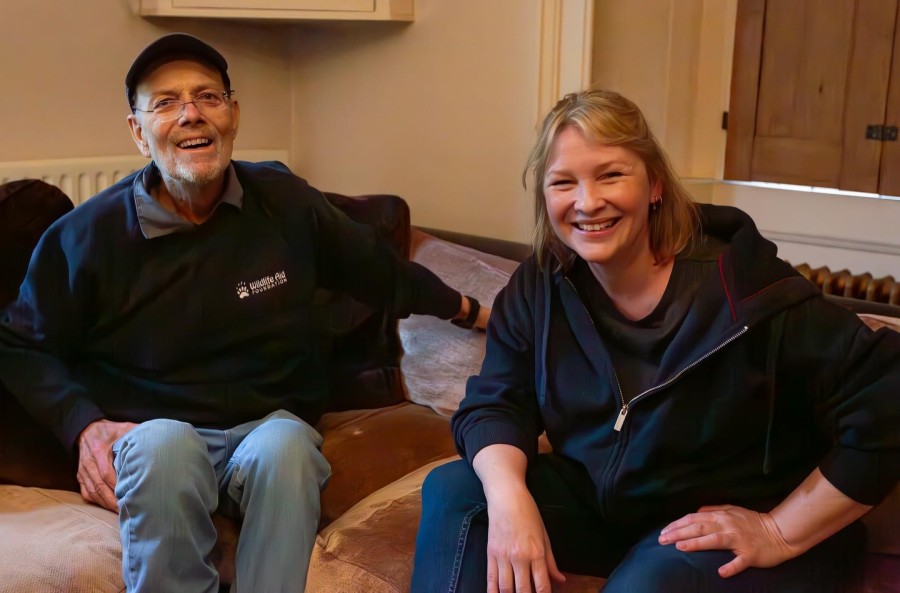
Shortly before his death (that’s him above with actress Joanna Page, who is training to be a rescuer at the sanctuary), his daughter and others launched a campaign to renovate the wildlife rescue and protect surrounding land.
How to Help Wildlife Aid
The easiest way to help is to set up an account at easyfundraising and set Wildlife Aid as your cause. Then each time you buy something from participating stores (or services), a portion goes to them (at no cost to you, and loyalty points are not affected).
You can donate at Just Giving to reach the target of £4 million. Or select ‘Wildlife Aid Foundation’ at Charities Aid Foundation and tick the box, to donate anonymously. Either way, tick the Gift Aid Box.
The centre (which has over 300 volunteers) also offers placement for vet students. Read latest rescue stories (a fox that fell in a swimming pool, and a hibernating dormouse found at the bottom of a recycling bin).
If you live within a 45-minute drive from Leatherhead and have suitable land, they welcome hedgehog release sites. These must have suitable cover and food, shallow sloping water sources and no chain linked fences (and be unsecure about for hogs to roam up to an acre at night (the size of around 8 average gardens).