Watching the Sunset (wild beauty)

Who doesn’t love to watch the sunset, a daily spectacle that captivates hearts worldwide? Sunsets are caused by one simple thing: the scattering of light.
As the sun dips below the horizon, light must travel through more of Earth’s atmosphere, which leads to a fascinating play of colours.
Rayleigh scattering is a key player in creating the colours we adore at sunset. When light enters molecules and small particles in the atmosphere, the shorter wavelengths of light (blue and violet) scatter more than longer wavelengths.
So as the sun’s light takes a longer path at sunset, the short wavelengths are out of sigh, leaving reds, oranges and pinks to paint the sky.
Humidity also plays a part, as unfortunately can dust and pollution. Dusty cities are not good, but often lead to bright red fiery sunsets.
The Psychological Effects of Sunsets
Watching the sun set is a wonderful way to spend an evening, we can find peace looking out to the closing day, just like animals in the wild. Many artists, poets and writers find their creativity enhanced by watching the sunset.
Is a Red Sky at Night A Good Sign?
And what about the oft-quoted rhyme that ‘red sky at night, shepherd’s delight, red sky in the morning, shepherd’s warning’. Is there truth in it?
Yes, there is! A pure red sunset means the air in the west is clear, and that usually bodes well for farmers (and everyone else) for the following morning. Red sky the next morning however means low-pressure weather is coming (stormy weather!)
One quote that is not so true is that cows are lying down, because they think it’s going to rain. The Met Office says there is no truth to this one at all – it’s likely that the cows are just having a rest!
Where are England’s most Beautiful Sunsets?
Likely the tourist guides have not reached all the hidden beautiful sunsets. But some of the most dramatic places to see beautiful sunsets are Sandbanks (Dorset – where all the millionaires live), Seven Sisters (cliffs in East Sussex) and Ness Point (the first place to see the sun rise – in Suffolk).
Never waste any amount of time doing anything important, when there is a sunset outside that you could be sitting under. C JoyBell C
You want proof there’s a God? Look outside, watch a sunset. Frank E Peretti
Twilight Meditations (for Peaceful Evenings)

Sunset Gratitude is a beautifully written and illustrated book, packed with peaceful meditations to get through the end of each stressful day.
Looking to the natural world for inspiration, just open up the date and read and absorb each large paragraph, before you go to sleep.
Find peace at the end of the day with words of encouragement and compassion. Find hope and gratitude, rather than let life’s worries get the best of you.
Focusing on the transition from day to night, these meditations can also be read at dusk or sunset, the times when you may need a glimpse of hope the most.
This is a peaceful book (no ‘toxic positivity’ asking you to shout at yourself that you’re happy when you’re not!).
Instead, try to practice each meditation with real empathy. Drawing on universal themes in nature, these meditations connect you to the setting sun.
When a tree falls, it offers nourishment to the forest floor. There is a richness within the tree as it provides sustenance and shelter to the understory of the forest. The same can be true, when we fall.
Failure doesn’t mean we are not valuable. It is a redirection to the path we are meant to be on. Embracing the cycles of growth, decay and rebirth can help us move forward, during times of breakdown. Your life is full of value.
Living in a space that feels in between is difficult, especially if it feels like it’s lasting forever. If you’re in that space, focus on the goodness that is happening right now.
Surrender all the desires that keep your heart from being present. What is meant for you will happen. Sometimes letting go is what needs to happen, so we can receive what’s on the way.
Emily Silva spent years working for corporations, until she took the leap to pursue her dreams. After training others in the banking and wine industries, she trained as a life and spiritual coach, and believes everyone has the power to create lives they dream of.
The Secret World of Twilight (dusk and dawn)
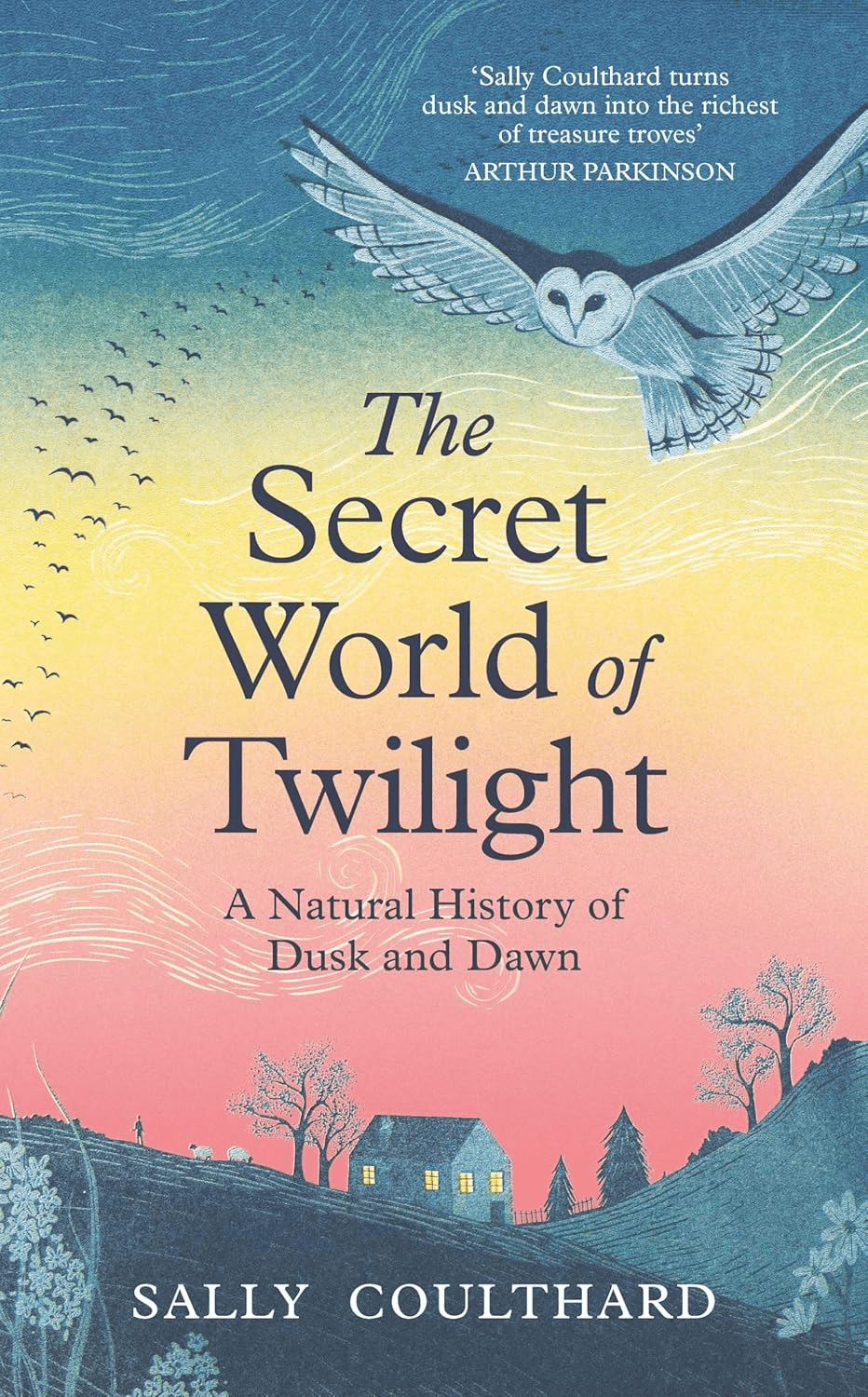
The Secret World of Twilight is a book to inspire on the moments just before sunrise and just after sunset. Dawn and dusk – those fleeting, half-lit hours are when the ordinary becomes extraordinary. Skies flare with colour, landscapes shift in mood and an unseen cast of creatures emerge from the shadows.
Welcome to twilight.
It’s important to avoid light pollution and turn off unused lights (especially near or in glass buildings) to help prevent birds flying into windows). Also many creatures come out at dusk and dawn, so keep cats indoors at these times (to create safe havens for garden birds), and learn more on keeping roads safe near wildlife (like deer).
In this book, the author invites into this seductive time of day, when night-blooming flowers open (good for endangered bats), secretive mammals stir, giant moths reign and fantastical sea creatures ride the tide. Twilight affects humans too – but in our age of electric light and closed doors, we’ve almost forgotten how to see it.
If planting night-scented flowers for wildlife, know that some are not safe near animal friends. Read more on pet-friendly gardens.
Sally Coulthard has written several best-selling books on nature and wildlife. She lives in Yorkshire on a smallholding which she shares with her husband, children and an assortment of unruly animals.
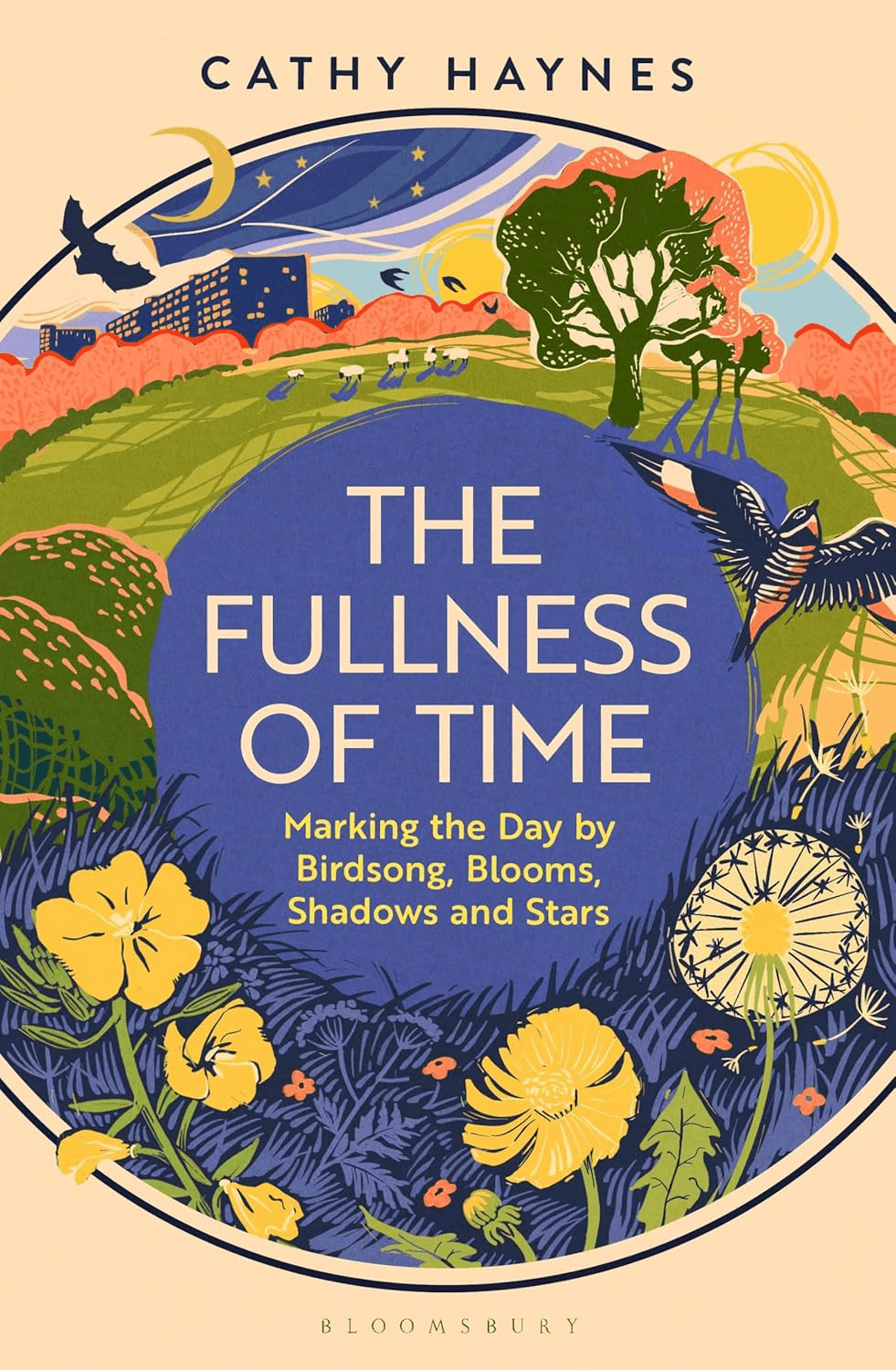
The Fullness of Time is a journey into the forgotten art of marking time through sings in the world around us – from the slow sliding of sunbeams to the wheeling of the stars.
Past generations would tell time by shadows shrinking (think of a sundial), the midday glow over a mountaintop, or the crowing of the rooster in darkness (today, city dwellers move to the country then complain about the cockerel waking them up at dawn!)
Years ago, people would notice flowers that close at noon, sensed how the quality of life changes at dusk, and marked time at night, by the motion of the stars.
Yet today in our clock-bound, screen-immersed world, most of us rely on machines to mark the hours. But what riches may we gain, from reclaiming the forgotten art of sensing time, by events in the living world?
Roaming from ancient download to city streets, this book is an adventure in search of the patterns that once shaped the rhythm of our days, and an invitation to discover the simple sensory joys of truly paying attention.
In his book Healthy at 100 (which looked at the world’s four-longest-lived communities), one interesting thing he found (apart from that none of them knew what an atheist was!) was that they worked almost until they died. But not by clocks.
For instance, if they were picking berries off a bush, they finished as the light began to fade. Even if they were only half-way through a hedge. They didn’t go ‘I must just do this last bit to finish in another 20 minutes’.
Most books about time teach you how to control your hours. This one teaches you how to inhabit them. Haynes shows how past generations read the day in flower petals, birdsong and the slant of light – and what we lost when we stopped. Daniel H Pink
Reminds us that we get to choose where we focus our attention, between one dawn and the next. Tristan Gooley
Cathy Haynes is a curator, writer, artist and educator who has been Timekeeper in Residence at Petrie Museum of Egyptian Archaeologist, artist in residence in Victoria Park for a gallery and curator for art on the underground. She lives in London.