Swedish Dishcloths (hold 15 times their weight in water!)
Swedish dishcloths were indeed first used in Sweden (over 30 years ago). They basically are quality dish cloths (which can also be used for cleaning). But unlike microfiber cloths, these are free from microplastics (that wash down sinks and into the sea), so at end of use, you can cut them up and compost them, or just bin them to naturally break down, without harm to the earth.
Use with biodegradable washing-up liquids and cleaners (unscented for pregnancy/nursing and baby/pet bowls). Also read about plastic-free cloths and sponges.
In theory then, any good quality natural dish cloth is a ‘Swedish dish cloth’. Here are a few good choices:
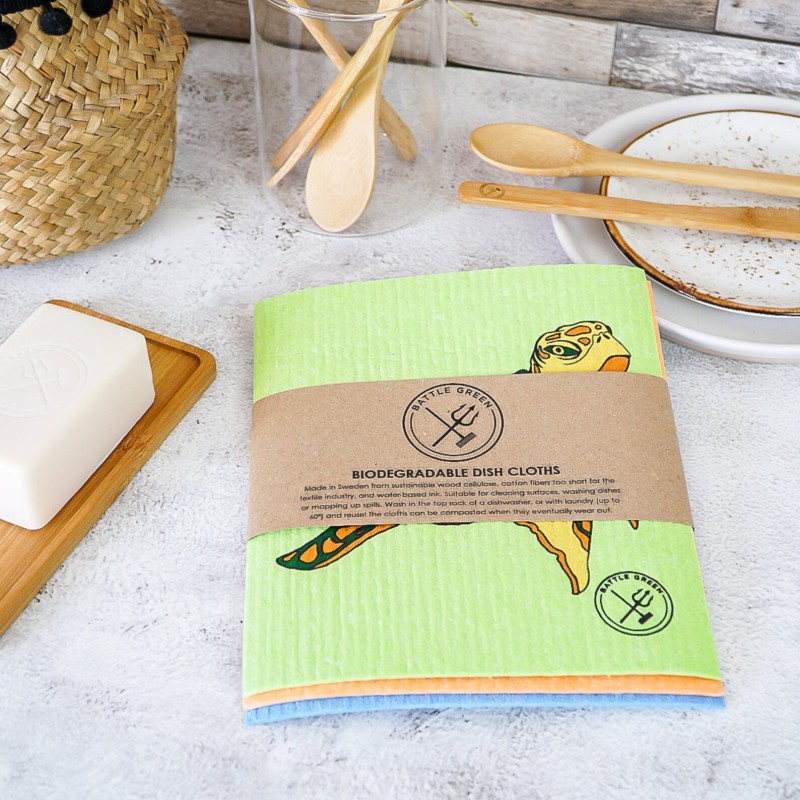
Battle Green Swedish dishcloths are made from cellulose (wood pulp) and cotton. They are in various pretty designs, all highlighting ocean species (whales, sea turtles and gulls) that are mostly affected by plastic pollution. You can wash these in the top rack of your dishwasher.
These reusable Swedish dishcloths from Dundee are sold in packs of 4 (so you don’t end up doing your washing-up with the cloth used for toilets!) Each cloth can hold up to 15 times its weight in liquid.
Dundee is known as the city of ‘jute, jam and journalism’, as its economy was based on jute production, fruit preserves and publishing. It’s also (would you believe this?) the sunniest city in Scotland!
There are only two seasons in Scotland. June and winter. Billy Connelly
Good Organic Cotton Dish Cloths

These textured cotton dishcloths are super-stylish, sold in a pack of three (cobalt, green, red or citrus). The texture of the stitching, means these are great for all cleaning jobs. Sold with an easy-to-recycle card belly band. Machine-washable (do not tumble dry).
Design in London by a small woman-owned company, 5% of annual profits are donated to a charity that helps refugees and displaced people, during their greatest time of need. Ethically produced in Indian, and shipped to England by sea.
Who Invented Swedish Dishcloths?
A Swede, of course! Engineer Carl Lindquist was fed of using rags that never dried properly, so he experimented – pressing cellulose ( wood pulp), cotton and salt into a cloth. They have many other uses like wiping wet bicycle seats (just store it underneath).
Carl lived in Norrköping, one of Sweden’s largest cities. In the south, its busy harbour and textile factories have led some to call it ‘Sweden’s Manchester!’