Oatly’s single-serve oat drink (for commercial use)
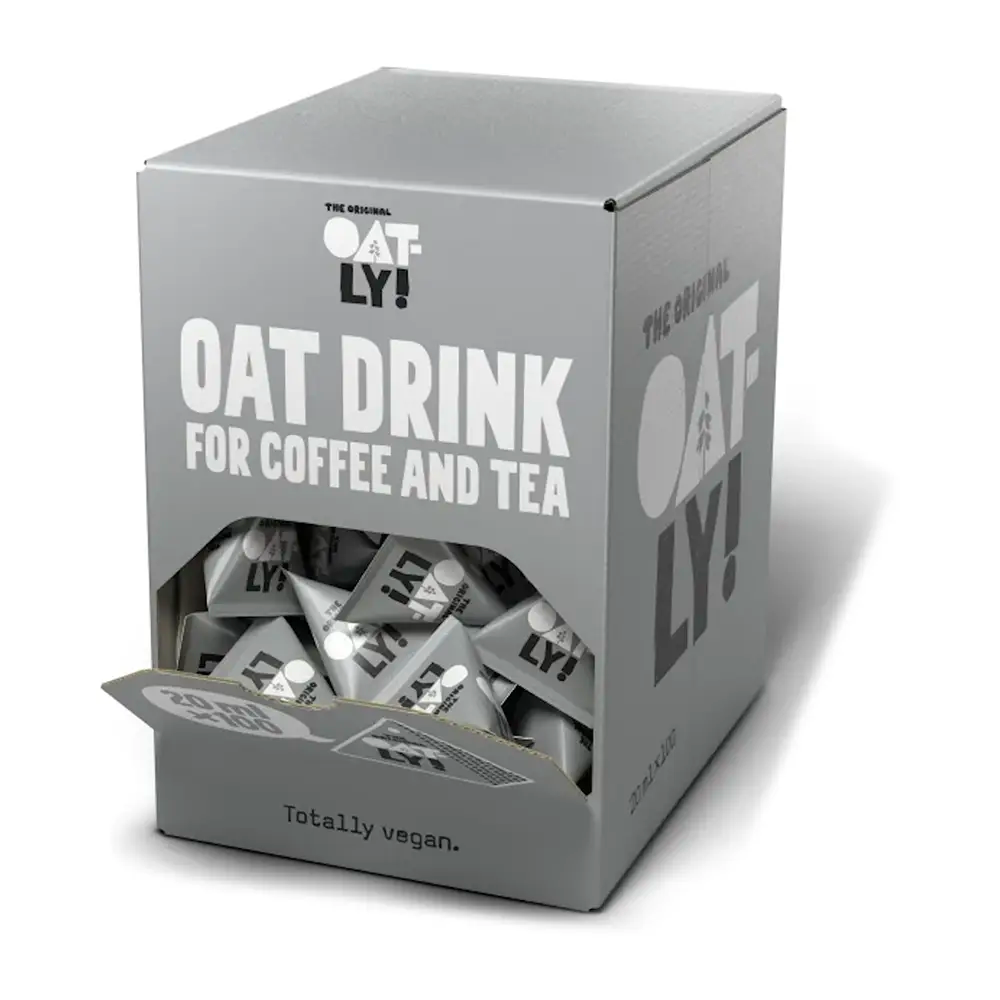
Oatly has become the first company to offer single-serve oat drink sachets for commercial use (offices, cafes, hotels, restaurants etc). It’s of course better to use bigger bottles to pour from. But millions of places around the world do use single-serve plastic sachets, so these are better choice.
Each box includes 100 pyramid-shaped single-serve oat drinks, for the perfect portion without waste. Easy-to-squeeze, the sachets are sold in a box that also serves as a product display, and is easily recycled after use. Oatly has a rich creamy taste, idea for people to serve with tea or coffee (for vegans or those with allergies).
You can also store it at room temperature for several months.
Why are people giving up dairy?

We all know that factory-farmed cows suffer, in reality the pressure on farmers and dairy cows doesn’t change, even if it’s a free-range herd (some larger herds have better welfare than some smaller ones). Labels like ‘grass-based or high welfare’ are often just marketing gimmicks.
Forced insemination, inferior winter care and high disease and mortality means cows can suffer in any parts of the dairy industry, plus of course there are welfare issues with veal meat, males cows shot dead at birth (being of no financial value) and issues with health and environment.
Cows and calves form incredibly strong relationships, and will cry out loudly for weeks, if separated.
The many benefits of oat drink
- Oat drink makes creamy drinks. It’s naturally thick and creamy, so often the best choice for coffee shops selling cappuccinos and hot chocolates.
- Oat drink has healthy fibre. Just like porridge, it contains soluble fibre. But animal-derived proteins and fats are also inflammatory, which is bad as high cholesterol (which no plant food has).
- You can get calcium from other foods like green veg. We are often told that we must drink dairy for calcium. But in fact, many plant foods are high in calcium and protein (oats are low in calcium unless in a fortified drink), but calcium is easy to get elsewhere.
- Oat drink supports local farmers. Organic oats can be locally grown. Farmers can grow oats to transfarm from livestock (leaving animals to live out lives in peace). This gives good income in a huge market (most oat drink is imported) and keeps long-held family farms in business, as people eat more plants and less meat.
Just as there are issues with almonds grown in California (monocultures create hive collapse due to pesticide residue, stress and parasites, which is why it’s better to buy European-grown nuts). Same with cashew drink. A lot of plantmilks sold are low-content in nuts and coconut (unlike ReRooted which is 6.5 to 7% nut and 10% coconut).
Note oat drink is not so high in protein, so ensure you eat plenty of plant-based proteins.
Ongoing debate on oat drink labels
Recently, Dairy UK won a court case against Oatly, to stop it using the words ‘milk’ or ‘post-milk-generation’, so now all such beverages must be called ‘oat drink’. The idea is that consumers don’t get confused, but we’re quite intelligent, and seems to be about listening to those lobbying for the farming industry (most dairy sold in the UK is not from certified free-range cows happily grazing in fields).
Factory livestock farming is a major emitter of greenhouse gases, so how this tallies with net zero policies of the government is not clear. The same happened in Sweden, when the powerful national dairy board took Oatly (a Swedish company) to court. It caused the founder so much good publicity and increased sales, he says he wished they’d taken him to court years ago!