Kingfishers (elusive blue & orange feathered friends)
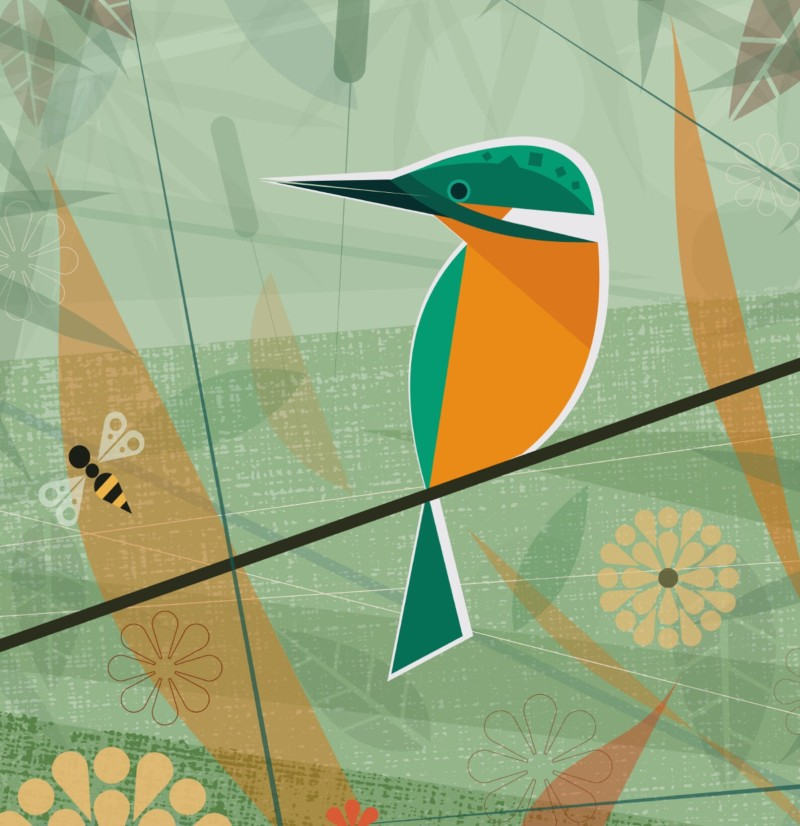
Kingfishers are beautiful birds, with bright orange and blue feathers. You won’t see them much, as these river birds are very secretive, you may just hear them splash as these excellent divers swoop down into the water for a tasty fish dinner.
Kingfishers are some of nature’s best hunters, as they have third eyelids that close underwater, and fused toes to grip fish. Most are located in East of England and the home counties (simply because it’s more difficult to see fish in stormy waters).
These small birds (only around 17cm long) also need clean rivers to fish in, so do your bit to keep the waters clean, by never dropping litter and taking all your waste with you.
We all know the familiar drumming sound of a woodpecker against the tree. England has three species, which is why it’s so important to protect our forests.
All wild birds, their nests and eggs are protected under the Wildlife and Countryside Act 1981. So don’t chop down trees, and keep dogs on leads near nesting sites, and follow access rules.
Even dead wood is useful to birds, as the rotten bark provides good hunting ground for food, and places for nests. And when birds abandon the nests after rearing chicks, the tree holes are often used by bats, owls and bees. Nature in balance.
Woodland birds rarely visit gardens. Learn how to create safe havens for garden birds, and how to stop birds flying into windows.
Great Spotted Woodpecker (big and bold!)
The Great Spotted Woodpecker is the one most people meet first. It’s medium-sized, black and white, with a bright red patch under the tail. Males show a red patch on the back of the head, while juveniles can have more red on the crown, which can confuse beginners.
Look for it in broadleaf and mixed woodland, parks with mature trees, and larger gardens. It feeds on insects and larvae under bark, yet it also takes seeds. In winter it may even visit your garden.
Green Woodpecker (likes to eat ants)
If the Great Spotted is a tree bird, the Green Woodpecker is a grass bird with wings. It looks larger than the Great Spotted, with a green body, a yellow rump that flashes as it flies, and red on the crown. The face looks pale, with a darker area around the eye that can read as a “mask” at distance.
Its favourite places in England include woodland edges, orchards, churchyards and cemeteries, golf courses, and any patch of rough or short grass rich in ants. They also eat larvae. They have ‘yaffle calls’ that roll out across open space.
The green woodpecker flies like a madman up and down, up and down. And when he’s not banging that beak away at a tree, he’s calling loud with his piercing ‘yaffle laugh. So what makes him such an extrovert?
Maybe it’s the extra long tongue he hides in his beak? Apparently it can stretch the length of his body to reach bores, beetles and weevils. Personally I think he’s be more at home with a can of lager and a kebab! Matt Sewell
Lesser Spotted Woodpecker (tiny and shy)
England’s smallest woodpecker is black and white, with a ladder-like pattern on the back. The bill looks short. Males have a red crown. Instead of clinging to big trunks in full view, it often works high in the canopy, picking along thin branches where small insects hide.
Seek it in older deciduous woodland, wet woodland, old orchards, and places with dead wood and ageing trees. That last point isn’t romantic, it’s practical. Dead wood holds insects, and insects feed woodpeckers.
Its drumming is softer and faster than the Great Spotted woodpecker, and you may only catch a short burst before silence returns.
English Beech Trees (adored by woodpeckers!)
Silver birch trees are one of England’s most beautiful plants, and can thrive in cold climates, and also support over 300 insect species, making them vital for ecosystem. They grow fast but don’t live as long as many other trees. Although they are often the first trees to recolonise land after disturbances (like glaciers or wildfires).
Lesser-spotter woodpeckers love these trees to nest in. And the trees’ deep roots help other plants to grow, when they drop their leaves.
Silver birch tree sap contains xylitol (the same lethal sap found in some chocolate, chewing gum and toothpaste?) So if have a a tree-licking dog, keep well away! Read more on pet-friendly gardens.
Kingfishers Build Clever (and smelly!) Nests
Like swans, kingfishers mate for life, and create unique burrows (rather than nests) to rear their young. Parents take turns to build unique tunnels at special angles, so the eggs don’t roll into the river.
One bird-watcher saw a pair of kingfishers making a tunnel that ‘smelled of rotting fish and coughed-up pellets’. And remarked that ‘even the kingfishers seemed to be mildly disgusted’, with each parent washing after leaving!
Young kingfishers fledge after around 3 weeks, with most independent within days. Ornithologist Paul Stancliffe calls these birds ‘the rock stars of the river’ as most are destined to ‘live fast and die young’.
If there is anything more flamboyantly haute couture in all of the fauna of the land, I have not seen it. Jim Crumley
Read Call of the Kingfisher, an enchanting book by a composer, who for 40 years, has observed the whistling calls of resident kingfishers, near his home on Northamptonshire’s River Nene.
Meet the Kingfisher’s Aussie Cousin!
Although England only has one species of kingfisher, there are 100 species worldwide. Including the largest – Australia’s kookaburra (Emma Whitelaw).
Known as ‘the bushman’s clock’, his laugh (which sounds like a human) can be heard for miles! This bird lives in family packs, also mates for life and can live up to 20 years.
Aussie kingfishers eat more varied food including snakes and lizards (which they bash against rocks, before swallowing whole). And rather than living near rivers, most live in open lands or in eucalyptus forests.
Another tropical relative is the Sacred Kingfisher, which lives mostly in the Western Pacific, in mangroves, woodlands, forests and river valleys.