Cambridge’s Curved Mathematical Bridge (built with straight wood?!)
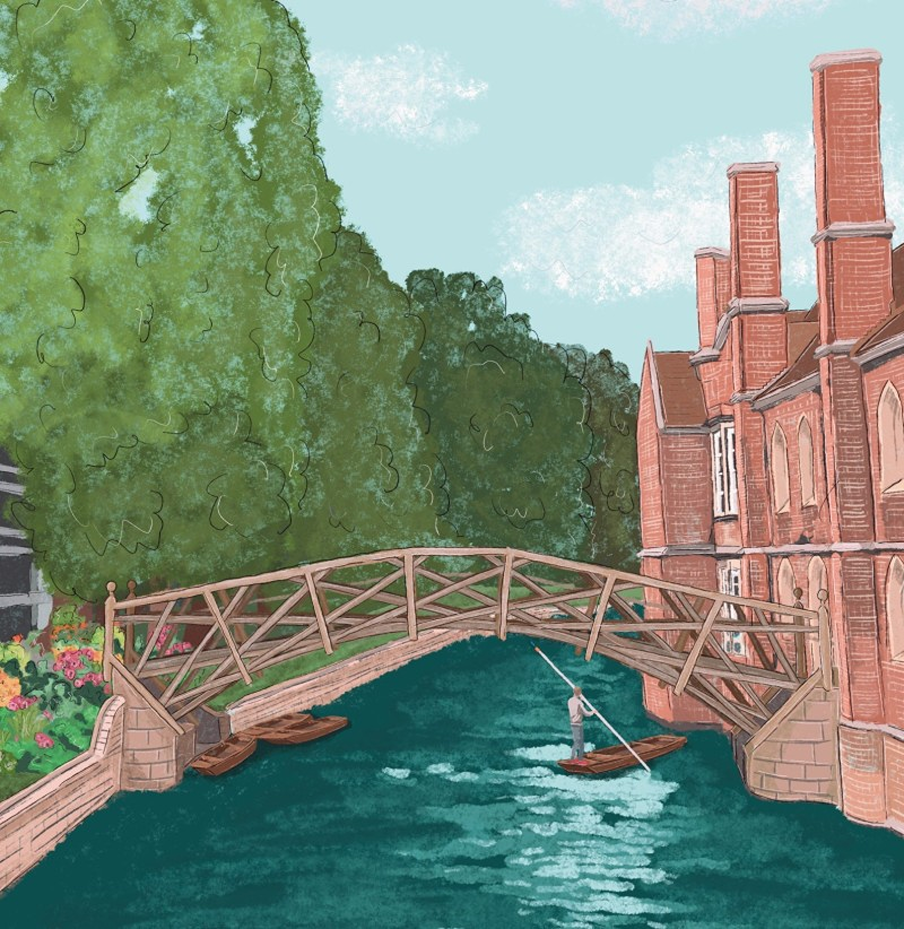
The Mathematical Bridge at Queen’s College (Cambridge) is an amazing piece of engineering. In that although it’s curved, it’s built from straight planks of wood!
Most of Cambridge’s bridges sit on the River Cam, which is over 120,000 years old, shaped into its present form by a flood 14,000 years ago. It’s home to unusual wildlife like elaborately coloured mandarin ducks and sea shags (like small green versions of cormorants).
Many people walk or cycle along the city’s bridges (half of all Cambridge residents ride a bicycle at least once a week!)
Built in 1749, it was designed by William Etheridge and built by James Essex, using a self-supporting tangent and radial trussing design, that acts under gravity to build a very stable structure.
The wooden timbers act under compression (so the bridge is strong, without bending). The unique design also means that the bridge is easily repaired and maintained. Individual parts are easy to replace, without having to take the entire bridge apart.
Having said that, the bridge has been rebuilt twice (in 1866 and 1905) but both to the original design. There was actually a twin bridge designed by the same architecture, though it no longer stands.
There are over 20 more bridges on the River Cam, including:
- Clare Bridge is the oldest (built from 1639 to 1640) and has 14 stone balls, with a wedge missing from one.
- Magdalene Bridge (1823) is made from cast iron, on the site of a Roman crossing. It is now Grade II listed, and was historically vital for trade routes.
- Garret Hostel Bridge (1832) was originally built to walk over, and connects Trinity and Garret Hostel Lane.