Prevent Cigarette Litter (simple affordable tips)

A cigarette butt looks small, and that’s part of the problem. It’s easy to ignore one on a pavement, outside a shop, by a bus stop, in a park, or near a building entrance. Yet they add up fast, and they stay around longer than many people think.
That matters because cigarette litter is more than a mess. Many filters are made with plastic fibres, and they can leak harmful chemicals into soil, drains, and water. The good news is that prevention doesn’t need blame, shame, or big spending. A few simple, low-cost changes can help smokers, households, landlords, workplaces, and local groups cut litter straight away.
Although cigarette butts are the world’s biggest source of litter, in many countries (like Japan and Switzerland), you don’t see them cast on the street, to go down drains and into sea. Nor left in fields (on dry land, a dropped butt is like a match to paper, and can cause wildfires).
Cigarettes are a mix of materials including nicotine but also plastic and tar, and these butts are then ingested by marine wildlife. Despite smoking being not as popular in England, millions of people do still smoke, and abroad the majority of people smoke, especially in Asia.
So it pays to find some solutions to prevent cigarette litter. There are a few council initiatives (see below). But the most effective solution is to take personal responsibility, and invest in a pocket ashtray.
This ‘snuffs out’ butts by removing oxygen, so you can then keep the butts safely with you, until you find a bin.
What is TakeTray Personal Ashtray?
TakeTray is made in Switzerland, and is one of the best personal ashtrays on the market (you can order online, shipping is quick and affordable). It’s also made from recycled and ocean-bound plastic.
Designed to keep odours out, it has a safety lock to prevent accidental opening. Designed to be easily used with one hand, it’s small enough for a trouser pocket, and can also be converted into a normal ashtray.
The company also has invented a personal bin for disposal of chewing gum (most brands contain pet-toxic xylitol when littered on streets) and a combi-bin for disposing of both.
There are discounts for orders of six or more ashtrays, so get together with others to order in bulk.
Do Smokers Use Personal Ashtrays?
Yes. Obviously people should not throw litter. But it’s interesting that research has found that when there are solutions, most smokers always use them (ie. nearby bins). So if smokers have a personal ashtray, they would almost certainly use it. Yet cigarettes are the world’s most common source of litter.
It’s a no-brainer. All smokers need a personal ashtray, that only costs a few pounds. It could even be argued that councils could hand out free ones, and this would likely cost less, than the cost of cleaning up cigarette litter in cities, towns and villages.
Having static litter bins are not enough. Most people who smoke outdoors are ‘on the move’. Say waiting for a bus, train or tram. So when the transport arrives, if there is no litter bin (and you can’t smoke indoors), they drop the butt on the ground. If they owned a personal ashtray, they would not.
This has got to be one of the world’s best ideas to reduce the world’s most common source of litter. Which causes so much harm to land and marine wildlife. And costs councils millions to clean up.
Yet you presently can’t find personal ashtrays in any newsagents, petrol stations or supermarkets. Why not? Mass use would also help prevent building fires and wildfires.
How Councils Can Prevent Cigarette Litter
Keep Britain Tidy is presently giving away personal ashtrays as part of a trial. Why a trial? Why are these not on sale at every shop that sells cigarettes? They’ been around for years.
Most personal ashtrays hold around 5 to 7 cigarettes, to save them being dropped on the ground, or thrown out of car windows. They are also a great idea for events like music festivals (and can be paid for sponsors, advertising on custom packs). Boodi offers such a service.
It also offers beach ashtrays. These have a little hole in the bottom. You can use sand to extinguish the cigarette, then the sand is poured out the hole at the bottom, so you can then keep it with you, until you find a safe bin.
Ballot Bin (a fun idea to stop cigarette litter)
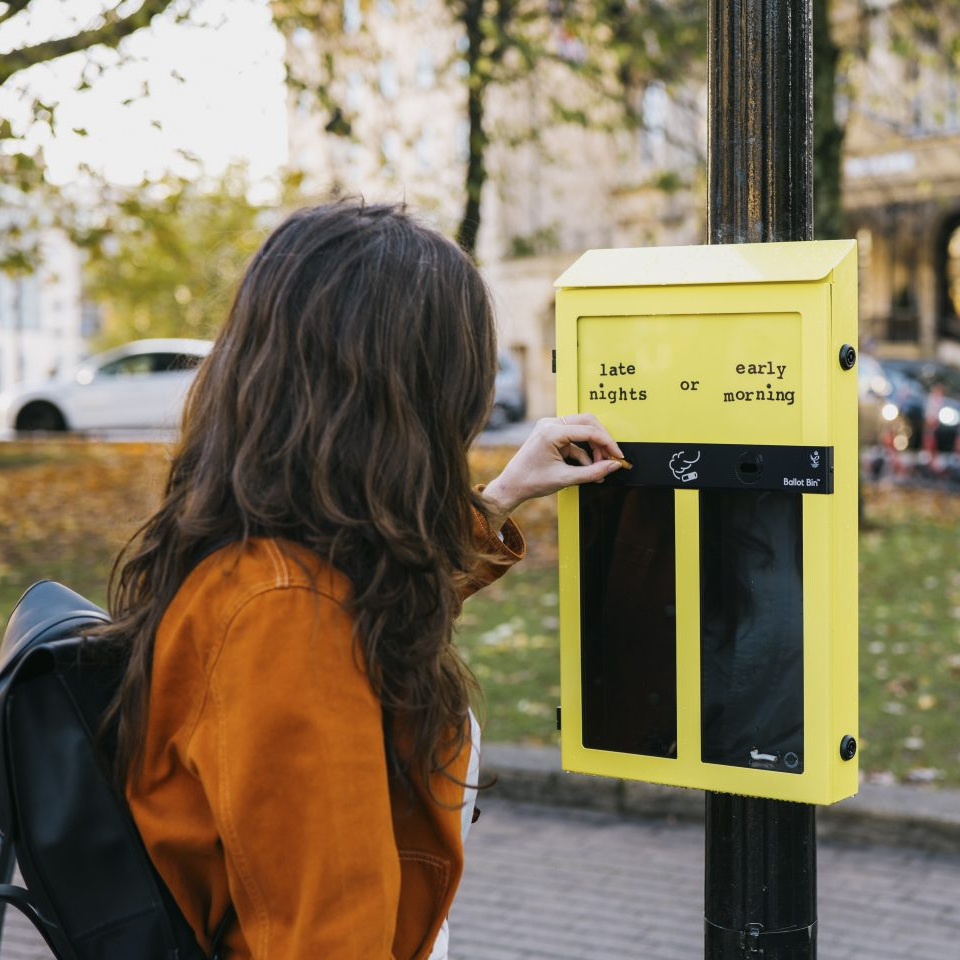
The Ballot Bin began as an experiment, and has proved very successful. It sounds a bit bonkers (and even a bit gimmicky). But that’s where we are today.
If cigarettes are the most littered item on earth (and abroad, most people still smoke as a majority), then something needs to be done. And if gimmicky works, so be it!
It’s basically a litter bin for cigarette butts. But instead of just popping a butt in the bin, most people litter them, where they end up going down storm drains and into the sea.
Instead, this bin asks people fun questions, with two choices. People visit the bin to ‘vote’ by placing their butt inside. It may sound silly, but it’s resulted in huge uptake where installed. And of course this saves councils money too, as well as preventing fires.
Many big companies like IKEA (and even McDonald’s) are now installing them, to help prevent litter in surrounding areas (on private land, it’s their financial responsibility to clean it up, or they can be hit with litter abatement order fines by local councils).
The Butt Ballot Bin is just for butts, and there is also a Big Ballot Bin, where the same idea applies, but for general recycling of other goods (popular at campsites and festivals). And all profits support Hubbub, the environmental charity that is trying to tackle litter problems nationwide.
How to Use the Ballot Bin
Just install it to a wall, and it gets to work. It’s weatherproof and anti-rust, and ideal to situation in high smoking areas like outside pubs and restaurants, or at music festivals. It can be emptied with one-hand and is a bright yellow colour, so hard to miss!
Each order includes 200 magnetic letters to ‘ask questions’ and a dry-wipe marker pen, plus fixings and instructions. The steel body can be recycled at end of life (a very long time!) It has to be connected to mains power, to work.
In the event of fire, the power trips automatically to shut off. You can buy a fire-suppressing brick for £150 extra. The bin itself costs a few hundred pounds (less than clean-up costs).
To use, just create a new question using the downloadable template, place it on the metal plate and slide the plate into position.
To empty, just unlock the front door, slide out the inner caddy and replace the liner. Councils can even then sign up with Terracycle to send old butts and cigarette butts off in pre-paid boxes for recycling into industrial products.
Sample questions (most are just yes or no):
- Should the government do more to tackle littering?
- I’d rather be stranded on Love Island or a desert island?
- Best player in the world: Ronaldo or Messi
- No Butts offers smoking shelters that are designed for butts not to fly away in the wind. Made in Dorset, they provide all-year weather protection, discouraging smoking at building entrances. Which again can minimise fire risk, from discarded butts.
Report Any Litter to Fix My Street
In England, councils have a responsibility to remove litter (no matter who dropped it). They can serve Litter Abatement Orders to private landowners (who then either have to remove it, or will have it removed by councils and get billed with the invoice).
So if you find rivers clogged with litter (or supermarket surrounds with the same), find out who owns the piece of land. Then you can report at Fix My Street for action to be taken.
Understand why cigarette butts end up on the ground in the first place
Most cigarette litter comes from ordinary moments, not grand acts of carelessness. People drop ends because there’s no bin nearby, no safe place to stub out, or no easy option in the moment. Sometimes they’re rushing for a train. Sometimes it’s raining and they want to get inside. Sometimes the habit is so automatic that they barely notice it.
There’s also a common false idea at work. One butt can seem too small to matter. But litter works like loose change in a pocket, one coin feels minor, yet a handful starts to weigh something down. In busy spots, that build-up happens every day.
So, the best way to prevent cigarette litter is to make the right choice feel effortless. If disposal is clear, nearby, and quick, people are far more likely to use it. If it’s awkward, hidden, or missing, good intentions often fall away.
The small habits that turn into daily litter
A lot of cigarette litter comes from repeat routines. People leave a pub, finish the last drag, and keep walking. Staff step outside on a short break, then head back in when the door opens. Commuters smoke on the way to the station and drop the end before the platform.
Cars are another common source. If there’s no ashtray in the vehicle, the butt often ends up out of the window or on the ground at the next stop. None of this feels dramatic in the moment. Still, convenience usually wins.
Why filters are not harmless or biodegradable
Filters may look like cotton, but many are made from plastic fibres. That means they don’t rot away quickly like a leaf or a paper tissue. They break up slowly, and the mess spreads.
Because of that, butts can wash into drains and streams, or sit in soil and public spaces for a long time. Birds and other wildlife may also peck at them. In plain terms, they’re small bits of plastic waste with old smoke chemicals still inside.
The easiest way to reduce cigarette litter is simple, make safe disposal the easiest option nearby.
Put ashtrays where people already stop to smoke
Placement matters more than people think. A cheap ashtray in the right spot often beats an expensive one tucked out of sight. Put ashtrays where people already pause, outside flats, near garden seating, close to staff break areas, or along the usual smoking route near an entrance.
At the same time, keep them a sensible distance from doors and windows where needed. That helps with smoke drift and keeps access points tidy.
Low-cost options can work well. A weighted sand pot is simple and easy to move. A wall-mounted unit suits cafés, offices, shared housing, and small business premises. The key is visibility. If people can see the ashtray from where they stand, they’re more likely to use it.
Make disposal easy with clear signs and regular emptying
Even a well-placed ashtray fails if it’s full, dirty, or hard to spot. So keep the message and the upkeep simple. A short sign works better than a lecture.
Good examples include:
- Please use the ashtray
- Butts in the bin, thanks
- Help keep this entrance clean
That kind of wording feels polite, not scolding. It gives a clear action and then gets out of the way.
Regular emptying matters just as much. At home, that may mean folding it into a weekly tidy-up. In a café or office, add it to a daily outdoor check. In shared buildings, give one person clear responsibility. People stop using ashtrays when they look neglected, so a quick routine goes a long way.
Use simple reminders that make the right choice easier
A reminder works best when it sits right in the path of the habit. Keep a pocket ashtray by your keys. Put a bin near the usual smoking spot at home. Add a friendly notice in a shared outdoor area where people naturally stop.
These cues are easy to miss when they’re absent, and easy to follow when they’re there. That’s the point. People often want to do the tidy thing, but they forget in the moment. A visible prompt closes that gap.
For households and shared flats, a short agreed rule can help. Something as plain as “please use the ashtray by the back door” is often enough.
Turn clean-up into feedback, not a punishment
If one area keeps collecting butts, treat that as useful feedback. Do a quick sweep now and then, then look at the pattern. Is the ashtray too far away? Is there no safe place to stub out? Is the sign hidden?
After that, adjust one thing at a time. Move the ashtray. Add a bin. Change the sign. In workplaces or shared housing, keep messages short and respectful. People tend to respond better to “please use the sand pot by the bench” than to a sharp warning stuck on a wall.
The aim is progress, not perfection. Cleaner spaces usually come from small fixes repeated, not one big campaign.