Support Independent Supermarkets (if you live near any!)
Every food shop is a small vote for the kind of high street you want. Spend your budget in one place, and that area gets busier. Spend it somewhere else, and different doors stay open.
An independent supermarket is usually locally owned and managed, and it isn’t part of a national chain. It might be a long-running family business, a local co-operative, or a neighbourhood store that’s grown over time.
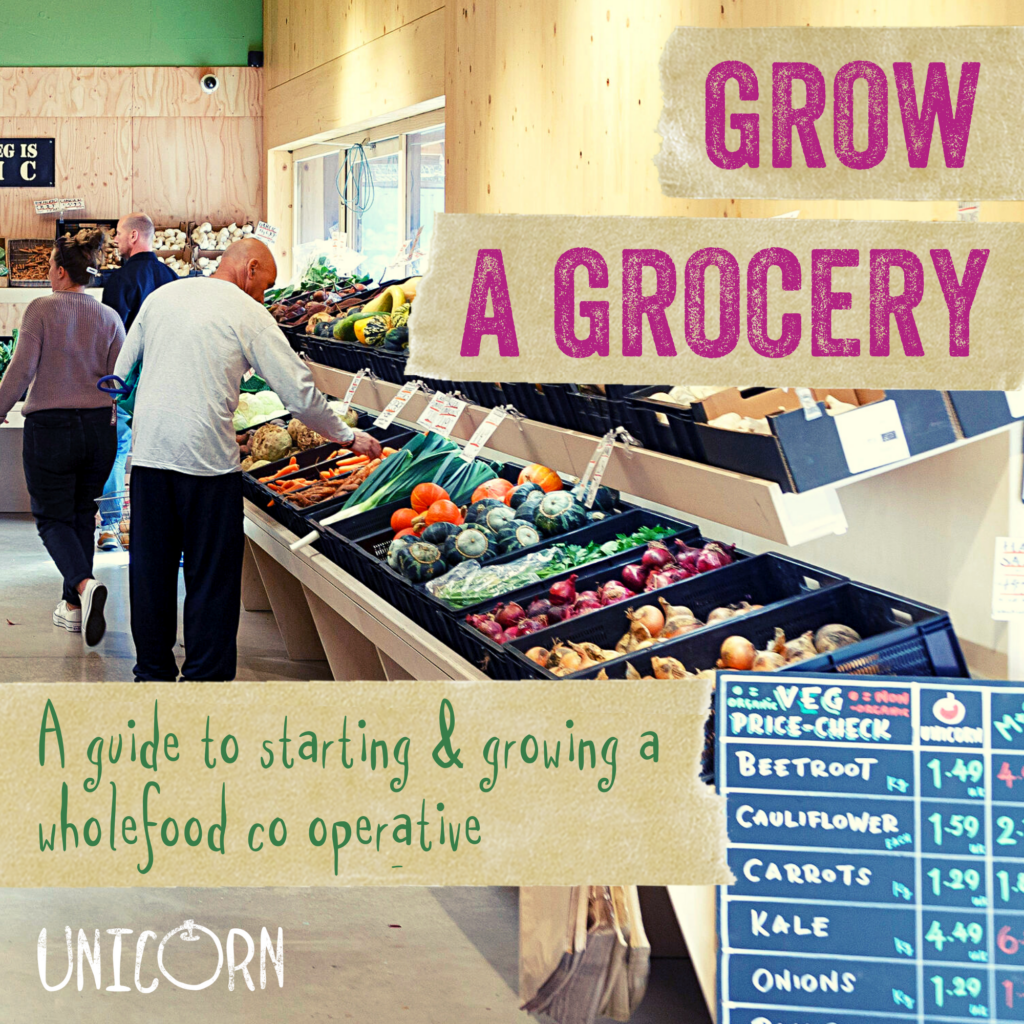
With no plans to expand, you can download Unicorn Grocery’s free Grow a Grocery guide to bring the same to your town!
Before cooking, read up on food safety for people and pets. Indie shops can learn which plants and flowers are unsafe near pets, to know what not to sell to people with animal friends.
Independent supermarkets keep jobs in communities
When you shop at an independent supermarket, more of that money tends to circle back into the same area. The owner lives nearby, hires nearby, and often pays nearby firms to keep things running. That local “ripple effect” is easy to miss because it’s spread across lots of small transactions.
Big chains still employ local people, of course. However, decisions on range, pricing, and suppliers often happen far away. By contrast, independents can change course quickly because the decision makers are close to the shop floor.
More of what you spend stays local
Local wages are the obvious part. Your shop spend helps pay the cashier, the shelf stacker, and the supervisor, then those wages get spent in local cafés, barbers, and bus routes. In addition, independents often pay local accountants, electricians, refrigeration engineers, and cleaners.
Local taxes and fees matter too. A locally owned business often pays business rates and service costs that support the area’s basics. Meanwhile, owners who see the same streets every day have a clear reason to reinvest, whether that’s a refit, better lighting, or a new counter for fresh food.
Picture a simple, everyday chain of work. A neighbourhood supermarket employs staff, uses a local courier for small deliveries, and calls a local plumber when the sink backs up. As a result, one shop can help support several livelihoods, even before you count local suppliers.
You often get better choice, fresher food
Independent supermarkets win loyalty in ways that don’t show up on a price label. They can tailor the shelves to the people who actually shop there. They can also keep stock moving in smaller amounts, which often helps freshness.
None of this means every independent shop will be perfect. Still, many people notice the difference when they switch from a one-size-fits-all store to a place that feels tuned to the neighbourhood.
Local and regional products are easier to find
Independent supermarkets often stock brands that don’t have the volume, budget, or connections to get into big chains. That can mean a local yoghurt maker, a small-batch sauce, bread from a nearby bakery, or seasonal fruit from a regional supplier when it’s available.
Culturally specific food is another big one. In areas with mixed communities, independents may carry the spices, grains, and fresh ingredients people actually cook with. On the other hand, a national chain may only offer a slim, standardised range.
Seasonal lines can be better too. A local shop can bring in a short-run product for a few weeks, see how it sells, then adjust fast. That keeps the shelves interesting, like a changing menu rather than a fixed script.
A simple tip: if you can’t find something, ask. Many independents will try to source it, especially if a few regulars want it. Even when they can’t get the exact brand, they’ll often suggest a decent substitute.
Better service and less hassle
If a product’s missing, staff can tell you when it’s due. If you need an alternative for an allergy, someone may guide you to a safer option. If you spot a problem at the checkout, it’s often fixed quickly because the manager is nearby.
Convenience can be different too. Many independent supermarkets sit closer to where people live, so you can pop in on foot rather than driving to an out-of-town site. Parking varies, yet smaller sites sometimes mean easier entry and exit, especially for a quick shop.
Unicorn Grocery (a food co-operative in Manchester)

Unicorn Grocery is a thriving Manchester food co-operative that is owned by its staff (who get paid a real living wage). All items are vegan (2500 foods) and fresh produce is from its own farm.
It even has England’s first living roof on a commercial building, to support habitat of the endangered black redstart bird):
It also offers organic beers and eco-refillable beauty and household items, sold in plastic-free packaging. Salads and olives are sold in reusable tubs, and there’s even a soup cup deposit scheme.
Get discounts with the loyalty card. Prices are very good (due to no shareholders and most produce is local). A few items cost more (like homemade organic flapjack). The ‘Good Stuff’ apple logo indicates favourite companies.
Kindly Supermarket (founded by a bored techy guy!)
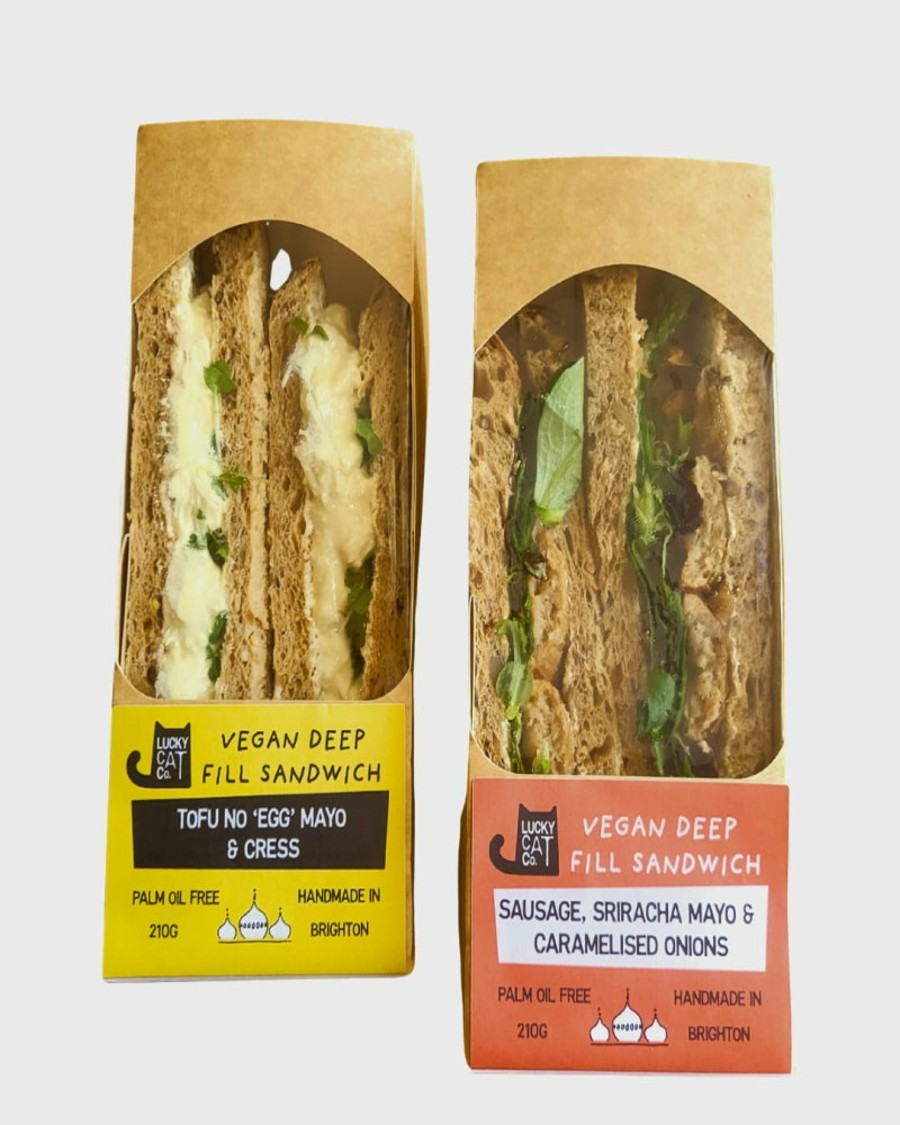
Now this is more like it! Kindly (Brighton) is a big busy vegan supermarket that was founded by an Internet techy wizard, who got bored and decided he wished to do something with his money, to do good.
His aim is to ‘flip the supermarket model on its head’ and put planet before profits. His supermarket even offers vegan sandwiches in compostable packaging (handmade in Brighton).
Locals in Brighton can also order online, or just pop in the store to shop in person. It supports local artisan brands including local beers, to keep money circulating within communities.
The good news is that as a former techy entrepreneur, the founder has plans to take this model nationwide, to rival the big bad supermarket chains! But this time it will be business doing good, not harming animals or the planet.
People want to do good, but they don’t want to do it at the cost of either convenience or choice. We’re trying to bring in a food revolution, where we change the way we consume things. Shiv Misra (founder, Kindly Supermarket)
Infinity Foods: A Wholefoods Co-op in Brighton
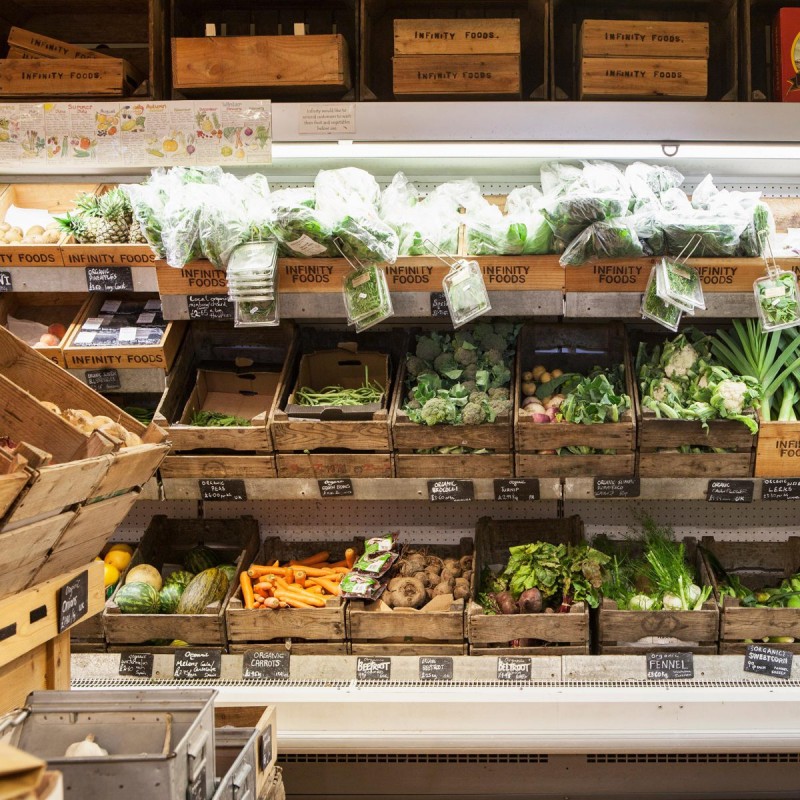
Infinity Foods in the city of Brighton has been around since the 1970s. Democratically run by its workers, it offers a huge range of organic fresh produce, in-store baked bread, vegan groceries and natural beauty and cleaning products, along with a wholesale division.
Many items are sold in refill containers, so bring along clean dry containers to fill up, saving you money as well as packaging. The shop also avoids selling items made with palm oil.
There is also a Community Card, which gives discounts to regular customers. A portion of profits are donated to local charities, usually ones to protect Sussex wildlife or to help poverty and homelessness in Brighton.
Aside from assistance dogs, dogs are not permitted (due to lots of food at nose level!)
The Clean Kilo (A Zero Waste Supermarket)

The Clean Kilo (Birmingham) is England’s largest zero-waste supermarket, founded by a couple that use a tare system to weigh food in your own clean containers, so you never pay for packaging (which makes up a third of the price in normal shops).
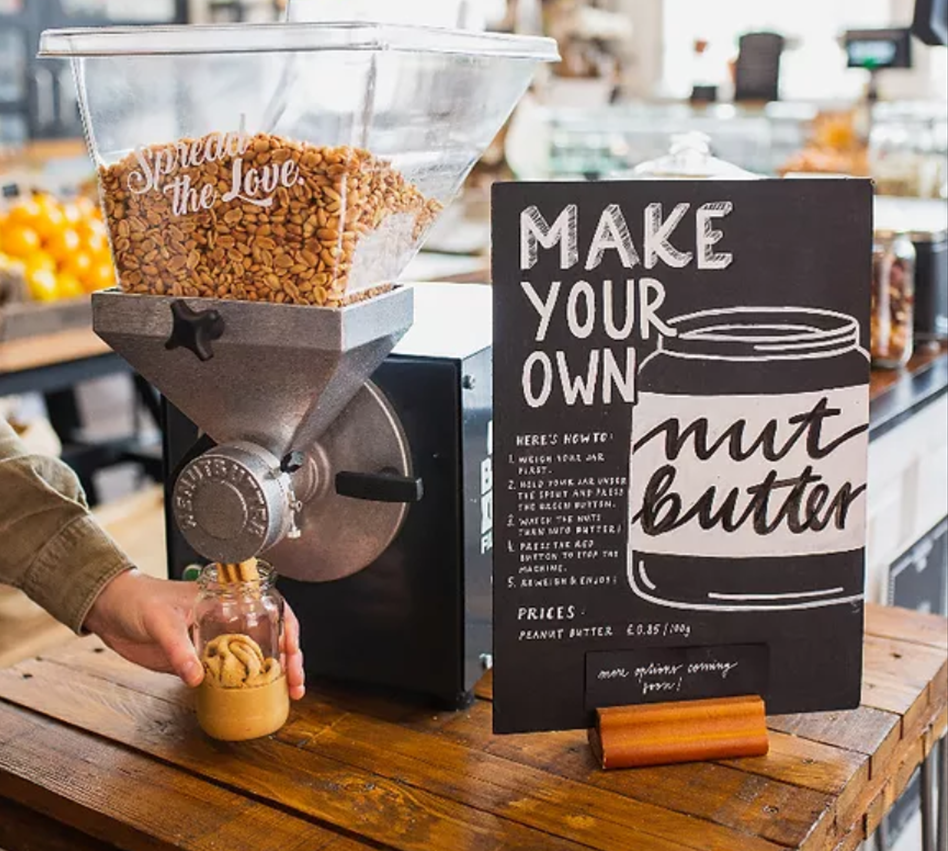
Beautifully fitted, the shop includes chilled plant milk dispensers, and machines to make your own orange juice and peanut butter.
Most food is organic and bought in bulk from local suppliers (even the crisps) and they use a reusable Brummie Cup that you can return after use.
Do Big Supermarkets Really Support Communities?
Most of us have no choice sometimes to pop into a larger supermarket chain, because most of the independent food shops have gone. Unless you live somewhere with farm shops, you likely have to shop at them.
So then after you’ve bought things (that after staff are paid, the rest of the profits will zoom up to head office and out to shareholders), you are asked to put a blue token or whatever in a choice of your favourite local charities. Because that way the big supermarkets can say they are helping.
In fact, that’s not really the case. When someone buys from local independent shops, that money stays in the community (salaries, staff who buy sandwiches and beer at local pubs and outlets, even the signwriters benefit).
With big supermarkets, there are ‘local jobs’ (usually at minimum wage working for companies that earn billions). The rest of the money then goes to the manager, top manager and super-top manager. Then out to shareholders, and on big TV and newspaper ads, and ‘free magazines’.
Most big supermarkets are out-of-town (so local ‘communities’ can’t shop at them, having to make do with smaller express stores). Which are marked up in price in high touristy areas for more profits.
And most big supermarkets will fine you if you park longer than you should (so there’s no time to go and support an independent coffee or gift shop – by the time you’ve done your weekly shop, it’s time to drive home again).
This is profiteering pure and simple. Tesco made £3.1bn profit last year, and its dominance means it can squeeze suppliers, while boosting its own profits.
This then feeds into more food inflation and worsens the cost of living crisis, for workers and communities. It is obscene. Where is the off button? Sharon Graham (Unite)
Supermarkets Do Listen (to rich people)
Supermarkets often differ in what they sell, depending on where you live. For example, Budgens in the affluent town of Holt (Norfolk) offers organic produce in plastic-free packaging, no canned music and strawberries from 4 miles away. There is also a post office, same-day home delivery, electric car charging points and an upcoming solar panel on the roof.
Yet in Clacton-on-Sea (one of England’s least affluent areas – Nigel Farage’s constituency), the website for Budgens offers no local food, instead boasting of national lottery tickets, and special offers on toilet roll and giant bottles of Pepsi cola.
The Sad Sorry End Tale in Sheringham
A few years back, there was a goliath 13-year battle in the Norfolk town of Sheringham, to stop Tesco building a big supermarket, in one of the towns left without one. When Paul Kingsnorth covered the story in his book Real England, the battle was ongoing.
Things looked hopeful, when a local entrepreneur offered to fund an independent supermarket, even hosting cooking classes above it. And yet the council (the council!) received the proposal, then voted to give planning permission to Tesco.
Today (many locals are likely unaware of the history) it’s a busy supermarket, and of course Tesco ‘gives back’ to the community. But many independent shops there have now gone under, there are no ‘blue tokens’ in the box to help them. A community has been half-destroyed.
And now this beautiful little seaside town has another hit: after the council (this time) refused a license for Dominoes pizza (the town already has 40 indie food outlets), the government (the government!) override the decision, and it’s going ahead.
So now the town will be littered with white plastic sauce pots, and money will go out of the town, and up to head office of Dominoes (Michigan, in the USA).
Big supermarkets don’t offer ‘choice’. Try looking for a natural toothpaste, a hair dye without chemicals or a vegan cake without palm oil. Despite all products with long shelf lives (so they can’t say ‘we won’t stock them in case they go off’) you won’t find any.
Posher and Expensive (not necessarily better)
Some bigger supermarkets are independent, but don’t really fare much better. In East Sussex, local bakery chain Jempson’s has a supermarket in a local village, but you have to drive there (it even has its own petrol station).
And Booths (often called ‘the Waitrose of the North’) is too expensive for most people (the ‘ready meals’ are tremendously expensive, as is orange juice from a machine you use to make yourself).
Good food should be affordable to everyone, not just those who can pay for organic sourdough bread. Booths website boasts that it has ‘removed all plastic cutlery’. That’s because there’s now a single-use plastic ban, so giving it out would be illegal anyway.
A few years back, a truck of pigs destined for the abattoir crashed, leaving many dead and more severely injured. But despite animal welfare campaigners offering to take the recoverable ones to a sanctuary, the (posh) supermarket refused, and had them put back on the truck to be slaughtered, already injured and traumatised.
- Waitrose only stopped selling ‘dredged’ scallops due to protests.
- M & S has faced controversy over selling farmed salmon.
- Harrods sells foie gras, so cruel it’s banned to make here.
- All the big supermarkets only drop certain unethical suppliers, when horrible stories come out in the press, forcing them to act. If they were really ethical, they would have dropped these suppliers already.