Greener Carpets & Hard Flooring (the best choices)

Flooring and carpet are huge investments, so unless you can find and securely fit second-hand, it’s likely best to just wait until you can find a bargain for quality flooring to last you years.
For hard floors, you can use natural floor cleaner (this post includes how to humanely deter and move cute spiders), avoid citrus oils near pets. For carpets, use a good hoover or carpet sweeper.
Although recycled plastic is not good for clothing (due to releasing microplastics in machines to the sea), for carpets it’s a fairly good option, especially for things like office tiles.
It’s a great way to use use up and remove ghost fishing waste (nets et al) from the sea, to make life safer for marine creatures.
SEDNA Carpets makes carpets and office carpet tiles from a blend of ghost fishing waste and old carpets, and linings are made from recycled plastic bottles.
This Belgian company is named after Sedna, who rules the seas and helps marine creatures (after being thrown overboard by her father in Greenland, she she refused to marry a suitor!)
You can search online to find local retailers. The range has lovely names (Kai is the Hawaiian word for ‘water’), Varuna is the an Indian god responsible for falling rain, and Yara is a ‘lady of the water’ who lures men to her underwater world, on the Brazilian river banks!
Sisal, Seagrass and Jute (natural carpets)
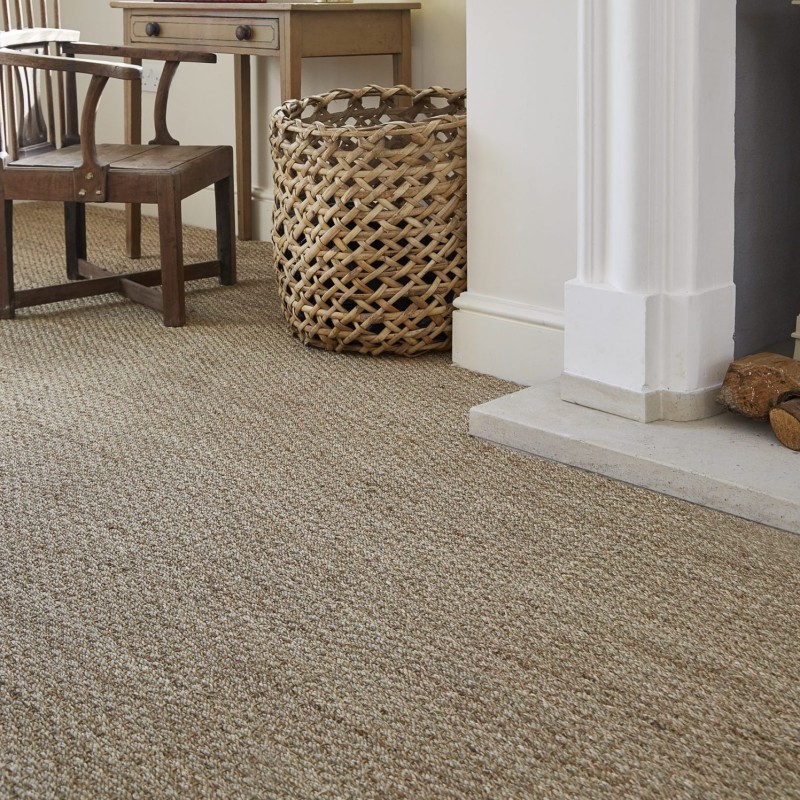
Flooring by Nature (seagrass carpet)
The two main types of eco-flooring are all good to the planet, though perhaps not as ‘soft and comfy’ as modern carpets, but good for people who like this style. You can use eco underlay with any carpet.
Sisal (from the agave plant) is a safer choice usually for stairs (jute is too soft to give good grip). Econyl (from fishing waste) sometimes gives low slip risk with lasting strength, ask your retailer.
Always have carpets (especially on stairs) professionally fitted, to avoid trip hazards. Avoid loose runners and check corners and edges for wear or lifting, on a regular basis.
Seagrass is sourced from rapidly regenerating coastal meadows, made from dried leaves and usually with a latex backing. It does not bend easily, so unlike sisal, is not suitable for stairs.
Jute is spun from plant stems in Indian and Bangladesh). It leaves a lighter footprint, but is too soft for stairs, so stick to low-traffic areas like bedrooms.
Cork, Bamboo & Wood (hard flooring choices)
Cork does not require trees to be chopped down (the cork bark is simply stripped from trees every 9 years or so, and keeping the industry alive helps to protect forests and wildlife in Spain and Portugal.
This is a naturally cushioned floor with acoustic properties, and lovely and warm. So good for bedrooms, playrooms or home offices. It can swell with too much moisture, so avoid in wet rooms.
Bamboo (not the same as fresh shoots eaten by pandas) is another popular choice, from the world’s fastest-growing grass. It stands up well to food traffic, so is good in living rooms, hallways and bedrooms. It works best in low-moisture areas (so not for kitchens or bathrooms).
Reclaimed wood is another choice, and you may find bargains at salvage yards or online. These planks are often bought from old barns, warehouses or factories, and retain original grain, yet save new trees being chopped down.
It’s important these are fitted well, as some boards could be uneven or have nails. But they are lovely for old homes and stately houses. Find at: