Simple Swaps to Help Our Small Farmers
If you don’t grow your own no-dig veggies, Local veg box schemes are one alternative to supermarkets, to order fresh fruits and veggies. Many are organic, others avoid pesticides but are not certified organic, simply because it’s an expensive and lengthy process to get certified, so don’t discount smaller organic box schemes with no logos.
Farmers need a government license to sell to the public (also buy liability insurance). Know food hygiene rules.
Box schemes basically have you sign up weekly or fortnightly, to receive a varied box of fresh seasonal produce, which has very low food miles, and helps to support small independent farmers. It’s a no-waste and affordable way to enjoying good tasty food, in season.
Veg Box Safety Tips
Check paper medication inserts, as some people should avoid grapefruit, rhubarb and green leafy veggies. Keep boxes in a safe place (like a shed) away from pets due to alliums (onion, garlic, leek, shallots, chives) and citrus fruits. Read more on food safety for people and pets. If buying flowers alongside, read up on pet-friendly gardens (many are unsafe near animal friends).
Due to acids, it’s best to avoid composting citrus fruits as they could harm garden creatures (just bin to break down naturally). Same with tomatoes, rhubarb and alliums.
If tinned foods are ordered alongside (some veg boxes offer grocery items). fully remove lids before recycling (or pop ring-pulls back over holes, to prevent curious wildlife getting trapped inside).
How Do Veg Box Schemes Work?
You simply sign up for a weekly or fortnightly box (some also offer groceries to go alongside). You usually can either choose individual produce, or more often just sign up a for a set box, so you usually get a surprise, depending on what’s in season.
Most boxes let you cancel easily or postpone (say if you go on holiday or had to go into hospital). And some also let you filter out things you don’t like or can’t eat, to get a substitution, to avoid waste.
The boxes are usually sold in various options: says boxes for one or two people, ones for small or large families. Plus there are often boxes for veg only, fruit only, or usually a mixture. Some even offer specialty boxes like ‘no potatoes’ or smoothie boxes.
There’s no plastic. You then just leave your empty cart/box out the next week, and get it replaced by a new box.
The Benefits of Local Veg Boxes
Where do we start?! For a start, you are supporting small independent farmers who grow organic produce. Then you are also benefiting from eating more plastic-free fresh produce.
Another big advantage is low food miles. Around 25% of road traffic in England is from lorries thundering produce along motorways to deliver food to central distribution houses, which then chill the produce, until it’s travelled again by lorry back to big supermarkets.
All of this uses oil (lorries, fridges, lighting and pesticides which are made with oil). If we want an oil-free economy (which is good to prevent oil spills to climate change), this is one good step. Plus veg boxes are more affordable, as they cut out the middlemen, and packaging.
Having a veg box also encourages you to eat more fruit and veg, and be creative in making simple recipes. If you buy a bag of rock-hard pears at the supermarket, some may go to waste. But if you get a bunch of juicy ripe local pears delivered to your door, you’ll likely be inspired to eat them, or turn them into a nice recipe, to avoid wasting such delicacies!
What To Do during England’s Hungry Gap?
England can grow all its own food. But around April, there is something called a ‘hungry gap’. This is when all the winter produce has been harvested, and the spring/summer harvest is not yet ripe. Kale is one of the few foods that is possible to grow year-round.
Some box schemes get around this by growing certain crops in polytunnels. And obviously we can’t grow some popular fruits like oranges, lemons and bananas. So most box schemes either avoid selling them, or do import them but sea-freight, to avoid air pollution.
Where to Find Local Box Schemes

Just look them up online. As said above, some are naturally organic, so won’t be listed with official organisations.
The Food Assembly links customers with local farmers, just pick up your delivery from a nearby pick-up point like a community hall or school. Produce changes weekly, depending on what’s in season.
Kentish Town Veg Box (London) offers affordable veg bags (and optional fruits like rhubarb) with farmers receiving around 60% of each pound spent. Pick-up points are more affordable, or have home delivery with a surcharge. You can even buy basil from London and aubergines from Kent! And donate to give discounts, for people on low incomes.
Riverford (London) delivers boxes of different sizes, with extras like salad or bread. Everything is picked to order, and delivered within 48 hours of harvest.
Growing Communities (East and South London) has boxes starting from £10, using pick-up points to keep prices low. Farmers receive 50% of the price you pay (three times more than supermarkets) for a resilient food system that is not affected by rising oil prices. It also sells wholesale.
Sutton Community Farm a community interest company that delivers over 500 veg boxes each week, with 80 volunteers to helps deliver over 15 tonnes of fresh affordable veggies each year, grown in South London.
Abel & Cole (London) sells organic veg boxes, you can add a pick-up bag to your order to seal rinsed soft plastic packaging (from any retailer) that is collected with empty boxes for recycling. Seasonal produce includes:
- Spring (new potatoes, asparagus, spring greens, rhubarb)
- Summer (strawberries, tomatoes, cucumbers, courgettes)
- Autumn (apples, pears, squash, kale)
- Winter (parsnips, carrots, leeks, cabbage)
You can also add organic oat drink in returnable glass bottles, sourdough bread and plant-based yoghurt.
Veg Boxes That Use Up Food Waste
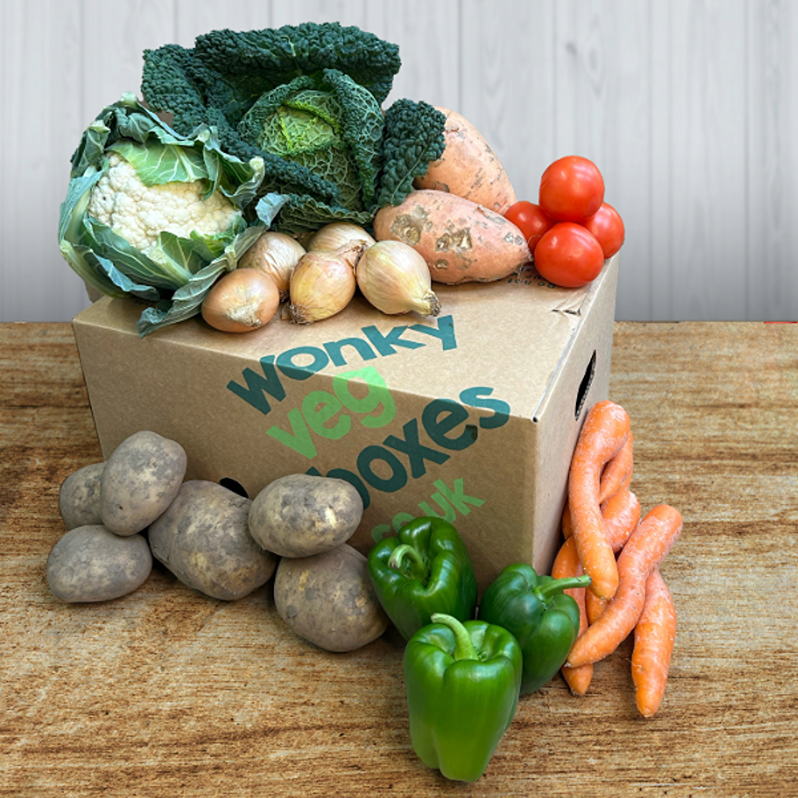
These are not always organic, but use up food that would otherwise go to waste. This food is often rejected by supermarkets because it’s wonky or odd-shaped and works out more affordable.
Food campaigner and chef Hugh Fearnley-Whittingstall is not impressed by ‘supermarket wonky produce’. He says it’s often the supermarkets themselves that are rejecting ‘imperfect produce’. Then tries to sell wonky leftovers, for more profits.
Despite being a food waste champ, Hugh has a guilty secret. Unlike his wife who can eat the whole apple including the core, he can’t. He says she can bite off the ends and middle to leave a tiny stalk, but he is still left with a ‘pencil-sized core!’
- Earth and Wheat sells wonky fresh produce and bread, and a vegan grocery store. Produce sold here has been rejected by others for being too big, long, blemished, too thin or the wrong colour.
- Wonky Veg Boxes again helps to buy up and sell ‘imperfect produce’ that farmers have had rejected by supermarkets: often carrots, parsnips, potatoes and apples with odd shapes or little scars.
- Oddbox offers dinky apples to curvy courgettes, with clear pricing for surprise boxes in plastic-free packaging. Nationwide delivery is available.

Community Supported Agriculture (CSA) is an interesting idea, where people give farmers financial security, by paying for the harvest in advance, leaving farmers free to focus on growing food.
Rather than having to sell out at low prices to supermarkets (who sometimes even cancel orders at the last minute, leaving farmers without income, if the crop is not suitable or the harvest fails).
Isn’t Paying a Farmer in Advance Risky?
Not really. You are pooling your money with others. So if the crop harvest fails due to say a flood, you may have lost £50 at most. But you have saved the farmer’s livelihood, for years to come. It’s a small price to pay to keep local food, and it’s unlikely to happen in most cases anyway.

Farming is Female is an inspiring book, looking at 25 young women who are shaking up the status quo of traditional farming. Farming food is one of the world’s most important jobs, so bring in some feminine blood to shake up the norm in a world full of pesticides and ‘men in grey suits’ that oversee much of our farming industry, can only be good.
Read our posts on no-dig gardening and wildlife-friendly gardening.
Farmers need a government license to sell to the public (also buy liability insurance). Know food hygiene rules and read up on food safety for people and pets.
If selling flowers and plants, learn about pet-safe gardens, to educate customers. Never face indoor foliage to gardens, to help stop bird strikes.
Women have always played a key (but often unspoken) role in agriculture. Across the world, millions of women plant, nurture and harvest. And today female farmers are stepping into the spotlight, shaping food security, to shake up the old farming infrastructure.
Let’s be clear – good men are farmers too! But a bit like everywhere, the industry could do with some feminine energy – these organic pioneering farmers are into local food miles, organic farming and welfare for both animals and wildlife affected.
The Historical Role of Women in Agriculture
Worldwide, it’s women who make up almost half the agricultural workforce, and that figure is even higher in South Asia and sub-Saharan Africa. And the number of female-led farms is rising in Europe and North America.
From small family plots to specialty farms growing herbs, organic produce or flowers. Many are also driving local food movements, and sustainable farming initiatives.
Whereas MPs bang on about supermarkets ‘bringing jobs to local people’ (not really true in detailed economics, as the money flows out to shareholders), female organic farmers are bringing money into economies, by providing natural organic food for local people of all incomes. And helping families feed their children, on low budgets.
For years, women had limited access to land and business information, so could not formally own the fields to grow food on. Today these social barriers are being broken down, and now female farmers are running eco-friendly business models, training other farmers and joining farming unions, to help smash the status quo.
They also bring compassion. For instance, the stupid and cruel badger cull to prevent bovine TB (which has not worked) was mostly due to stick-in-the-mud MPs and farming unions not listening to the science.
Adding some feminine energy and a different point of view, helps people sit up and listen, and learn to accept change, to help both cattle and badgers (and farmers).
The Woman Who Pioneered Organic Farming

Have you heard of Mina Hofstetter-Lehner? No? Well, she lived from 1883 to 1967 and was the first organic farmer who did not use livestock. Age 3, she put her spoon down when fed meat broth (despite a terrible fear of cows!)
She even refused to marry a farmer because she didn’t like the smells of the countryside, but went on to marry and have 8 children. Growing her own food on the shores of Lake Greifen, as long as it didn’t involve killing animals.
After her health improved by going vegetarian, she began to teach her unique cultivation methods (one of her students was Maximillian Bircher-Benner, who invented the famed ‘Bircher Muesli’ that is still served today at health spas). She also campaigned for world peace and gender equality.
The (female-led) Transfarmation Movement

The transformation movement is now massive worldwide, as farmers struggle to make money from selling dairy and meat, due to differing values and tastes of consumers.
Instead of saying to farmers ‘try to force people to eat more meat and dairy’, this movement accepts what is happening, and gives starter seeds and help to long-held and much-loved family farms, to ‘transition over’ to the more profitable oat milk market, or grow trees to sell peaches or local nuts etc.
Remaining animals then live out lives in peace, akin to a farm sanctuary.
The founder Sarah Heiligtag is a Swiss vegan farmer, who after receiving a phone call from a struggling dairy farmer (racked with guilt at sending his animals to slaughter) asked her for help. He asked if there was any way he could make money, and she said yes.
Today Sarah has helped over 100 farms go vegan, but ‘transfarming’ their land over to growing more profitable crops like oats (the animals remaining simply live out the rest of their lives in peace).
Sarah and her husband (along with a friend) founded an animal sanctuary near Zurich, designed to help educate on plant-based agriculture, as well as be a haven for rescued creatures.
It almost accidentally then became a contact point for farmers, who are interested in livestock-free agriculture:
If you are a farmer and have questions about farming without ‘farm’ animals or about setting up a life-saving farm, do not hesitate to contact us. We will be happy to advise you, with no obligation.
In the end, the goal is for you to be able to do what really fulfils you, and be true to your true self.
Transfarmation is a book by the (female) president of US charity Mercy For Animals, showing how food and farming have failed over decades, and how factory farmers, rescued farm animals and rural communities are now being transfarmed into new starts.
The (female) Founder of Soil Association

Lady Eve Balfour was raised in a Scottish aristocratic family (the niece of a Prime Minister), but instead of looking for a suitor, took a degree in agriculture age just 17.
Later on in life, she led the successful campaign against the tithes that farmers were obliged to pay. She dressed in trousers (not acceptable!) and lived mostly in run-down houses, whilst giving speeches on farming into her 80s.
She never had much money, so would play saxophone in a jazz band (and write crime thrillers) to pay the rent.
Dismissed as a crank for her views that using chemicals to grow food was not good, she was known for being angry at farmers who used them. One farmer would ‘get up at 5am to spray them’, to avoid her finding out.
She would then apparently smell them in the air and accuse ‘I smell Methoxone in the air. What have you been doing?’
Lady Eve went on to found the Soil Association, our national organic certifying scheme for farmers. Her views on farming are now widely accepted – 80 years after she was mocked for writing about them.
Why Pay Farmers in Advance?
Because small organic farmers often live and work on long-held family farms, and have to sell to supermarkets at tiny prices (some even earn just 1p for some crops). A loaf that sells in supermarkets for over £1 may only make a wheat farmer 9p profit.
If we want good food at affordable prices, the obvious start is to cut out the middlemen, and buy direct from CSAs and farmers’ markets (even farm shops can be expensive, as they are taking profit).
If a supermarket sells a 1kg bag of carrots at 70p, the farmer is not making much profit, and if locked into supermarket contracts, is unable to sell elsewhere. And supporting local farmers is good for local economies, as they are more likely to support other local businesses.
Where To Find CSA Farms
Just enter your postcode to find local CSA farms! You then choose a category (there are over 135 vegetable CSAs listed). If you eat animal foods, ensure any listings are for certified free-range organic foods, for best welfare.
How to Order from CSA Farms
Each one works differently. But as a rule, you just pay for the harvest in advance, then receive your ‘money back’ in the form of a harvested crop, or sometimes a regular organic box.
Veg boxes can be left in a safe place if you are out (say a shed or garage or porch). Keep them away from pets (onion, garlic etc are not safe near animal friends). Read more on food safety for people and pets.
Unless you’re an expert composter, avoid composting acidic scraps (onion, garlic, leeks, shallots, chives, tomatoes, citrus, rhubarb) as this could harm compost bin creatures. Just bin them, to break down naturally.
If ordering plants or flowers, read up on pet-friendly gardens (never face indoor foliage to outdoor gardens, to help stop birds flying into windows).
The Community Farm (Bristol & Bath)
The Community Farm is a good example of a non-profit CSA Farm. It offers a wide range of veg boxes (potatoes, onions, carrots, beetroot, sweetcorn, kale, parsnips, cauliflower, runner beans and kohlrabi). The warehouse handles allergens (gluten, mustard, celery/celeriac).
Profits have been reinvented back to create 30 quality jobs. You can also add £3 to your order that goes to their Community Fund, to provide organic food to local people on low incomes.
This farm’s organic methods protect hedgerows (which has led to an increase in numbers of endangered bees and butterflies). Other wildlife enjoying their land include deer, badgers, stoats, and birds (skylarks, kestrels, buzzards, yellowhammers, tawny owls, woodpeckers and endangered lapwings).
Can CSA Be Used for Other Foods?
Yes! The Handmade Bakery (Yorkshire) is a good example of how a thriving enterprise was launched, by offering ‘bread bonds’ to local people, who received ‘share dividends’ in the form of freshly-baked loaves.
Peaceful Politics in Action!
The government and big food chains are not going to change the food system, so it’s up to us to make small empowered changes. Switching some of your shopping to a CSA farm helps to keep good organic food local and affordable, and supports farmers directly, who don’t have to sell out.
Many small farmers tend their crops and look after their animals well. But often have to either sell at a pittance to big supermarkets, or suffer from rising costs, high tenancy rents and/or natural disasters like floods, and end up living on the breadline, some even suicidal.
The good news is that there are wonderful small charities that can help:
Forage Aid (Free feed and bedding)
Forage Aid helps with free feed and bedding, if your farm has suffered due to weather or an ‘act of God’. Farmers who have had their farms flooded have received silage, hay and straw for animals, through donations to Addington Fund (below).
Addington Fund (emergency housing help)
Addington Fund helps with housing for farming families during tough times. If someone loses their farm or home due to finance or ill health, Addington steps in with emergency accommodation or relocation help.
Farming Community Network (general support)
The Farming Community Network offers support 365 days a year. Volunteers (many with farming backgrounds) listen, and guide those struggling with practical or emotional problems.
It also runs Farmwell, a site of useful information including grants and funding, animal welfare and staying connected.
RABI (financial support and counselling)
RABI delivers confidential financial support and counselling. They help farming families facing hardship – paying bills, offering grants and funding therapy sessions.
Prince’s Countryside Fund (grants for local farmers)
The Prince’s Countryside Fund invests in projects that keep rural communities strong. It awards grants to help upskill farmers, boost local markets, and support young people starting out in agriculture.
Hen Helpline (help with anything chicken!)
Hen Helpline is run by a charity that rescues chickens (and roosters) designed to be killed, after end of egg-laying life. The free helpline helps with anything chicken!
Small farmers in England face more pressure than ever. Not just being priced out and dominated by big supermarkets, but often climate change is now affecting weather, so they wait for rain when none arrives, and unpredictable weather threatens crop harvests.
Read our posts on no-dig gardening and wildlife-friendly gardening. And if you farm alongside dogs and cats, read about pet-friendly gardens.
Find info on preventive/treating common conditions at Homeopathy at Wellie Level (courses are endorsed by vets).
Alongside mounting bills and economic uncertainty, small farmers are feeling cut off from society, but there are wonderful non-profits that can help with advice and financial aid. And a listening ear, when farmers need it most.
Help farmers by following the countryside code to protect livestock (and dogs). Report concerns of farm animals to RSPCA (or Crimestoppers to remain anonymous).
For financial help (including free food for animals during hard times and natural disasters), read about charities that help small farmers.
Transfarmation helps farmer ‘transition over’ to growing oats for the profitable plant milk market, with remaining animals living lives out in peace.
A Good Book to Help Small Farmers
Six Steps Back to the Land is a unique book by an expert on sustainable farming, on why England needs to turn back from the 1930s notion that ‘everyone needs meat for protein’, as this idea has destroyed our land and caused huge issues with factory farms and climate emissions.
Instead, the author offers a new idea of millions of small farmers, growing sustainable food without destroying our soil, harming our bees or making climate change worse.
You don’t have to be vegan or vegetarian, to know that we need to grow more plants, and eat less meat (a view shared by many chefs including Hugh Fearnley-Whittingstall).
The book also shows how taking his action steps could stop consumers and farmers being dominated by big corporations who control (and import) most of our food. Let’s restore farming to to feed the world, for a peaceful and prosperous future.
Crowdfarming (order organic food direct from farmers)
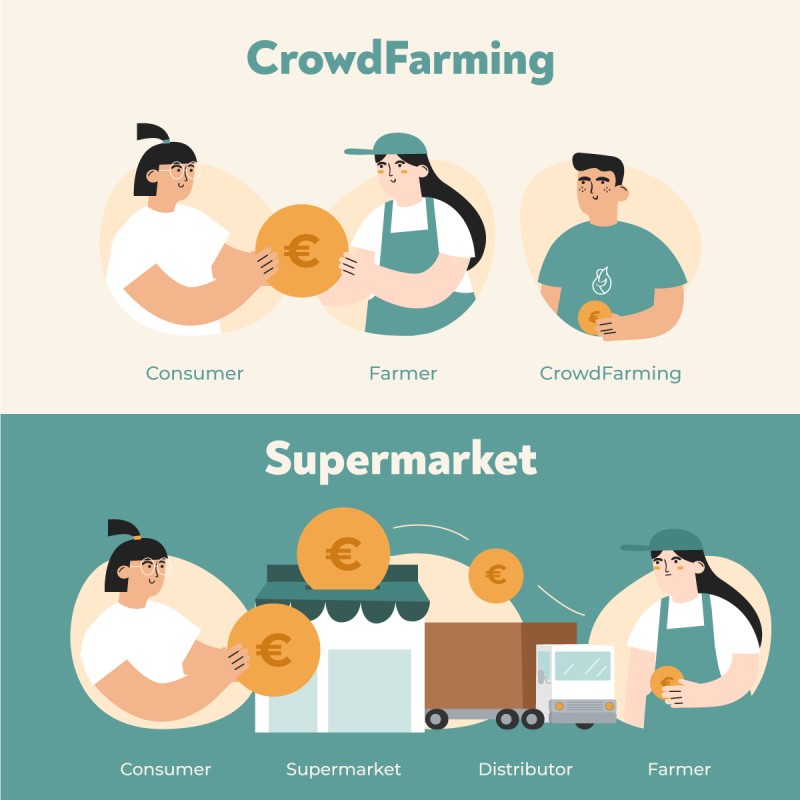
Crowdfarming is an ideal whose time has come! This website is global (and it does not appear to have many English farmers on board). But as a worldwide enterprise, presumably that’s simply because no farmers have yet signed up from here!
Basically, it’s like an online version of community supported agriculture. To keep them financially secure from selling out at a pittance to supermarkets, you can either ‘adopt’ a tree (say an apple or pear tree) and then receive your ‘money back’ when the fruit is harvested.
Or alternative, buy seasonal boxes from farmers. These are delivered direct to you, cutting out supermarkets and other middlemen profits, so the farmer gets to keep most income from his or her labours in the fields.
Why Support Crowdfunding of Farmers?
Firstly, to avoid food waste. Around 19% happens at processing and wholesale phases (and 5% at retailer end and 12% in the catering and hospitality industry). In other words, a lot of food waste is not from you forgetting that your apples have gone off – it’s mostly that millions of items are thrown away by big business for ‘not being perfect’ before they even go on sale.
Supporting farmers direct stops this. Because if you’re going to make a tasty carrot soup or a batch of banana bread, you likely don’t care if the carrots are curly, or the bananas (yes, not local!) have a few black spots on them.
Many farmers that grow food end up making a tiny profit when selling to supermarkets (who often cancel orders at the last minute).
A farmer anonymously told us how he grew 60 tonnes of salad potatoes for a large supermarket. Upon harvest, the supermarket decided they were no longer interested in that variety, and cancelled the order. Leaving a huge amount of food with no home, and the farmer financially screwed. Get Fair About Farming

The Kindest Garden is a trailblazing guide on how to use your garden as a place to restore good soil, grow good food and help native wildlife. And you can do this whether you have a large plot of land, or a shady patio garden.
Use no-dig gardening and learn of pet-friendly and wildlife-friendly gardening. Avoid facing indoor foliage to gardens, to help stop birds flying into windows.
Using lessons from farmers, foresters and rewilding experts, create a beautiful sanctuary for both yourself and nature.
Learn how the key elements (soil, water, materials, energy and plants) harness a garden’s positive eco-impact, then apply this knowledge to plan your planting, and nourish the soil.
Beautifully written with planting advice, and useful diagrams and charts, the author is a landscape architect and horticulturalist.
Regenerative Farming is gaining ground as the clear solution for healthy soil, better food and a cleaner planet. It helps repair the land, and brings farms back to life, helping all creatures from earthworms to cattle.
Healthier Soil for Stronger Crops
Regenerative farming involves rotating crops, and also keeps the ground covered, and adds compost to rebuild the soil. This leads to rich dark earth, that holds onto water and nutrients.
When the soil is healthy, we can grow stronger crops that also have more nutrition, and yield better harvests. Farms can then grow organically, without relying on chemical fertilisers or pesticides.
Boosts Biodiversity on Farms
Regenerative farms are rewarded by a lively mix of plants, insects, birds and animals. Farmers are able to plant different crops and use hedgerows, wildflower strips and cover crops, to welcome wildlife who gain from food and shelter.
Regenerative farming in turn lets farmers grow organically, and this supports pollinators like bees, butterflies, moths and bats. This creates a healthier food web, which benefits both farms and the wild spaces surrounding them.
Cleaner Water and Less Erosion
Keeping the soil covered and using no-till (no-dig) methods of farming, stops soil from washing away in heavy rain. This means that plant roots can hold the soil in place, helping water to soak in, rather than run-off (which if chemicals are used, can pollute rivers and streams, which lead to the sea).
Also by farming organically, this means that local water stays cleaner, good for people, birds and wildlife.
Carbon Storage for Lower Emissions
Regenerative farming is a big help to prevent climate change, as it stores carbon in the soil. This is done by growing cover crops, reducing ploughing (digging) and managing grazing, so plants capture carbon dioxide from the air.
Carbon then ends up locked in the ground, as organic matter. Large farms in particular can then store plenty of carbon, which helps to offset emissions.
Farm Profits Grow with Healthy Land
Regenerative farming supports small organic farmers, who put healthy soil and diverse crops, over big farms. Yet can also support higher profits.
Healthy soil cuts the need for expensive fertilisers and chemicals, so diverse crops can be sold year-round, bringing in a steady income. This shields small farmers from risky price drops, or crop failures.
Better Food Quality
We all know that local, season and organic food tastes better! And it’s better for us, as well as for the soil and surrounding wildlife. Regenerative food tends to have more nutrients, due to healthy soil. And better flavour.
Stronger Communities and Rural Life
Unlike big supermarket crops, regenerative farms can support thriving rural communities. It makes use of proper labour and skills, and hires local farm helps, and keeps money in the local economy.
Local people also can visit, and learn where their food is from. Encouraging regenerative farming helps to keep local farming communities thriving.
The Many Benefits of Regenerative Farming
An organic farmer may use ‘organic methods’ to kill weeds. A regenerative farmer is more likely to use methods that natural deter weeds in the first place, through no-dig methods that attract worms (who do most of the work).
Soil releases huge amounts of carbon dioxide, so no-dig farming and regenerative agriculture can help to stop this. Keeping trees intact also helps to reduce flooding.
You can even use no-dig methods to plant trees (leaving soil undisturbed around the root). Due to dispersing seeds, more trees even increase rainfall, very important if using climate smart agriculture in drought countries like in Africa.
The 5 Principles of Regenerative Farming
The organisation Groundswell is at the heart of promoting regenerative farming methods, and has developed 5 principles for all farmers to use:
- Don’t disturb soil. By using no-dig methods and avoiding heavy ploughing and chemicals, good soil can recover.
- Keep soil surface covered. This is where good mulch and layered gardening helps, to avoid disturbance from rain, sun and frost.
- Feed living roots. This keeps underground networks healthy, where plants turn carbon dioxide into sugars. Cover crops is the best way to do this, to avoid bare soil.
- Grow diverse crops. Monocultures (that grow the same crops on land each year) end up needing chemicals, but regenerative farming uses crop rotation and companion planting (crops are grown together to deter unwelcome visitors).
- For livestock farming, have free-range grazing animals. Even if you’re not vegan, all sustainability experts say that everyone needs to eat far less meat.
Kiss the Ground is a US film (narrated by ex-Cheers actor Woody Harrelson who is now a climate campaigner). Available for free school screenings, it shows how regenerative farming and restoring good soil is one of the best ways to reduce climate change and restore healthy food and farming systems.
100 Million Acres is a common project, to restore our soil in the US, transforming 10% of the USA’s millions of acres of land over to regenerative farming. It would be great is someone set up a similar project in England.
Devon’s eco-retreat centre of Embercombe is one of the first places to showcase regenerative farming. This 50-acre rewilding estate includes a lake, mature woodland and scrub, meadows and orchards, all home to badgers, foxes, birds, rodents, snakes, trees and wild flowers. It also offers an in-depth rewilding course.
Healing Communities with Regenerative Farming
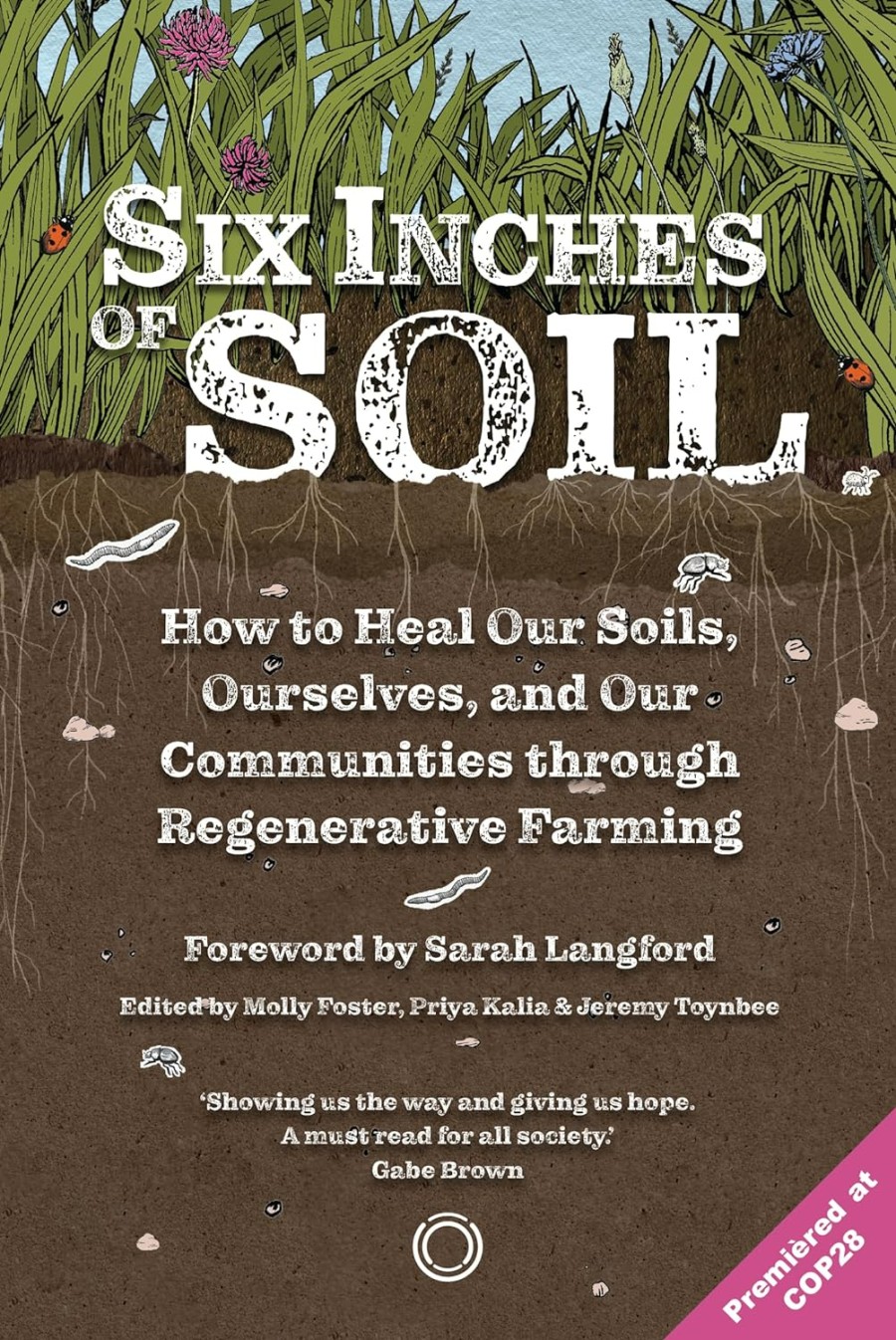
Six Inches of Soil is the story of how we must transforming our landscapes from industrial farming to better crop yields and food security, by restoring ecology of our soil.
A book to accompany the documentary film, this is the inspiring story of three farmers who are standing up to industrial food system, by transforming the way they grow food.
The book details problems with the current food system and proposes solutions for the future. It considers soil science and land use, ‘greenwashing’ and food security (access to good food, no matter where people live).
Follow farmers on their first year of their journey to heal the soil in Lincolnshire, Cambridgeshire and Cornwall.
See them meet seasoned mentors to help them on their journey to heal a broken food system and farm on landscapes degraded by industrial agriculture, and learn how to reconnect people to the soil where food grows.
Not shying away from exploring connections between food and health, food poverty and the role of animals in farming, the book also looks at Britain’s unequal system of land ownership and barriers to farmers from diverse backgrounds, and carbon offsetting on farms. For more information, download the resources at Six Inches of Soil.
Why Free-Range Supports Regenerative Farming

At present, most farmland worldwide is used to grow crops (like maize for animal feed) or biofuels. But we could solve world starvation by growing high-protein food crops for humans in developing countries (teff is high in protein and needs little water, ideal to reduce famine).
The UK presently has almost 2000 intensive (factory) farms, where aside from animal welfare issues, antibiotics are used that result in poor human health too.
Animals raised on regenerative farms have better lives as they have natural space and shelter, eat natural foods (like grass) and are looked after by small-scale farmers, who know what they are doing.
Eating local also has beneficial effects in a country where we import almost half our vegetables and nearly 90% of fruit (often from countries using intensive systems, due to lack of fresh water).
Local organic food means less plastic packaging, less oil (25% of road traffic is from lorries driving food from central distribution houses to big supermarkets) and better welfare (some farmers are transfarming over to profitable crops like oats, leaving remaining animals to live out their lives in peace).
Ceres Rural is a regenerative agriculture consultancy, that can help you transition over.

Transfarmation is a new and exciting area of agriculture, where plant-based farmers are helping livestock farmers to ‘transfarm’ over to a new way of farming, by growing more profitable crops like oats (for the huge oat milk industry).
This way farmers retain long-held family farms, but embrace the new plant-based movement. Remaining animals are then not over-bred, but instead still graze the land, and live akin to animals in a farm sanctuary, just living and enjoying life, as God’s creatures.
The Swiss farmer (helping others to transfarm’)
Sarah Heiligtag is a Swiss vegan farmer, who after receiving a phone call from a struggling dairy farmer (racked with guilt at sending his animals to slaughter) asked her for help. He asked if there was any way he could make money, and she said yes.
Today Sarah has helped over 100 farms go vegan, but ‘transfarming’ their land over to growing more profitable crops like oats (the animals remaining simply live out the rest of their lives in peace).
Sarah and her husband (along with a friend) founded an animal sanctuary near Zurich, designed to help educate on plant-based agriculture, as well as be a haven for rescued creatures.
It almost accidentally then became a contact point for farmers, who are interested in livestock-free agriculture:
If you are a farmer and have questions about farming without ‘farm’ animals or about setting up a life-saving farm, do not hesitate to contact us. We will be happy to advise you, with no obligation.
In the end, the goal is for you to be able to do what really fulfils you, and be true to your true self.
Read stories of farmers who gave up farming animals, to grow plants instead. These include a couple who became the first UK beef farmers to transition to an organic permaculture farm and vegan cooking school, and two couples in Switzerland (one now grows oats to make plant milk, the other grows chickpeas to make local hummus!)
5 Easy Ways to Stop Factory Farming

Transfarmation is a book by the president of US charity Mercy For Animals, showing how food and farming have failed over decades, and how factory farmers, rescued farm animals and rural communities are now being transfarmed into new starts.
- Meet a family farm that was crushed by factory farming who instead now have transitioned to growing hemp and rescuing dogs.
- Meet Norma the former industrial dairy cow who was was almost killed, after injuring a worker in an effort to protect her calf.
- And communities that pollute historically black areas with air and water pollution from hog farms. And how we can stop this to create a compassionate food system.
Transfarmation is a farming revolution, that holds the promise of a more efficient and sustainable future for agriculture.
Rather than ‘vegans vs farmers’, they are getting together to create local sustainable food, so your oat milk can be delivered in glass bottles from the local friendly organic farmer, rather than shipped in Tetrapaks from the other side of the world.

The Tiny Farm Planner is an illustrated planner and record keepers that’s ideal for small farmers, veg box schemes, community gardeners and community gardeners.
Manage your tasks by season using the checklists, tracking planting dates to chore lists and yield/harvest times. It includes record pages for soil test results and handy growing tips.
Read our posts on no-dig gardening and wildlife-friendly gardening.
If selling flowers and plants, learn about pet-safe gardens, to educate customers. Never face indoor foliage to gardens, to help stop bird strikes.
Farmers need a government license to sell to the public (also buy liability insurance). Know food hygiene rules and read up on food safety for people and pets.
If you dream of fresh organic food grown just steps from your back door (and are stuck in a job you don’t like), why not provide food for local people, and start your own tiny organic farm?
More people are seeking empowering ways to take back their lives, to do something they love. If you fancy yourself as a bit of a Good Life dreamer, why not turn that dream into reality?
You likely won’t make a lot of money, but you’ll probably make enough to survive with local support, you will be able to feed yourself, and have few overheads, if you keep things small and local.
People increasingly wish to buy local organic food, and support local farmers. And the idea of producing more food with less space, makes even more sense now, than ever.
The Unique Appeal of Tiny Organic Farm
What’s not to love? You get to grow your own organic food and feed your community, and local people can buy fresh seasonal organic produce at a lower price, with no plastic packaging. And keep money circulating in local communities.
A tiny farm is usually a plot of less than 2 acres. It could be a small field, or even a handful of raised beds in someone’s backyard. Unlike large farms, these plots rely on close care and hands-on growing, rather than heavy machinery and high costs.
Tiny farms require no storage barns or tractors, and usually sell direct to customers, or work with local veg box schemes and farmers’ markets to sell their wares.
Land, Resources, and Certification
Begin by choosing the right land. You can even use a medium-sized garden as a micro-farm, as long as it’s sunny and drains well. Good soil is the key point, so if not already good, you’ll need to build this up, to grow good food.
Most veggies and herbs need at least 6 to 8 hours of sun each day, and regular watering is essentially (especially in warm months). You’ll need to test your soil for nutrients, and consider adding organic matter, on a regular basis.
Choosing Crops for Tiny Organic Farms

Compact Farms is a book of 15 illustrated vegetable farm plans, on 5 acres or less of land.
Choose crops that give the best return for your time and effort, and fit with local demand. If you planning to grow local organic food in an urban inner-city space, selling common veggies like carrots are likely going to sell better than ‘Waitrose-type’ spring greens. But a big hearty cabbage will likely also sell well.
Popular choices for tiny organic farms are:
- Vegetables: Salad leaves, tomatoes, courgettes, beans, beetroot.
- Herbs: Basil, parsley, coriander, chives (be careful, can over-grow)
- Fruits: Strawberries, raspberries, dwarf fruit trees in pots.
Consider what grows well in your climate, and how fast a harvest you want.
Organic Farming (on a small scale)
Organic farming works best when you feed the soil, not just the plants. On a small farm, every detail counts. Crop rotation (swapping what you grow each season) helps to keep the soil healthy. And turn food waste and plant clippings into rich natural fertiliser.
Stick with certified organic seeds for best results. Start small and use good techniques, and your harvest will be richer and quicker.
Organic farming also means nature and wildlife will take care of unwelcome guests. For instance, ladybirds eat aphids, so you won’t need chemicals to remove them.
Selling Produce from Tiny Organic Farms
Once you have grown your food and taken what you need, it’s good to learn how to store your farm produce, so you don’t waste any that you don’t sell immediately.
It should be pretty easy with some good design and marketing, to get the word out about your tiny organic farm. People love to buy affordable produce that is locally grown. As well as selling at markets, you could approach local cafés, pubs, or shops to sell wholesale.
Start a No-Dig Organic Vegetable Farm
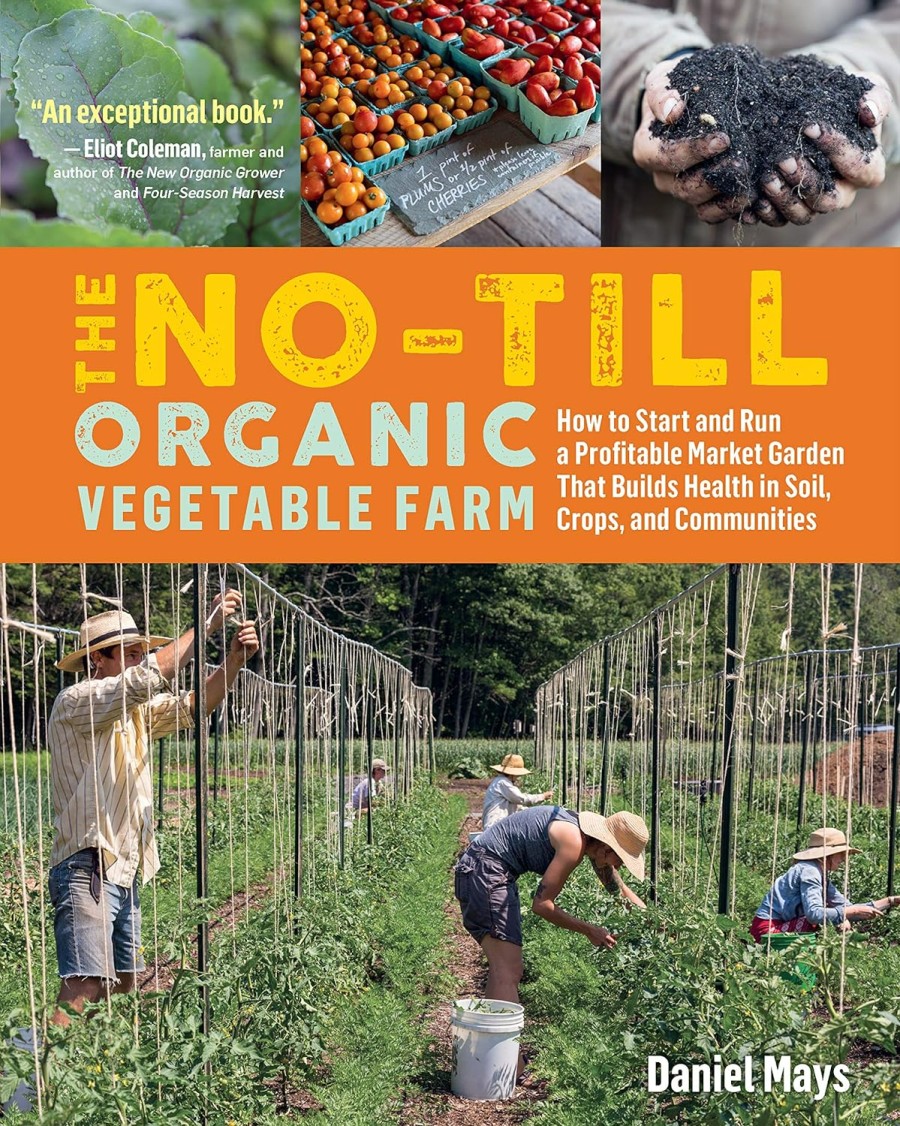
The No-Till Organic Vegetable Farm is an ideal read for farmers and community gardeners, to reduce weeds, use inter-planting to increase resilience, and create hedgerows and beneficial insect habitats, along with tips on finding customers to buy your produce.
The book covers:
- Science & Soil Health
- Start-up Costs & Land Search
- Establishing Beds
- Crop Planning
- Water Resilience
- Preventing Weeds & Manual Weeding
- Harvesting & Marketing
- Attracting & Retaining Employees
- Planning & Recordkeeping
- Agriculture-Supported Communities
I began the farm with a loan of $180,000 and an interest rate of 3.8%. Four years later, the farm grossed over $250,000 in a season. Today, the farm sells about $300,000 of food each year from 2.5 acres of vegetables. All profits are reinvented in the farm.
If you want to farm for a living, I highly recommend reading this book. It is one of the best guides for serious growers that I know of. Ben Hartman
Also read this book on how to build your own farm tools. Set up a workshop and make 15 tools including simple seedling benches, a mini barrel washer, a DIY germination chamber and a rolling pack table.
Plus learn how to design an effective drip irritation system. Daniel Mays (who has a degree in environmental engineering) runs a no-till farm in Maine (USA) that produces food for hundreds of local families on three acres of land.
More Help for Tiny Organic Farms
- Sustainable Market Farming is a guide to growing food organically, by someone who feeds a community of 100 people on just a few acres of land in Virginia, using disease-resistant varieties of crops and organised business skills.
- The Farm Carbon Calculator is a free toolkit that takes up to 2 hours, to help save carbon and therefore money. Developed by a Scilly organic farmer, it can be used for any scale or soil type.
- MudControl slabs turns muddy dangerous land into safe places eto pass through, or eat hay. They are used with sand for easy installation.
- The Farmer’s Office is a book to help farms get more profits (which means better welfare for animals as it costs money to buy feed and good housing).
- Agritourism is money made from renting farm buildings to holidaymakers (don’t let dogs near livestock). WWOOF offers free board and food in return for volunteers who get knowledge and experience (this is active learning, not cheap labour).

Nature-friendly farming is gaining traction as farmers across the globe recognise its vital role in sustainable agriculture.
This approach not only enriches the environment but also fosters community resilience and supports farmers’ livelihoods. For farmers looking to enhance their practices, joining a nature-friendly farming network can be a transformative step.
If you’re a farmer, you can find lots of tips and help at the farming tag. Also consider joining the Nature Friendly Farming Network. Over 70% of our land is agricultural, so farmers are so important to food security and environment, so let’s support farmers not given good treatment by supermarkets.
Some of us are vegan, but most people aren’t, and there is no point pitching one against the other. We need to ringfence all organic and free-range small-scale farmers, so the food is as ethical as it can be, it’s not dominated by big supermarkets and big government (often influenced by sponsors and lobbyists) and we get back to producing local food for local people.
The organisation was founded by an arable farmer in Cambridgeshire with a special interest in conservation management.
The network is growing with many members and the site has a huge amount of free downloads and information on the website to enable farmers to be more resilient to changing weather patterns etc.
Such advice also helps to reduce carbon emissions and protect habitats for native wildlife. And also grow better food, which means more profits for small farmers.
You don’t have to be a certified organic farmer to become a member, you will be supported at whichever step of the journey you are. The aim is to create a nation of sustainable agriculture and long-term food security. This also contributes to cleaner air and water, and less floods & droughts.
Grazers is a good company from Yorkshire, which offers lots of nontoxic products to deter rabbits, pigeons, deer, slugs/snails and aphids, all using nature-led methods.
Also visit Farm Wildlife to learn how to protect existing habitats, create field boundaries and wet features, and habitats for seeds and flowers, all of which is better for wildlife. Also find wildlife-friendly farming experts.
The Hare Preservation Trust advises to break up blocks of cereal and provide more grass for grazing on arable farms and run wide strips of grass on open fields (or have pasture patches). It’s important that hares can raise leverets in quiet undisturbed areas, so leave areas uncut and un-grazed for hiding.
If making silage, cut the field from centre outward so hares can escape. And leave ploughed or rough-cultivated areas left so hares can sleep. Leave 6 metre uncultivated margins around arable fields and leave cereal stubbles over winter.
Join the Fair Farming Campaign
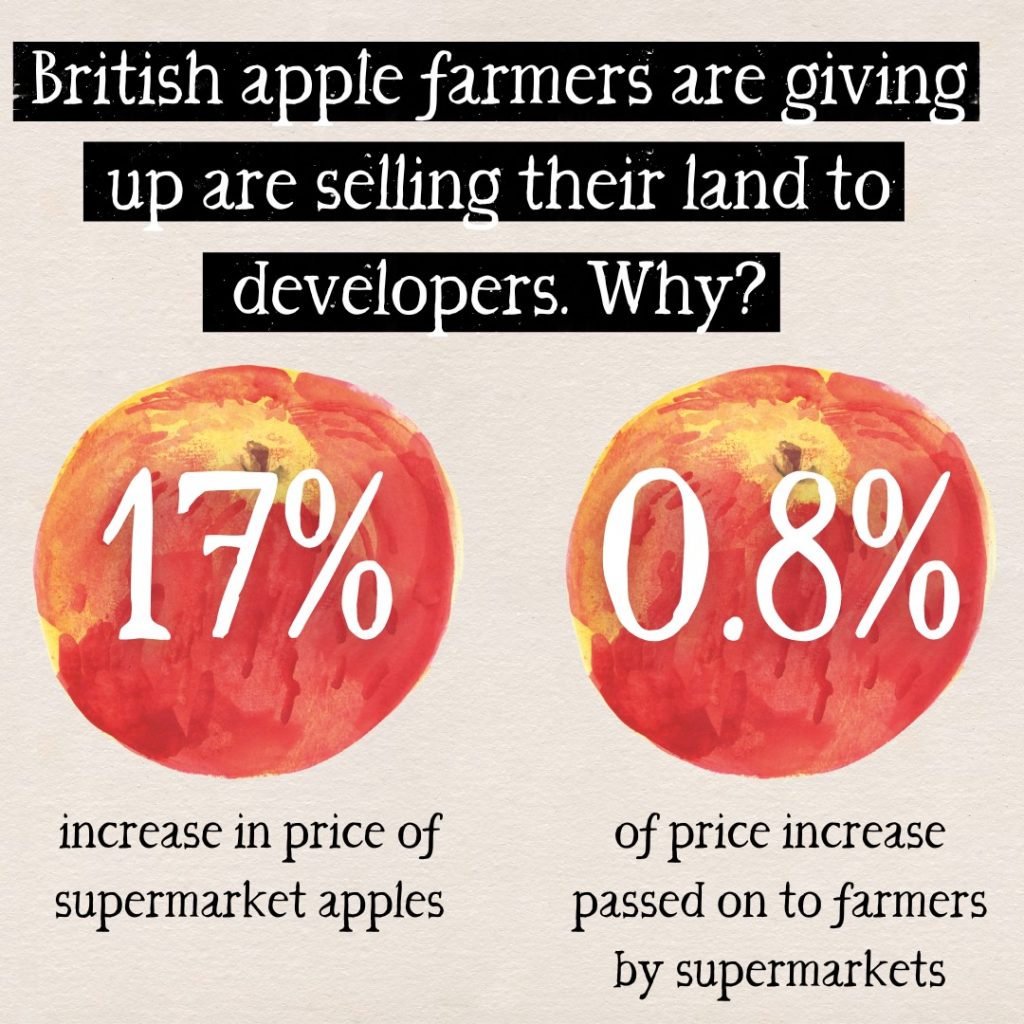
Get Fair about Farming is a campaign began, after learning that 75% of fruit and veg farmers are scared they may fold within a year, citing supermarkets as the main cause.
The founder has written an open letter to the big six supermarkets, asking supermarkets to:
- Pay on time (not up to 12 weeks, illegal in the rest of Europe)
- Not wiggle out of contracts.
- Pay what is agreed. One farmer grew 60 tonnes of salad potatoes, then was told they were no longer needed, leaving him ‘financially screwed’.
The price of supermarket apples has gone up 17% (yet the cost of growing them is far more, yet farmers see little extra payment). This also means more will be imported, bad for our endangered orchards, bad for farmers and bad for the planet.
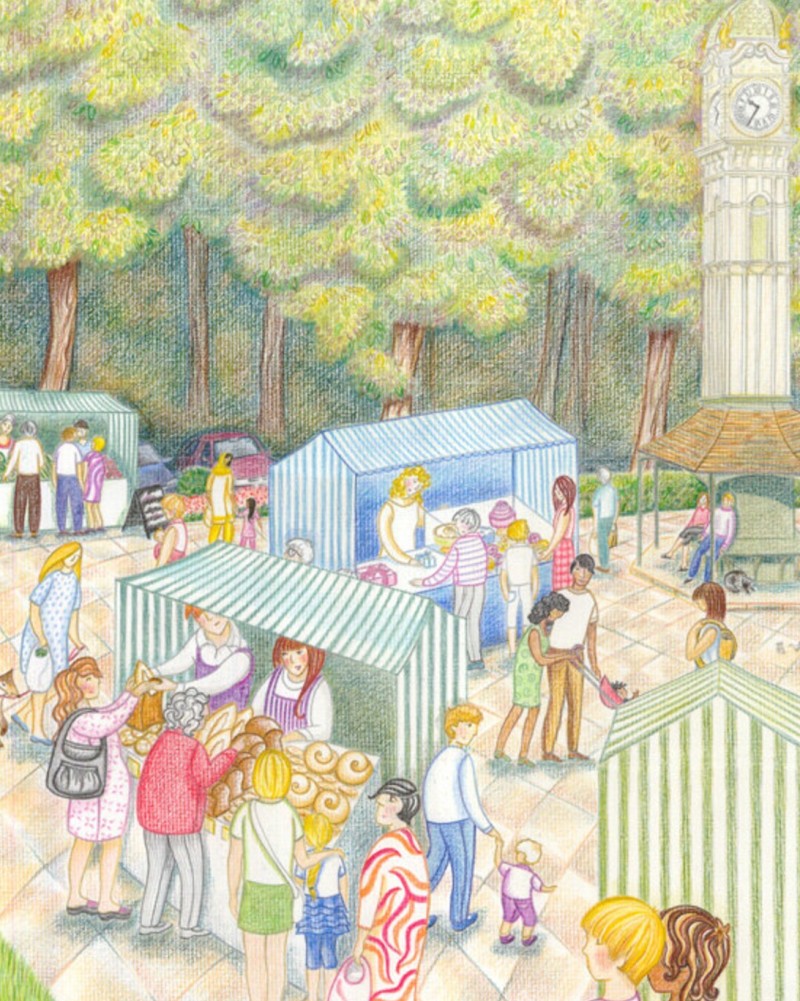
Farmers’ markets thrive in many countries abroad, including in the New York state of Ithaca, which has a wonderful book of how their markets thrive, to inspire. More than just places to buy food, farmers’ markets offer a direct link between farmers and their customers, cutting out middlemen for more farmer profits, lower food miles and less plastic packaging.
London Farmer’s Markets operate in many boroughs. You won’t find pots of olives (not local!) but you will find local organic apples and cherries!
Surbiton Farmers’ Market (Surrey) has raised over £60,000 for local shelters, hospices and carer networks by match-funding money raised and offering a free stall for charity volunteers. Thanks to them, a local cancer ward has been refurbished, blind people have gone on day trips, carers enjoyed an ice-skating trip and a homeless shelter received books.
Farmers need a government license to sell at markets (and liability insurance). Know food hygiene rules and read up on food safety for people and pets.
If selling flowers and plants, learn about pet-safe gardens, to educate customers. Never face indoor foliage to gardens, to help stop birds flying into windows.
Once home, just bin allium scraps (onion, garlic, scallions, chives, leeks) along with rhubarb/tomato/citrus scraps, as acids may harm compost creatures.
Shorter Supply Chains and Peak Freshness
Fresh produce sold at supermarkets usually is not local (even if it’s grown locally, often it travels to central distribution houses before being returned to supermarket shelves). When you shop at a farmers’ market, often the produce has been harvested that day, or the day before. From a few miles away.
Buying local produce means it has fewer food miles (so less traffic on the road), most produce is organic and it tastes better, and is more affordable.
The person who is selling you the produce knows about it, because they grew it! So can often tell you the differences between different types of apples or cabbages, and may have some useful recipe tips!
Keeping Money in the Community
Supermarkets may well bring in ‘jobs’ and ask you to put tokens in community charity boxes. But most profits for the big guns go to shareholders, not to locally-run shops and farmers.
A farmers’ market is likely rented out by councils or social enterprises. So the rent is going to be spent making your own a nicer place, not to fund head office of a major store. Local traders likely eat their lunch at the local pub or sandwich shop, and will order a sign from the local signwriter. Just spending £5 a day locally in a town, can generate millions of local town income.
A recent report by Sustain found that the average farmer growing 1kg of carrots gets little more than 1p in profit, despite them costing 19p or so to grow, and the carrots selling for around 69p a bag. That means supermarkets are making more profit than the farmers.
Meeting the People Who Grow Your Food
A worrying survey among young schoolchildren, found that many had no idea where their food came from. Some had no idea that potatoes grew underground, and even thought cheese grew on trees!
Taking children to farmers’ markets, lets them meet the very people who grew the food. They can ask questions on how tomatoes grow, which produce is seasonal, and parents and adults can even swap tips, with the farmers who actually harvested the carrots from the soil.