Waterless Car Washes (how they help to stop oil spills)
A car wash can feel harmless. Soap, water, a quick rinse, job done. But that dirty water rarely just disappears.
When you wash a car on a drive, a kerb, or a roadside, the runoff can carry oil, fuel, grease, brake dust, soap and road grime into street drains. In many places, those drains lead to streams, rivers, or coastal water. That means everyday cleaning can add to a much bigger pollution problem.
This is where waterless car washes stand out. They don’t just save water. They can also cut oily runoff at the source, before it reaches the drain.
If you own a car, read our posts on greener driving tips and safer roads for wildlife. But one other way to help the planet, is by switching how you wash (and valet) your vehicle.
Conventional car washes on the drive or in supermarkets are not good, as oily water goes untreated down storm drains, and into the sea. This causes oil spills, which harms marine wildlife. Either use an eco-friendly car wash company, or switch to a waterless car wash.
Another reason to avoid supermarket car washes, is concern over worker welfare, often paid below minimum wage without protective clothing. If you book one, use Safe Car Wash app.
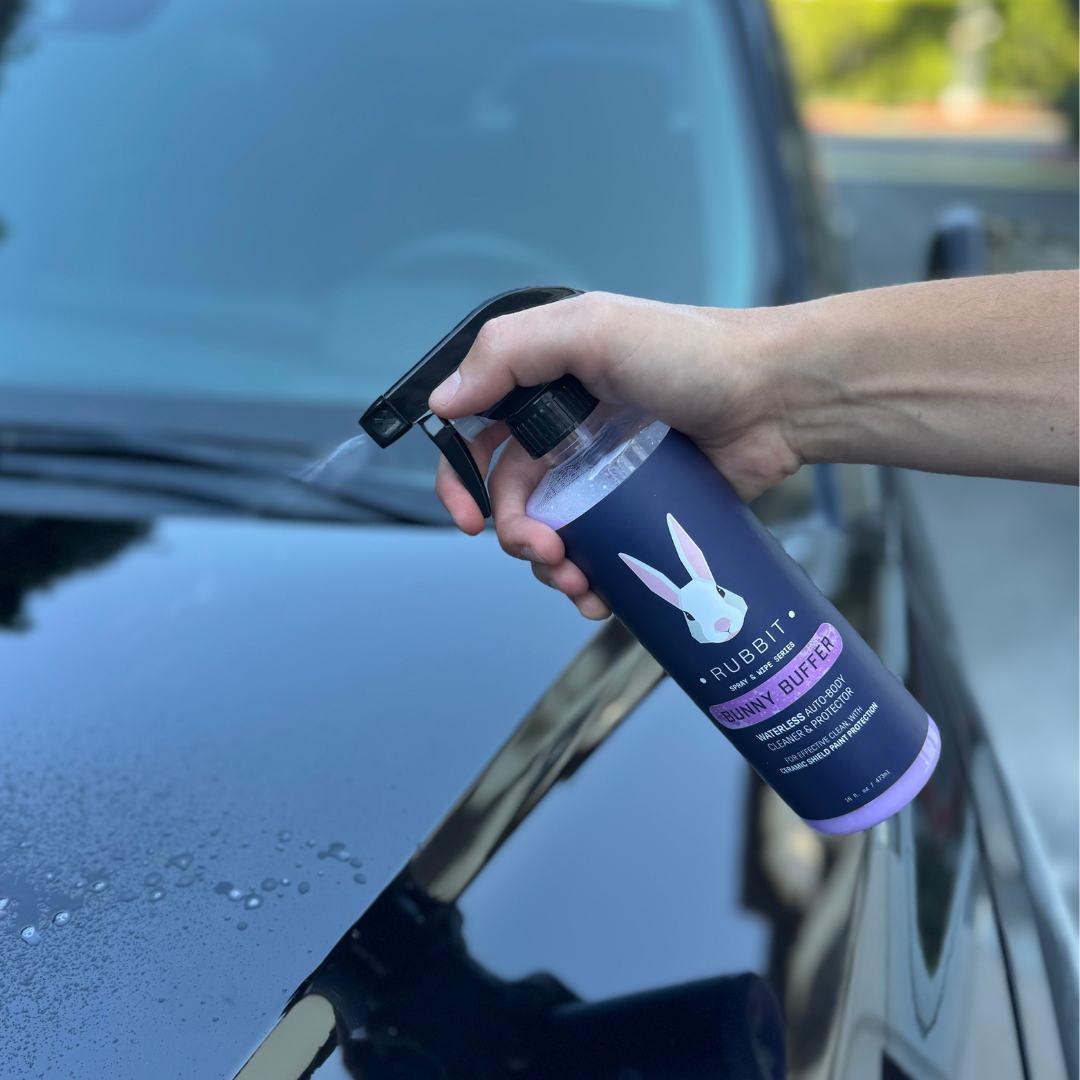
Rubbit is a kit to clean cars without water, designed by two airline pilot, who worked with chemists to design a foaming formula, to absorb dirt and be wiped, without rinsing. If you wash your car every two weeks, this kit saves over 3000 gallons of water.
Just soak the included Microfiber towels in a budget of water (the detergent has already washed them, so no need to launder in the washing machine).
The company also makes eco-friendly dissolving windshield window tablets (give the air-fresheners a miss, they are made with fake scent). Instead use charcoal purifying bag that are scent-free, so good if travelling with babies, pets or allergies).
How washing a car with water can help oil pollution spread
A car picks up more than mud. It also collects a thin film of oily dirt from roads, traffic and wear. When you hose that off, the water has to go somewhere.
On a driveway or hardstanding, it often runs straight towards a street drain. From there, the mix can travel into local water without much cleaning on the way. One wash won’t look dramatic. Still, small amounts add up when thousands of cars are cleaned this way.
That matters because oil doesn’t need to pour out like a tanker spill to cause harm. A faint smear under one car, a greasy patch around another, a bit of leaked fuel near the wheel arch, all of it can join the wash water. Then the hose does the moving for you.
What gets washed off a car and into the drain
Some of this pollution is easy to spot, like greasy marks or black residue on lower panels. Some of it isn’t visible at all.
Common wash-off includes engine oil, fuel residue, grease, brake dust, tyre particles, soot, dirt and strong detergents. Brake dust can contain metals. Tyre wear leaves tiny particles behind. Even a shiny-looking car can still hold a grimy film.
Because the dirt mixes with water, it can look mild. In reality, it’s a bit like stirring a stain into a bucket. You don’t see a slick anymore, but the pollution is still there.
Why storm drains are not the same as water treatment systems
People often assume all drains lead to a treatment plant. Many don’t. Surface water drains usually move rainwater, and anything in it, away from roads and pavements as fast as possible.
A storm drain is often a shortcut to local water, not a cleaning step.
Think of a car being washed outside a block of flats. The water runs along the kerb, drops into a grate, and heads into a nearby stream. It may pass through little or no treatment. So if oily residue goes down the drain, it can end up in the watercourse not far away.
How a waterless car wash helps stop oil spills before they start
A waterless car wash works in a different way. Instead of flushing dirt off the car and onto the ground, the product softens and lifts light grime so you can wipe it away with a microfibre cloth.
That change is simple, but it matters. When there is no hose and no bucket of dirty rinse water, there is far less polluted runoff. The dirt stays on the cloth, not in the street. In other words, the mess gets contained.
Good waterless products also add lubrication. That helps the cloth glide over the paint when the car is only lightly or moderately dirty. You’re not washing pollution into the drain. You’re picking it up by hand and dealing with it properly.
Less runoff means less oily water reaching streets and streams
The main gain is straightforward. Less runoff means fewer chances for oil and grease to travel across concrete and tarmac.
With a traditional home wash, water acts like a conveyor belt. It grabs whatever sits on the paint, wheels and underbody edges, then carries it into the drainage system. A waterless wash breaks that chain. No rinse water, no oily puddle, no trail towards the nearest grate.
This is especially useful in built-up areas, where hard surfaces dominate and water has nowhere to soak in. On a city street, runoff moves fast. In a car park, it can spread across a wide area before draining away. A waterless clean keeps that contamination small and localised.
It also changes habits a little. When people stop thinking of a hose as the default, they often become more aware of what they’re removing from the car in the first place.
Cleaning by hand can help spot leaks before they become bigger spills
There’s another benefit, and it’s easy to miss. A wipe-by-wipe clean makes you look closely at the car.
While working around the sills, wheels and lower panels, you may notice fresh oily marks, greasy build-up or fluid splatter. You might see a damp patch under the engine area, or residue near a wheel that wasn’t there last week. That kind of early warning matters.
A hose can wash over a problem. Hand cleaning slows the process just enough to reveal it. Then you can act before a small seep turns into a stain on the road or a larger leak on your drive.
So a waterless wash doesn’t only reduce runoff. It can also help prevent future spills by catching faults sooner.
When waterless washing works best, and how to do it safely
Waterless washing works best for regular upkeep. It’s a maintenance clean, not a rescue job for a car coated in thick mud.
If the vehicle is heavily soiled, a rinseless wash or a professional wash bay may be the better option. That gives grit less chance to drag across the paint. Balance matters here. The goal is cleaner paint and less runoff, not shortcuts.
The right time to use a waterless wash
This method suits lightly to moderately dirty cars, especially ones cleaned often. It’s handy in urban areas, in flats with no hose access, and in places where water use is under pressure.
It’s also a good fit for drivers who want to cut runoff at home. If the car mostly has dust, fingerprints, traffic film and light road grime, waterless products can do the job well.
On the other hand, after off-road use, winter slush, or heavy mud, don’t force it. In those cases, grit is the problem. A safer first step is a rinse or a controlled professional wash.
Simple tips to make it effective and paint-safe
- Work in the shade, on cool panels, so the product doesn’t dry too fast. Spray enough to soften the dirt. Then wipe gently in one direction, rather than scrubbing back and forth.
- Use clean cloths and change sides often. Once a section of cloth looks dirty, swap to a fresh side. That lowers the risk of rubbing trapped grit into the paint.
- Afterwards, wash the cloths properly, separate from lint-heavy items. Skip fabric softener, because it can reduce their grip. With the right routine, the process stays simple, quick and kind to the finish.
- Waterless car washes do more than save a few litres. They help stop oily runoff from reaching drains, streets and local waterways. That’s the real point.
- Used in the right way, they’re a practical way to cut small, everyday pollution before it spreads. Cleaner car care won’t solve every water problem on its own, but it does help. And often, cleaner rivers start with smaller habits on ordinary drives.
Removing Bird Poop Off Car Paintwork
Remove this immediately to avoid burning paint (and scratches, due to containing seeds). mix 4 tablespoons of baking soda in a litre of warm water, shake to mix and spray from a bottle. Leave to soak for 10 minutes, then rinse off with a wet cloth or hose.
To prevent birds pooping on your car (apart from not parking under trees!), a survey found that birds hardly ever poop on green cars (nobody is sure why!)
How to Valet Your Car, Naturally

- Use a car trash bag to store rubbish, until you get home. Never throw it out the window (this attracts scavenging wildlife, putting them in danger of traffic).
- Use plastic-free cloths and sponges with biodegradable unscented cleaner. Absorb odours with a charcoal purifying bag (if you smoke, do so outside the car, and use a personal ashtray to safely extinguish butts, until you find a bin).
- Avoid de-icing sprays (use a windscreen cover or park your car facing east, to naturally defrost in the morning). Or rub half an onion on the screen the night before (the oil lines the glass to stop freezing – keep onions away from pets).