Wild cousins, wonderful creatures: exploring animal families
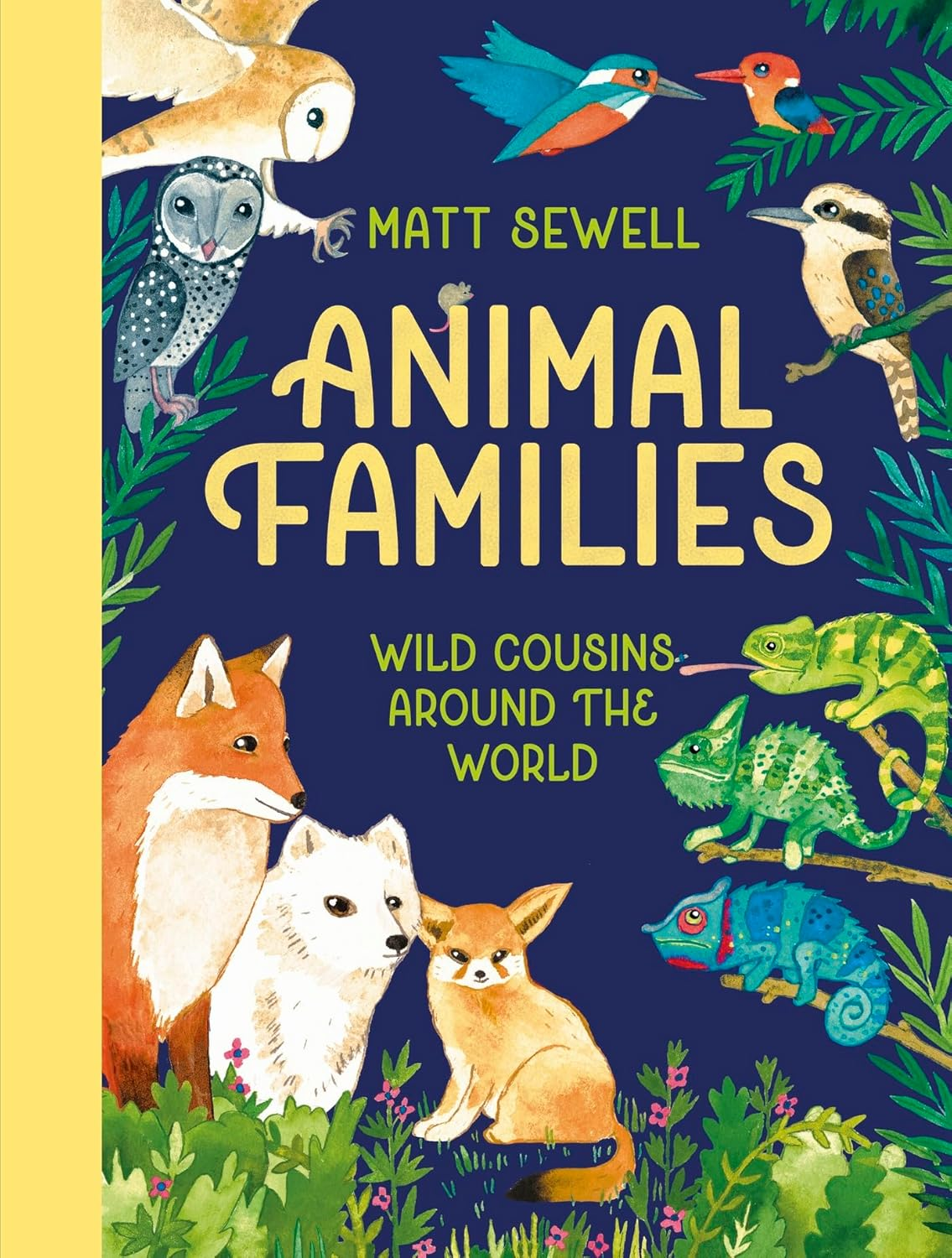
Animal Families is a wonderful read by pop artist Matt Sewell, teaching children how to spot family resemblances, some of which are rather surprising!
You likely know that the blue-and-orange river kingfisher is related to Australia’s laughing kookaburra. But did you know that that the there are 21 fascinating animal families to read about, from the fox and bear families to dolphins, owls and cobras.
Some species (like the elephant and hummingbird hawkmoths) may not live near each other, but are part of the same family. The South American coati belongs to the same family as the North American raccoon!
Other creatures that are (surprisingly) related to each other are:
- Woodlice are the land cousins of prawns and shrimp
- Elephants and manatees (‘sea cows’ that also have trunks!)
- Chickens descend from dinosaurs!
- Whales and cows are apparently distant cousins!
This is a beautiful, beautiful book! You’ll learn about the eight species of bears (and which order they belong to), you’ll learn how dolphins are mammals (so need to breathe) but can hold their breath for up to 7 minutes. And how foxes often get an undeserving reputation, they are to be admired!
From goldfinches to chameleons and from raccoons to tiger beetles, by the time your child has finished reading this book, you will have a little David Attenborough on your hands!
Matt Sewell is one of England’s most popular authors on birds and wildlife, combining his funny commentary and expert knowledge, with lovely pop-art illustrations. His work is displayed worldwide, and his bird illustrations are even on Isle of Man stamps!
Five illustrated tales of animal families
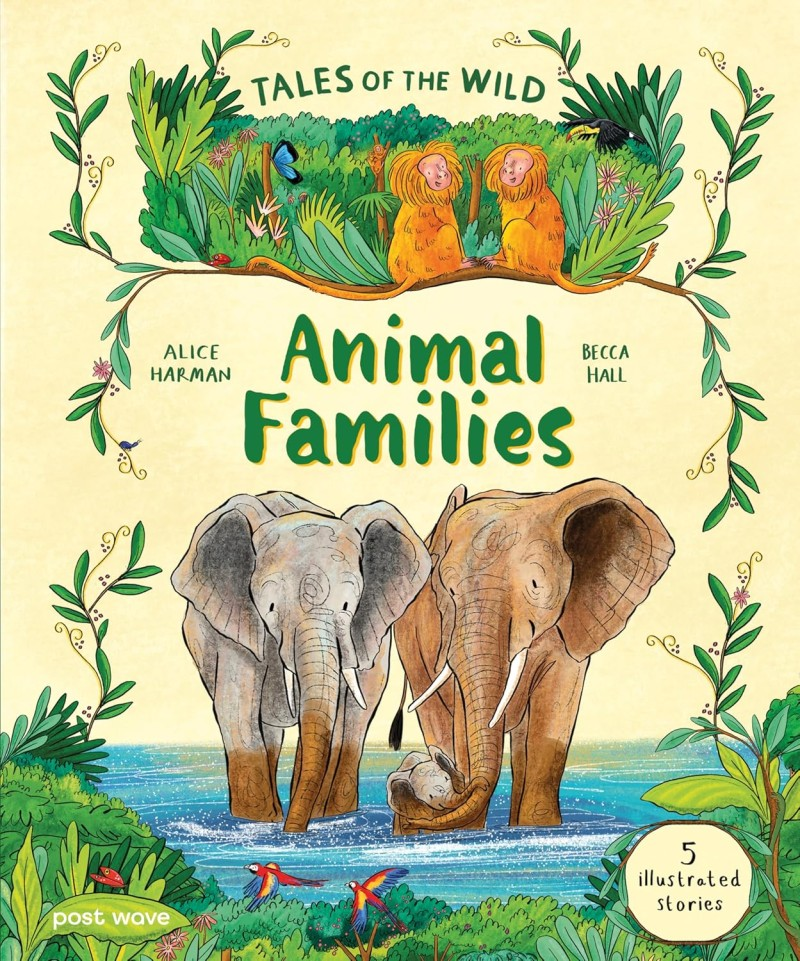
Animal Families is a book of five illustrated stories, to teach children about relationships between various creatures. It also shows how they navigate the challenges of survival in the wild.
With themes of conservation, climate change and rewilding woven throughout (and non-fiction pages after every story), each tale is as educational as it is heart-warming:
- In the suburbs, a red fox encourages his subs to take their first steps towards independence.
- In Botswana, an elephant matriarch must trust the youngest member of the herd, to find water.
Becca Hall is an illustrator originally from the Lake District, who now lives in Cornwall. When not in the studio, she enjoys surfing and hiding in a cosy tea room with a cuppa and slice of cake!
What does it mean to be animal cousins?
When we call two animals ‘cousins’, we are talking about evolutionary relationships rather than family relationships in the human sense.
Species that share a common ancestor are related. Some share a relatively recent ancestor, while others may have diverged from one another millions of years ago.
For example, lions, tigers, leopards, and domestic cats belong to the cat family. They are different species, but their similarities provide clues about their shared evolutionary history.
The same idea applies across the animal kingdom.
Humans are primates, making us relatives of other primates. Dogs are related to wolves and foxes. Whales and dolphins belong to a group of marine mammals known as cetaceans.
Instead of thinking about evolution as a complicated diagram, children can imagine an enormous family tree with branches spreading in different directions.
How scientists discover animal relationships
How do scientists know which animals are related? They use many different kinds of evidence.
- Physical characteristics provide some clues. Scientists can compare bones, teeth, body structures, and other features between species.
- Fossils provide another important source of information. Fossilised remains allow researchers to study animals that lived long ago and compare them with species alive today.
- Modern scientists can also study DNA. Genetic information can reveal relationships that may not be obvious from appearance alone.
This is particularly useful because animals can evolve similar characteristics independently.
For example, sharks and dolphins both have streamlined bodies that help them move efficiently through water. However, sharks are fish, while dolphins are mammals. Their similar body shapes are adaptations to life in the same environment rather than evidence that they are close relatives.
The big cats: share many characteristics
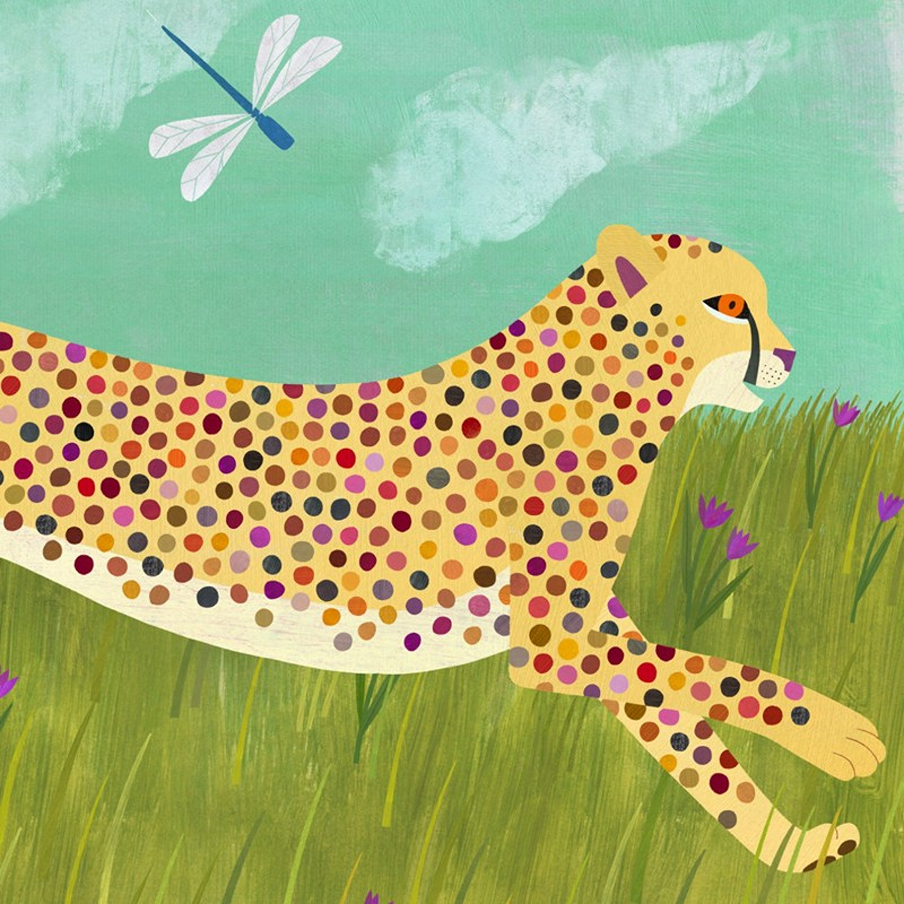
Lions, tigers, leopards, and jaguars are all members of the cat family. They share many characteristics, including powerful bodies, sharp claws, strong jaws, and specialised teeth. Yet each species has developed its own adaptations.
Lions are famous for living in social groups called prides. Tigers are generally solitary and are excellent swimmers. Leopards are highly adaptable and can live in a variety of habitats. Jaguars are powerful predators associated particularly with the Americas.
Their differences make them fascinating, but their similarities reveal their family connections. Even the domestic cat sitting on someone’s sofa belongs to the same broader family.
This is one of the most enjoyable discoveries for children: the familiar animals they see at home may have distant wild cousins living thousands of miles away.
Bears, dogs and their wild relatives
The dog family and bear family provide another opportunity to explore animal relationships.
- Dogs belong to the canid family, which includes wolves, foxes, jackals, and other related species.
- Foxes and wolves may look different, but they share characteristics that reveal their relationship.
- Bears belong to a different family, but they are also part of the larger group of carnivorous mammals known as Carnivora.
There are several bear species around the world, including polar bears, brown bears, black bears, and giant pandas. Their diets and lifestyles can be very different, yet they share important features.
Elephants and surprising family connections
Modern elephants belong to the order Proboscidea. Their evolutionary history includes many extinct relatives, including mammoth species that once lived across parts of the world.
Today, African and Asian elephants are the only surviving elephant groups.
Their enormous bodies, trunks, tusks, and large ears make them instantly recognisable. Their physical characteristics are closely connected to their lifestyles and environments.
Elephants are also highly social animals. They live in family groups and communicate in a variety of ways.
Studying elephants therefore provides an opportunity to explore both evolutionary relationships and animal behaviour. It also reminds us that today’s animal kingdom is only a small part of a much larger history of life on Earth.
Primates: from monkeys to our closest relatives
Humans are part of the animal kingdom, and our own family relationships provide one of the most fascinating examples of evolution.
Humans belong to the primate group, which includes monkeys, lemurs, apes, and other species. Our closest living relatives are the great apes, including chimpanzees and bonobos.
This does not mean that humans evolved directly from modern chimpanzees. Instead, humans and chimpanzees share common ancestors from the distant past.
Horses, rhinos and other hoofed cousin
Horses, zebras, and donkeys belong to the same family, the Equidae. They share common ancestry but have adapted to different environments and lifestyles.
Zebras are famous for their stripes, while horses have been domesticated by humans for thousands of years. Donkeys are known for their strength and ability to cope with challenging conditions.
Rhinos are not as closely related to horses as their appearance might suggest, but they belong to the same broader evolutionary group of odd-toed ungulates.
Ocean families: whales, dolphins and relatives
Whales and dolphins are mammals, not fish. They breathe air, give birth to live young, and feed their babies with milk. They belong to the cetacean group.
There are many different cetacean species, ranging from enormous blue whales to smaller dolphins.Their bodies have evolved for life in water. Streamlined shapes help them move efficiently, while specialised adaptations allow them to find food and communicate.
Some species travel great distances through the oceans, while others live in particular coastal or freshwater environments. Learning that dolphins and whales are related can be a wonderful surprise for children.
Birds and their remarkable family tree
From tiny hummingbirds to huge ostriches, birds come in many shapes and sizes.
Feathers are one of their defining characteristics, and many birds have lightweight skeletons and other adaptations associated with flight. But birds have also adapted to lifestyles that do not involve flying.
Penguins, for example, have wings that have become highly effective flippers for swimming. Ostriches have powerful legs and are adapted for running.
Birds also provide an opportunity to discuss dinosaurs because many birds (including chickens) are descended from dinosaurs. It’s said that if a palentologist looks at a silhouette of a certain dinosaur and a chicken, there is no difference!