Get Your Animals in Order: A book on animal classification
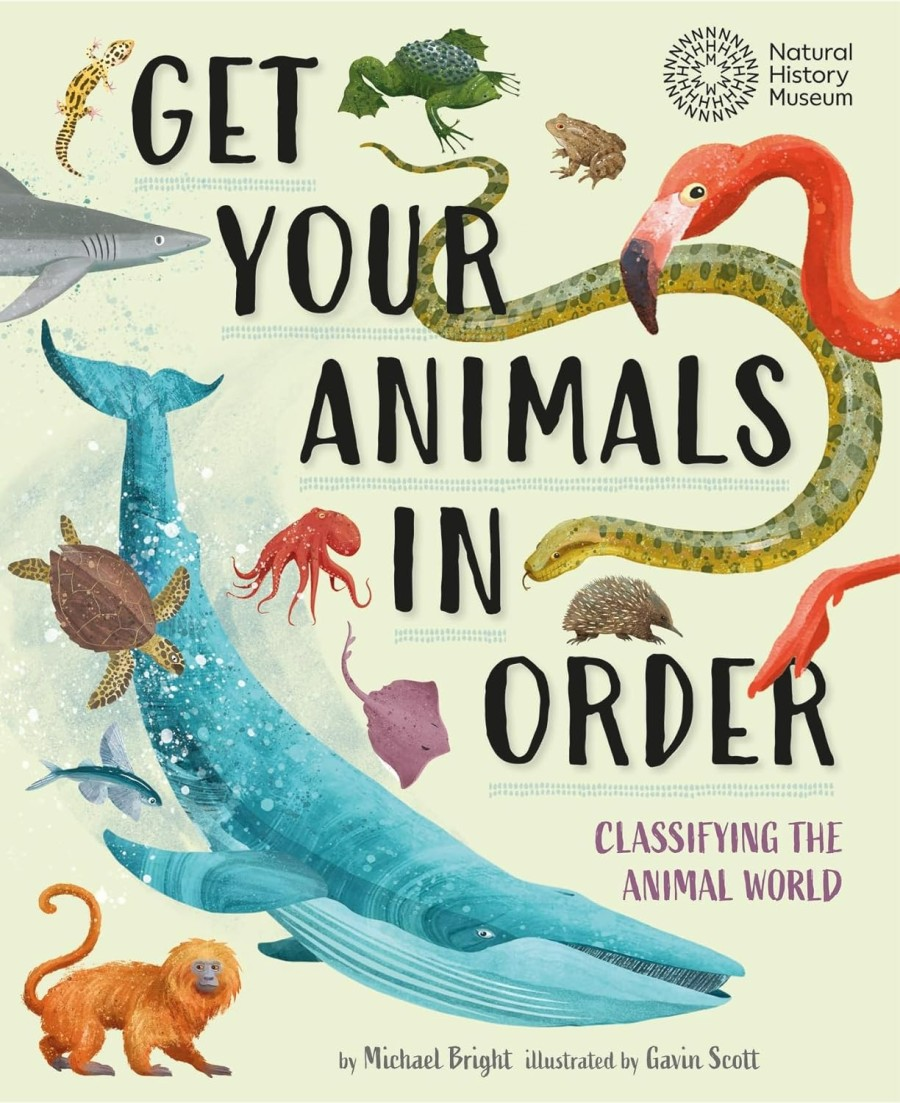
Get Your Animals In Order shows the similarities, differences and connections between animal groups, and how scientists are helping to conserve animals and their habitats, from whales to worms, and from snakes to stinkbugs.
There are just two main groups of animals: vertebrates with backbones (animals, fish) and invertebrates without backbones (crustaceans, insects and spiders). Vertebrates are divided into five species:
- Mammals (including us)
- Birds
- Amphibians
- Reptiles
- Fish
However, nearly all the world’s creatures are invertebrates including insects (this includes bees, butterflies and beetles), earthworms, spiders, slugs, snails and spiders.
Scientists also classify plants into two types: ones that make seeds (trees and flowering plants) and those that don’t (like moss or fern). Then we have bacteria and fungi (which includes mushrooms and viruses).
Michael Bright has worked as an executive producer with BBC Natural History Unit in Bristol and is a member of the Royal Society of Biology, who has worked with Sir David Attenborough.
Illustrator Gavin Scott spent much of his childhood drawing and painting animals and birds, and studied for a BA Natural History Illustration at Bournemouth Arts University. He loves rock-climbing in Dorset, and riding his old Triumph motorbike.
Why do scientists classify animals?
Imagine trying to organise a library containing millions of books without using categories. Finding a particular book would be incredibly difficult.
Scientists face a similar challenge when studying the enormous diversity of life on Earth. Classification provides a system for organising information.
By grouping organisms according to shared characteristics and evolutionary relationships, scientists can communicate more clearly about the natural world. Classification also helps researchers understand how species are related to one another.
For children, this can be an exciting discovery because it changes the way they look at animals. Instead of seeing a lion simply as ‘a lion’ they can recognise it as a mammal, a vertebrate, a carnivore, and a member of the cat family.
One animal can belong to several levels of classification. This layered approach makes the animal kingdom easier to understand.
Starting with vertebrates and invertebrates
One of the easiest ways to begin classifying animals is by asking whether they have a backbone.
- Animals with backbones are called vertebrates. These include mammals, birds, reptiles, amphibians, and fish.
- Animals without backbones are called invertebrates. This enormous group includes insects, spiders, worms, molluscs, crustaceans, and many other creatures.
Consider a dog and a butterfly. A dog has an internal skeleton and a backbone, while a butterfly has an exoskeleton and no backbone. They are both animals, but they belong to very different groups.
This is where classification becomes interesting: two creatures can have very different bodies and lifestyles while still sharing certain characteristics.
Exploring the world of mammals
Mammals are one of the best-known groups of vertebrates.
Humans are mammals, as are dogs, cats, elephants, whales, bats, horses, and many other species.
Mammals have several characteristic features. Most have hair or fur at some stage of their lives, and female mammals produce milk to feed their young.
But mammals come in many different forms.
An elephant is huge and spends much of its time walking across land. A bat is small enough to fly through the night sky. A whale lives in the ocean, while a human can live in almost any environment.
Although mammals can look completely different from one another, they share characteristics that connect them as a group.
Birds: more than just animals that fly
Many children first associate birds with flight, but not every bird flies. Penguins, ostriches, and some other birds have adapted to lifestyles in which flight is not their main form of movement.
Birds are generally recognised by features such as feathers and beaks. Their bodies are adapted to a wide range of environments, from forests and grasslands to oceans and deserts.
A tiny hummingbird and a huge ostrich may seem like opposites, but classification helps us recognise their shared characteristics.
Looking at birds through the lens of classification can also encourage children to notice details they might otherwise ignore.
- Why do different birds have different beaks?
- Why are some feet designed for swimming while others are suited to perching?
- How do feathers help birds survive?
These questions turn classification into an exploration of adaptation.
Reptiles and amphibians: cold-blooded wonders
- Reptiles include snakes, lizards, turtles, and crocodiles. Many have scales and are adapted to life on land, although some reptiles spend significant amounts of time in water.
- Amphibians include frogs, toads, salamanders, and newts. Many amphibians have life cycles that involve both water and land.
The frog is a particularly useful example. A young frog begins life in water and undergoes dramatic changes as it develops into an adult.
Learning about these groups demonstrates that animals can change throughout their lives and that their bodies are closely connected to their environments.
Discovering the incredible world of fish
Fish live in environments that are very different from those experienced by land animals. They are adapted for life underwater, using features such as fins and gills to survive in aquatic environments.
There are thousands of fish species, ranging from tiny reef fish to enormous fish such as whale sharks. They can live in freshwater or saltwater, near the surface or in deep parts of the ocean.
The extraordinary world of invertebrates
Most animal species are invertebrates, and they include creatures with astonishingly different body structures and lifestyles.
Insects are one of the largest groups. Ants, bees, beetles, butterflies, grasshoppers, and flies all belong to this group.
Then there are spiders and their relatives, along with worms, snails, octopuses, crabs, lobsters, and countless other creatures.
An octopus and a butterfly may have little in common at first glance, but both demonstrate how extraordinary the animal kingdom can be.
Exploring invertebrates helps children understand that animals do not need a backbone to be complex, fascinating, or highly adapted to their environment.