Caring for Cancer Patients (helpful tips)

Cancer patients face many challenges, from physical symptoms to emotional stress. And caregivers have a major part in not just easing the burdens, but also looking after themselves at the same time. Both to be a better carer, and for better mental health.
These days, cancer is not always a death sentence. But it’s still a serious illness and sometimes can be terminal. Or at the very least exhausting, as often side effects from treatment, can prove more difficult than the disease itself.
To find cures for cancer, it’s important we ditch unkind, ineffective and out-dated tests on animals, and instead switch donations to humane research charities which receive no government grants and little publicity.
Offer practical and emotional support
- Offer help for walking dogs, feeding other pets, child-minding, shopping, cooking and household chores.
- Maggie’s Centres are beautiful buildings with landscaped gardens near HHS hospitals, to give patients and carers somewhere to relax. A legacy from an architect and her husband. Most towns have agencies with volunteers to look after patients.
- Something to Look Forward To lets hotels, holiday home owners and theatres donate stays or visits.
- Macmillan Nurses provide palliative care. Funded by the NHS, it also offers a free phoneline, email support and live chat.
- Just listening is good, to help people deal with a cancer diagnosis. Share gentle walks or watch light films. Acknowledge your own emotions (it’s okay to feel sad and overwhelmed, if caring for others).
Tips to Help Prevent Breast Cancer
Breast cancer still remains a serious disease, but survival rates are far better these days. Here are tips from the experts, on how to prevent (and hopefully recurrence) of breast cancer:
- Maintain a healthy weight (particularly after menopause)
- Limit alcohol (avoid or limit to one drink per day)
- Exercise (at least 150 minutes of moderate activity per week)
- Eat well (fruits, veggies, whole grains and lean plant proteins.
- Limit processed, fatty and sugary foods)
- Reduce chemical exposure (live an organic life!)
- Carry out regular breast exams (and follow mammogram screening guides).
- Breastfeed for several months (this offers protective effect in later life)
- Avoid long-term HRT (read how to sail through menopause!) This is also good to avoid medicines made from the urine of pregnant horses.
- Know your family history. Talk to your GP if you have a family history, and consider genetic testing for mutations.
Towards a cancer-free world
- Physicians Committee for Responsible Medicine trains volunteers how to cook foods to prevent and treat cancer (plant-based and free from sugar and refined oils).
- Use your vote, for a world free from environmental toxins (fracking can cause cancer). American biologist Sandra Steingraber was told her bladder cancer diagnosis was due to her mother having the same condition – but she is adopted.
- Don’t bother with pink ribbon campaigns. These are promoted often by companies that use cancer-causing chemicals. The original US campaign had a peach ribbon. The cancer patient would not allow its use for toxic beauty companies, which is why the ribbon is pink.
Boost (a silicone breathable breast form)
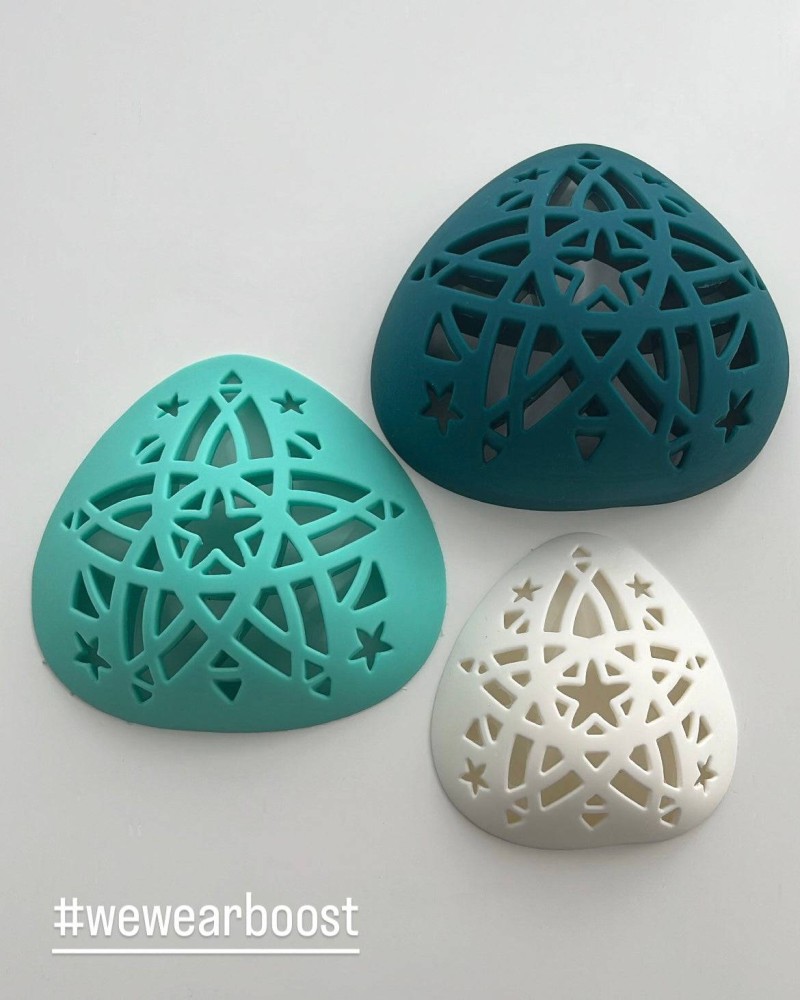
Boost is an innovative breast form (for women to use who have had mastectomies, made from medical silicone in Cornwall. It’s breathable and lightweight, in attractive colours and patterns (breast forms don’t have to be beige and boring!)
Some are now sold in independent shops, ideal so you can try them on before purchase. You can now even get a Boost breast form on the NHS in England and Wales, contact your GP or Breast Care team to discuss.
Sold individually (so obviously order two for double mastectomies), they are designed to fit inside a standard bar, and sold by normal bra size (there are charts online including for abroad sizes).
For fuller breast shapes, there is a ‘curve range’ to create a more natural silhouette. Please allow up to five days to process orders, as this is a small company. You can send it back for replacement if it doesn’t not fit right, or a full refund.
Speak to your healthcare provider (GP, breast care nurse or physicians) to ensure you are ready to begin wearing a prosthesis, after surgery.
The breast forms are made from silicone, which is a much greener alternative to plastic, lasts for years and is easily recycled (it also doesn’t have the health concerns of plastic, next to your skin).
All offcuts (and old forms) are recycled into a material called Flekl, used to make lampshades and plant pots. The breast forms are also sent in reusable cotton bags. ‘Seconds’ (with small air bubbles or colour blemishes) are sometimes sold online at discounted prices, if you’re on a budget.
Unlike some, these are up to 50% lighter and so you can just get on with your day. The delicate cut-outs allow air to circular under your clothing, and avoid feeling hot and sweaty. You can even wear them when exercising, dancing or inside a swimsuit.
You can wear the breast forms under a normal bra of their mastectomy bralettes (these are made from synthetic materials, so launder in a microfiber filter, to avoid microplastics leaching out of washing machines).
Switch donations to humane medical research
Humane medical research (which does not use animals) has far less funding, but uses modern, kind, quicker and cheaper research to find cures for many diseases.
Animal Free Research UK is currently funding Dr Cinzia, who is developing a human-cell based model to provide an accurate platform to study the disease, and test new treatments.
In the UK, breast cancer accounts for 15% of all new cases (over 56,800 new cases of which 390 are men), a number that has risen sharply in women in their mid to late 60s, in recent years.
And despite advances in treatment, breast cancer still claims the lives of around 11,500 people each year in the UK. Although 76% of patients survive for over 10 years.
But what is concerning is that around 30% of cases are preventable, so the need for accurate animal-free research that focuses mostly on prevention and early diagnosis, is more important than ever.
SimPal (pre-paid SIM cards for low incomes)

Obviously it’s not good to be on your phone all the time. But these days, not having access to a mobile phone can sometimes leave vulnerable people feeling scared and alone, and even cut off from their GP or being able to find a job or claim benefits that they are entitled to.
SimPal is an award-winning charity that provides free pre-paid SIM cards (6 months duration with 20G data per month) to people affected by those living with cancer or poor health, in low incomes. Where possible, actual phones are also provided. This lets people on low incomes stay in touch, call for help or apply for jobs and benefits (the service is not means-tested).
The charity welcomes donated factory-set 4G working phones (preferably factory-reset) to their website’s registered address, if you have any sitting unused in drawers. These must be 4G only and in working condition (no broken screens, with passwords and Google accounts removed, and preferably factory reset). Send to their registered address.
Obviously we don’t want a world with everyone glued to their mobile phones or laptops. But the truth is that in today’s world, to be digitally connected can make a real difference to people’s lives. And those on very low incomes are not going to be able to afford (or understand) the complicated contracts sold by people in mobile phone shops or even in supermarkets.
A young boy with cancer was undergoing medical treatment for leukaemia and many other serious conditions. A mobile phone and SIM helped him stay in touch with medical teams, school and family (including when he was in hospital for a long time).