Let’s Visit the Historic Cumbrian Coast
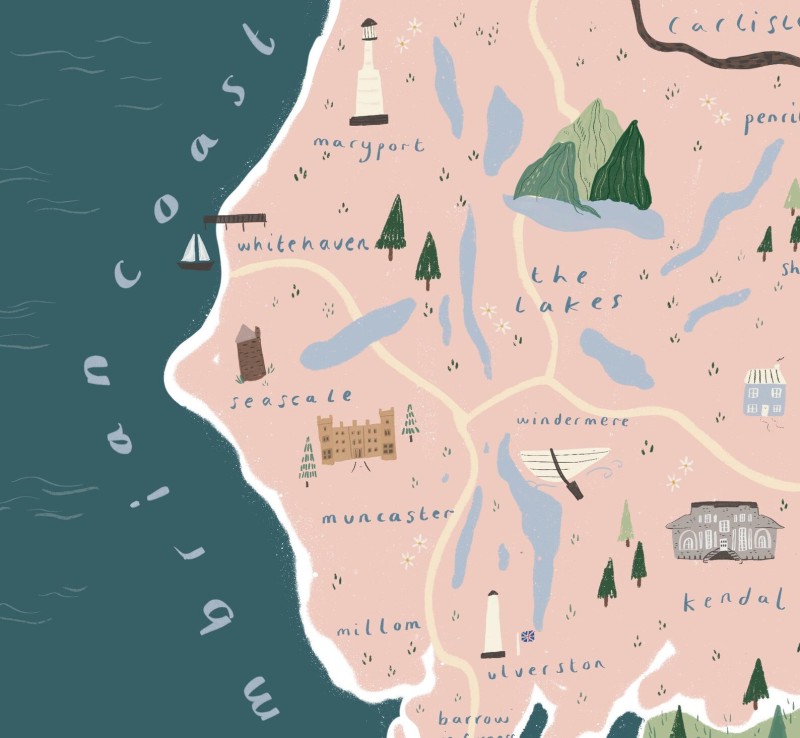
We tend to always think of Cumbria as Carlisle and the Lake District, but in fact the county has a substantial coast, with pretty beaches and a rich history. Let’s discover the main towns and learn a bit more about them.
Out walking? Follow the Countryside Code to keep all creatures safe. Keep dogs away from steep banks, mushrooms (and other toxic plants/trees) and on leads during nesting season (and near barnyard friends and wild ponies).
At the coast, keep away from nesting birds and never walk on sand dunes. Learn how to keep dogs safe by the seaside (check beach bans before travel).
Maryport (a charming Georgian town)
This was renamed from ‘Ellenfoot’ after the landowner’s wife Mary. It has a famous lighthouse and a historic harbour, and also hosts an annual Blues festival.
Due to the views across Solway Firth in Scotland, it’s considered a hidden gem of the Lake District’s edge.
Whitehaven (once a smuggling harbour!)
It’s a bit run-down these days, but it has a harbour and beautiful Georgian buildings. Locals say that with a big litter-clean-up, it could be lovely. Years ago, this was the third busiest harbour, and the import of rum, treacle and brown sugar led to the invention nearby of sticky toffee pudding!
Seascale (a sandy coastal village)
This has long sandy beaches facing the Irish Sea, which turned from farmland to a coastal resort, with the arrival of the railways in the 1800s. Its name means ‘a shelter by the sea’. It features a huge sundial that is accurate to within 15 minutes, and nearby is the Grey Croft Stone Circle, featuring ten stones, some up to six feet tall.
It’s alas overshadowed by the nearby Sellafield, the world’s first commercial nuclear power station, that is now very outdated and being decommissioned, which will take decades, if not hundreds of years.
Muncaster (home to an ancient haunted castle)
Muncaster is known for being home to a 900-year old Lake District home, set in 77-acre Himalayan gardens, and considered one of England’s most haunted castles. The ‘white lady’ ghost is believed to be Mary Bragg, a young women murdered in the early 1800s. A housekeeper, it was said that two men lured her away, saying her love (a footman) needed her, but it was a lie, and her body was found floating in a river weeks later.
Millom (history and scenic views)
Millom is a historic coastal town, which grew from a tiny hamlet to a population of over 10,000 during the 1850s iron ore boom. Surrounded by scenic fells and coastal views, the nine prehistoric crop marks are known as ‘England’s lost Stonehenge’. On a clear day, you can see Wales and Scotland from nearby Black Combe.