Salisbury Cathedral (England’s Most Beautiful Building?)
American writer Bill Bryson once wrote that he believed Salisbury Cathedral to be England’s most beautiful building (he also is an avid campaigner against litter, saying he cannot believe that people drop sweet wrappers and crisp packets on our green and pleasant land).
The cathedral took 38 years to build, and is a striking example of English Gothic style, with the world’s oldest working mechanical clock, stunning stained glass and peaceful cloisters. The Chapter House displays one of the four surviving copies of the Magna Carta. Outside, the lush close is ringed with trees and lawn, and as popular as the cathedral itself.
What makes Salisbury Cathedral stand out?
Many English cathedrals are beautiful, but Salisbury looks different straight away. Part of that comes from timing. It was built mainly between 1220 and 1258, which is unusually quick for a great medieval church. Because of that, the whole building feels joined-up, steady, and clear.
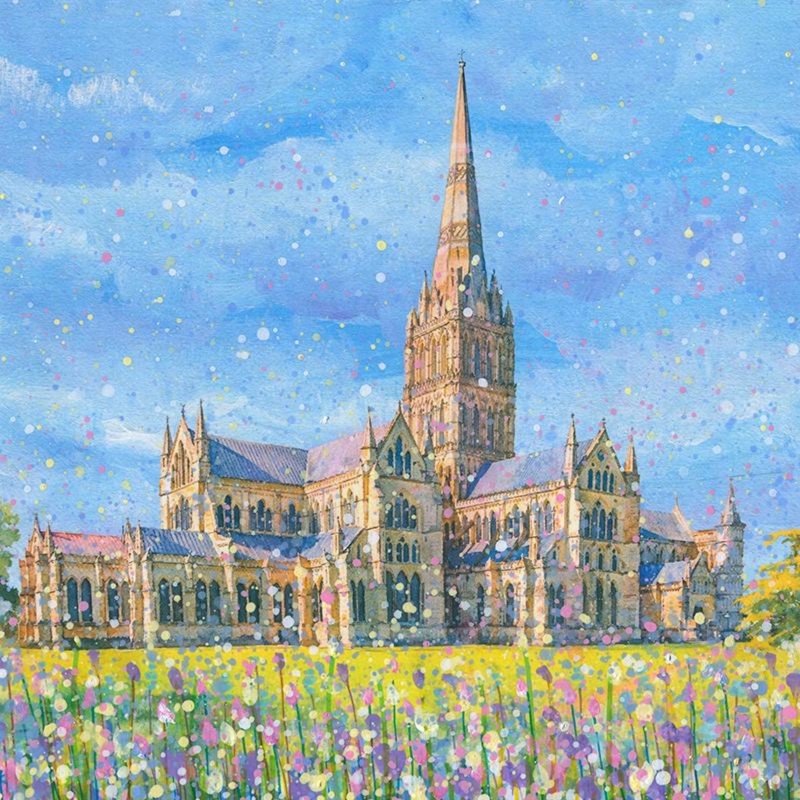
It also has the tallest church spire in England, at about 123 metres. That matters because the spire doesn’t just crown the cathedral, it shapes the whole view of the city. Then there’s the setting. Salisbury Cathedral sits in a wide, green close, not pressed into tight streets. As a result, you can see it properly, from a distance and from many angles.
A rare design that feels calm and balanced
Salisbury is one of the best examples of Early English Gothic architecture, but you don’t need that term to enjoy it. What most visitors notice is the sense of order. The lines are clean. The arches are pointed but not fussy. The pale stone catches light softly, so the whole building feels bright even on a grey day.
Because so much of it went up in one main building phase, there is very little visual argument within the design. Some cathedrals feel like patchwork, lovely patchwork, but patchwork all the same. Salisbury feels whole. Every part seems to agree with the next.
The spire, the close, and the first view
The approach matters almost as much as the building itself. You don’t stumble on Salisbury Cathedral between shops and traffic. You see it across grass, beside old brick and stone buildings, with room to take it in. That open ground acts like a frame around a painting.
Then the spire takes over. It is slim, tall, and almost improbably elegant. Many churches have towers that feel solid and rooted. Salisbury’s spire feels lighter than that, almost like it has been drawn upward by the sky.
Inside Salisbury Cathedral (beauty meets history)
The outside gives you shape and skyline. The inside gives you atmosphere. As soon as you enter, the building changes pace. The close is open and airy, yet the nave feels taller, quieter, and more focused. Sound drops. Light shifts. Your eyes move up before you mean them to.
That sense of inward calm is a large part of Salisbury’s appeal. Yet the cathedral also carries serious national history. So the experience isn’t only visual. It has weight.
Inside the nave, the first impression is height, then space, then light. The columns rise in long pale runs, and the arches lead your eye forward with almost no strain. Nothing feels cramped. Even the ornament seems measured.
Many churches impress through richness. Salisbury works in a plainer key. The stone has a soft colour. The patterns are there, but they don’t push forward. So the eye keeps moving between large shapes and small details, between the roof above and the carved work below.
Holding a copy of the Magna Carta
Salisbury Cathedral holds one of the best-preserved original 1215 copies of the Magna Carta. That single fact changes the feel of a visit. You are no longer only in front of a lovely church. You are standing beside one of the country’s most important surviving documents.
The Magna Carta matters because it became a touchstone for ideas about law and limits on power. Salisbury does not need it to be beautiful, of course. Still, it gives the cathedral extra depth. The building holds both visual grace and national memory, and that combination is rare.