Homemade Strawberry and Rhubarb Crumble

This strawberry rhubarb crumble (Cupful of Kale) can be made as is, or just use rhubarb alone, though it won’t be as sweet.
Avoid rhubarb for kidney stones or liver problems (even a history). Check medication , before eating. Keep rhubarb away from pets (due to soluble oxalate crystals). Before cooking, read up on food safety for people and pets (many foods are unsafe near animal friends).
Just bin rhubarb scraps as acids could harm compost creatures (same with citrus, tomato and allium scraps – garlic, shallots, leeks, chives). For tinned ingredients, fully remove lid or pop ring-pull over holes before recycling (pinch top closed), to avoid wildlife getting trapped.
Rhubarb is one of England’s favourite fruits (even though it’s not a fruit, it’s actually a seed!) Related to buckwheat, it’s too bitter to eat raw, but cooked it’s delicious with sugar, and just as popular in Scandinavia).
If you’ve never tasted rhubarb, it’s difficult to describe as it is unique. Someone once described it as a cross between a ripe strawberry and a tart Granny Smith apple?
How to Buy & Store Rhubarb
There are two types of rhubarb:
- Forced rhubarb (January to March) is grown in pots in Yorkshire’s ‘rhubarb triangle’ region (Bradford, Leeds and Wakefield). It’s said the eerie ‘cracks’ of the stalks, means you can hear it growing!
- Maincrop rhubarb (March to June) is more tart.
Look for healthy looking rhubarb, often the leaves have already been removed.
Once home, trim off excess leaves and store in a reusable silicone freezer bag (keep it open) or at least cut a few holes inside, to let the rhubarb breathe. Then store in your fridge’s salad crisper drawer.
Today ‘forced rhubarb’ is so popular, that growers outside of Yorkshire are supplying supermarkets, including many from Norfolk.
How to Prepare & Cook Rhubarb
Rhubarb has to be cooked (discard and bin the leaves).
Bring to the boil in a pot with enough water to cover, then simmer for around 20 minutes. Then stir in sugar (and optional cinnamon). Serve with vegan custard or ice-cream.
More about Yorkshire’s Rhubarb Triangle
- Yorkshire has the ideal soil to grow rhubarb as cold weather up north has no effect (rhubarb is native to Siberia!)
- Years ago, 200 local growers would send their rhubarb via ‘rhubarb trains’ to London’s Covent Garden market.
- The crop has been popular ever since, apart from during the Second World War (when the rationing of sugar, meant it was too bitter to eat).
- The Rhubarb Triangle consists of 9 square miles in West Yorkshire. At one point, the area produced 90% of the world’s winter forced rhubarb, from the sheds near the fields.
- Forced rhubarb is grown in a very special way, without light (even harvesting is done by candlelight, so not to stop growth). Then once harvested, any root stock left is composted.

The novel The Body on the Train (published in 2019) has a plot of a man, whose murdered body is found on a rhubarb train, on arrival in London.
How to balance rhubarb tartness
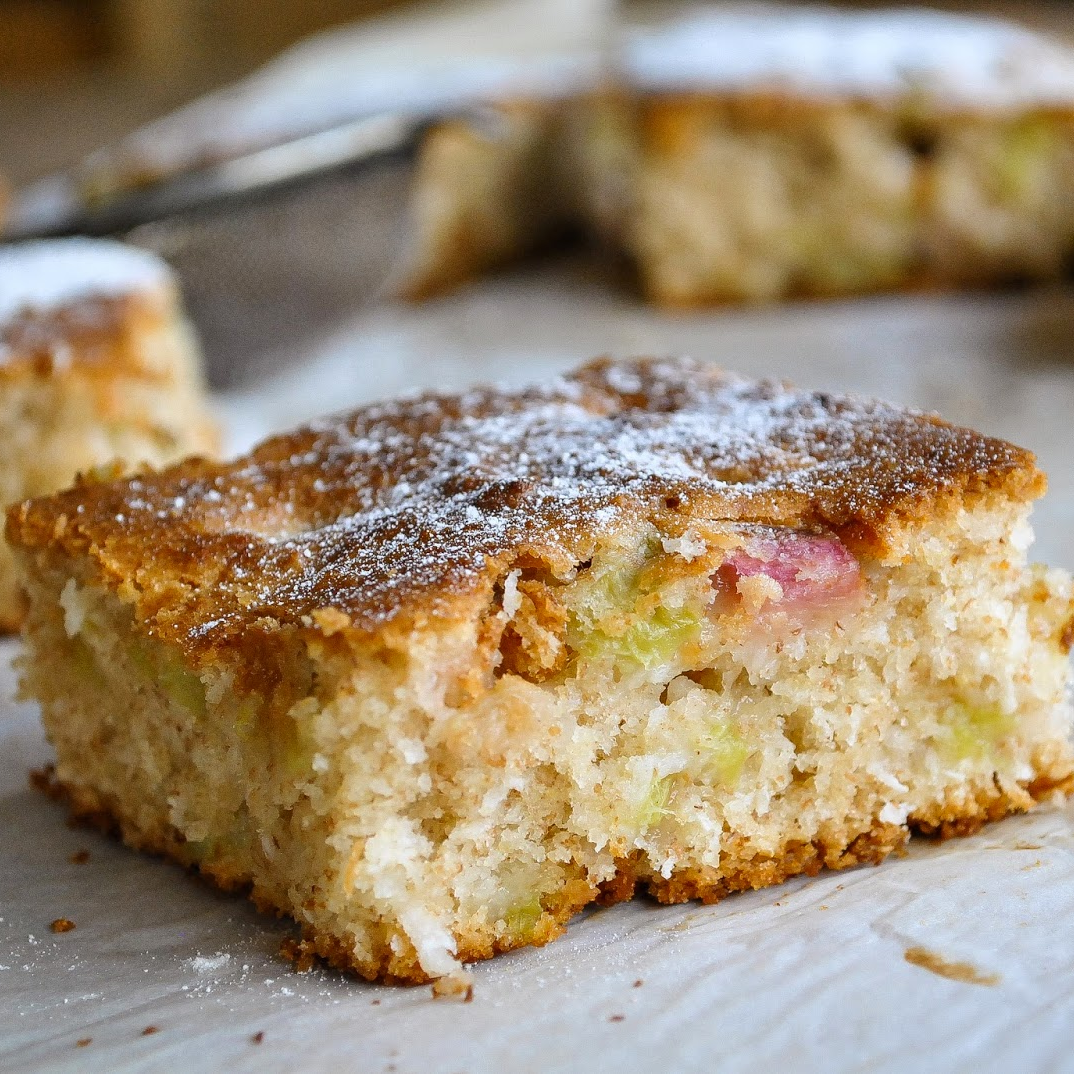
Simple rhubarb cake (Vegan Sandra)
Rinse the stalks under cold water, then trim off the ends. If the stalks feel very stringy, peel off tough fibres with a small knife, much like you would with celery. Most supermarket rhubarb won’t need much peeling.
Chop size depends on what you’re making:
- For compote and jam, go for a small dice (about 1 cm), so it breaks down fast on the hob.
- For roasting and crumbles, cut into 2 to 3 cm pieces, so it softens without turning to mush.
To take the edge off tart rhubarb, you don’t need heaps of sugar. Use a simple “balance kit” instead: sweet fruit (strawberries, apples, oranges), a spoon of maple syrup or caster sugar, chopped dates, and a pinch of salt. Salt sounds odd, but it rounds the flavour.
Then add a booster you already own. Vanilla, ginger, cinnamon, and orange zest all make rhubarb taste fuller and less sharp.