How to Easily Give Up Unwanted Addictions

Unlike the 1940s (when most people smoked), today just over 11% of people in England smoke cigarettes (this is still around 6 million people) which causes health problems and cigarette litter (butts fall down storm drains and go into the sea, or if dropped on land, can cause fires and wildfires.
If you smoke, invest in a small personal ashtray. This immediately extinguishes cigarettes until you find a bin, preventing litter and fires. Charcoal purifying bags can absorb and remove odours from homes and cars, without chemical air fresheners.
Just like cigarettes, vets recommend to keep vaping equipment (e-cigarettes and refill containers) away from pets.
All shops that sell vapes must by law take old ones back for recycling (they are fire hazards when littered). Also read how councils can prevent cigarette litter.
Smoking is the world’s leading cause of premature death, with tobacco killing half its users (with more deaths from passive smoking). Main health conditions caused are lung/oral cancer, heart disease, stroke, blood clots, tooth and gum decay, and wrinkled skin.
Abroad, there are 1.3 billion smokers, the highest numbers in Nauru (an island in Oceania), Papua New Guinea and the Solomon Islands (South Pacific), many Asian countries, along with Jordan, Croatia, Bulgaria and Andorra (next to Spain).
Countries that smoke the least by ratio are Sweden, Norway, Finland, Iceland and Luxembourg.
It’s surprising therefore that despite the high cost of cigarettes, most people who smoke are in low-income countries. And those who don’t are in the wealthiest countries.
Some believe this is that on low incomes, there is ‘nothing much to do’, so people start smoking, and then become addicted. More than half of all people who smoke wish to quit in the next few months.
What’s positive is that we’ve moved on from idolising chain-smoking anorexic models. Today’s role models tend to be healthy fit women like football and tennis players, who eat well, exercise and don’t smoke or drink.
Practical Tips to Quit Smoking
- Learn to cook healthy meals, and take a supplement to ensure you have vitamins and minerals to help your nerves and rebalance your nutrition.
- Exercise also releases endorphins, which lift your mood without nicotine. Physical activity also helps manage weight, a concern for many who quit smoking.
- Change your routine. Stay away from smoke-filled environments and find activities that don’t tempt you. Take up an evening class to learn French, instead of visiting the pub (with outside smokers) each night.
- Open a savings account and put the money you would spend on cigarettes into it. Someone who smokes 20 cigarettes a day spends over £100 a week (that’s £5000 a year you could spend on something else).
Chewing gum is not the answer (it has its own health issues, and most gum contains pet-lethal xylitol, which harms dogs and other creatures, when littered on the ground). If you chew gum, use a gumdrop bin (sent off for recycling). Or chew organic mints instead!
NHS Quit Smoking website has a good chart to inspire, on the quick benefits to your body, when you give up smoking (or vaping).
It only takes a few weeks for your body to receive huge benefits, with most coughs improving within months, heart attack risk halved in a year, and lung cancer risk halved in 10 years.
If you don’t wish to quite smoking right now, Smokey Treats at least use filters made from unbleached wood pulp, unbleached paper and with compostable outer wrap. Presently sold in Germany and South Africa, but soon elsewhere. Greenbutts make biodegradable cigarette filters.
Why Allen Carr’s EasyWay Method Works
You’ve likely heard of people who take local courses using Allen Carr’s Easyway. Despite it being way more successful than nicotine patches, for a long while if did not qualify for NICE evidence, so was not available on the NHS. It is now in some areas, so ask your GP if you can be funded for a local course, if one is available.
Allen was an athlete who began to smoke while doing National Service in 1952, and then became a chartered accountant. He was eventually smoking three to five packs a day, and would ‘cry like a baby’ when he couldn’t give up.
Long story short, he realised that smoking is not a physical addiction to nicotine (otherwise after five days without it, you would be ‘cured’). It’s a mental addiction, and his method has helped millions of people to give up (newsreader Krishnan Guru-Murthy gave up smoking in just four hours). Allen Carr also uses a method to give up vaping.
Think nicotine patches work, do all the ads? In fact, they almost certainly don’t in most cases. The quote that ‘nicotine patches double your chance of success’, simply means they are around 6.2% effective (compared to 3.4% for trying to give up without help). That’s not really effective, is it?
But there is a huge nicotine patch industry, that tries to make it look like the patches do work. In fact, everything to help you give up is mental: support, changes of habits, changes of lifestyle, and a different mindset. The idea is to take you back to when you didn’t smoke.
Many people on earth have incredible stressful situations, but many of them don’t smoke, vape, drink or take drugs. They deal with problems in a healthier way, and you can too.
Who Profits from the Cigarette Industry?
Smoking is like paying someone to kill you. They’re rich, you’re dead. Anonymous
Many companies make billions from the sale of cigarettes (many of which by the way are tested on rats, mice and dogs who are forced to inhale smoke and have tar applied to their skin for several hours).
Social Market Foundation says that despite being highly taxed, the cigarette industry’s taxes are dwarfed by its profits, and yet the NHS then has to pay a huge amount of money to help people with diseases caused by smoking (not to blame them as cigarettes are highly addictive, but it’s a financial fact).
Smoking is the leading cause of death and disability in the UK:
Smoking costs society in England £43.7bn a year through a combination of lost economic productivity and health/social care costs. This rises to £78.3bn, if the cost of early deaths due to smoking is included. In 2024, smoking cost the public finances in England £16.bn, more than double the £6.8bn raised through tobacco taxes. ASH (Action on Smoking & Health)
ALDI and LIDL supermarkets refuse to stock cigarettes. So why don’t the other supermarkets follow suit? People who smoke could still buy from newsagents and tobacconists, proving that supermarkets put profits before public health.
Don’t Smoke (just because some celebrities do)
A couple of decades ago, a lot of young women were smoking to keep thin, emulating supermodels like Kate Moss, who was stunningly beautiful, but never really looked healthy. Make life decisions for you, not because magazines create a ‘brand’.
Thankfully today, things have moved on. We have ‘stars like tennis pro Emma Raducanu (fit not thin, and no doubt does not smoke, or else she could not play pro-level tennis). These are the kind of young women that teenagers now aspire to be like, a healthy and positive step in the right direction.
Kate Moss says she is aware not to promote smoking, but even today she has not quit, showing just how addictive cigarettes are.

Gambling can seem like harmless fun at first, but for many, it becomes a serious issue that affects every part of life. Whether you’re betting on horses or rolling dice in a casino, gambling addiction can drain your bank account and strain your relationships.
Lying, secrecy, shirking responsibilities are big red flags. Are you finding excuses to cover up a trip to the casino? Neglecting family dinners or missing deadlines at work?
- GambleAware is the main site to help with addiction to gambling, and has a freephone phone number (or live chat) for help.
- It recommends software to block gambling sites like GamBan or GamBlock (the modern equivalent of asking the bookie not to serve you, if your willpower slips).
- The site also has information on self-exclusion (where with one phone call, you can nominate places not to serve you in the surrounding areas (betting shops, online bingo, arcades & casinos).
- Gamblers Anonymous offers help for the addiction often only known by ‘the banker and the bookie’.
Campaigners want a ban to all gambling ads on TV (even if they do add a caveat to ‘be sensible’). It helps also to use free ad-blocking software online.
Coalition Against Gambling Ads wants a complete ban on ads. Of course this won’t happen, as TV companies and the Internet make too much money from them.
So it’s up to us as empowered adults to make the decision to not watch or take any notice of them. Especially when they try to entice with ‘free bets’ to get people to start gambling, who otherwise may never have been tempted.
Any time you offer a big prize for a small amount of money, you encourage stupid behaviour, on behalf of those you’re appealing to. Warren Buffet
Gambling is a tax on ignorance. People often gamble because they think they can win, they’re lucky, they have hunches. That sort of thing. Whereas in fact, they’re going to be remorselessly ground down over time. Edward Thorp
It may help to look up welfare issues for greyhounds and racehorses, rather than just think of gambling in monetary terms.
The Lottery is Another Form of Gambling
Playing the lottery is also a form of gambling (a silly one at that). You’re more likely to get killed by lightning on the way to buying your ticket, than to win it. Quakers refuse lottery funding, saying it takes advantage of desperate people. And order for someone to win, another person has to loses.
Bingo may seem like a bit of harmless fun at the pub, and it probably is. But many people today have spent hundreds of thousands of pounds on online Bingo.
This is not like the old ‘2 fat ladies, 88’ kind of Bingo that your grandma likely played at the community club to win a bottle of plonk. But more big companies advertising on TV, so vulnerable people ending up spending money they don’t have, to try to get themselves out of financially desperate situations.
London’s Notting Hill (not just a big blue door)

The London area of Notting Hill is linked to the Ladbroke gambling family. It is of course known for the blue door, featured in the film of the same name, with Hugh Grant and Julia Roberts. The door still attracts thousands of film buffs each year, in the area known for Portobello Market, which also featured in the stories of Paddington Bear.
The sad truth is that the next door to the ‘door’ is now a Starbucks coffee chop.
There is a little bookshop nearby, but not the one featured in the film, that was filmed elsewhere.
It’s sad that the money in Notting Hill was built from gambling and horse-racing. Today we know better. Much of the land back in the day was owned by the Ladbroke family, and that’s why you’ll find that many roads are named after them. There was even a local racecourse, though that shut down in the 1800s.
Today the area is terribly expensive. You can buy a garage for the price of a normal house. But a quick look online found the cheapest studio flat was around £250K. A luxury six-bedroom house is listed at over £17 million?
Also known for its street carnival, Notting Hill is also known for its colourful buildings, and walkable streets. But as one local says, the clue’s in the name if you’re not that fit – it is of course built on a hill!
Nearly all lotteries are a scam, as you will hardly ever win (you have more chance of getting killed by lightning on the way to buy your lottery ticket, than you are of winning it!) From scratch cards to complicated odds, the odds of hitting the jackpot is usually 1 in several hundred million.
Lottery Wins Don’t Solve Problems
Lottery wins also don’t solve debt problems? Nearly everyone who wins the lottery loses the money soon after, as it’s more a mindset (receive money, spend it). There is also a suspicion that lotteries are just a lazy way for MPs not to tackle society problems.
For instance, a £4 million jackpot could be divided, for 80 winners each week to pay off the average £50K debt. But then there would be no need for credit cards or mortgages. Food for thought?
Many people of faith refuse to play the lottery. Quakers say that in order to win, someone else (often desperate) has to lose. They refused Lottery funds, as they don’t agree with gambling.
Lottery: a tax on people who are bad at maths. Ambrose Bierce
The universe will throw somebody a bone every now and then, and you win the lottery. But for the most part, you get in this life what you put in. Arian Foster
I despise the lottery. There’s less chance of you becoming a millionaire, than there is of getting hit on the head by a passing asteroid. Brian May (Queen guitarist, badger friend and qualified astrophysicist).
Help ‘good causes’ Without Lotteries
You can still help good causes, just donating to small local charities. You also don’t have to put a big red plastic nose on your face, to help good causes.
A Caveat (Lottos to Help Animals)

If you do play lotteries, then at least play smaller ones that do real good. Veggie Lotto is a small lottery (akin to Bingo or tombola), but still has prizes up to £25K (but cost just £1 a week with 7 guaranteed winners).
50% of all sales go to Vegetarian Society (that is mostly vegan these days) (National Lottery only gives 25% to good causes). One recent recipient was a tiny sheep sanctuary that relies on volunteers.
Compassion Lottery is run by Compassion in World Farming, which again costs £1 per entry. Match 3 or more numbers to win a cash prize up to £10,000 for six numbers. Winnings automatically go into your bank account, no need to claim.
The Power of Compound Interest in Savings
Instead, just save the money for a rainy day. You’ll be less stressed and safer too (some people are murdered for their money).
- Save £100 monthly at age 20: By age 60, you could have around £250,000 assuming a 5% interest rate.
- Save £100 monthly at age 30: By age 60, you’d have about £140,000.
To truly appreciate the impact of choosing savings over lotteries, consider these real-life examples of individuals who saved money, instead of playing the lottery:
- Emily: Emily saved £50 every month instead of buying lottery tickets. Over ten years, she built up £6,000. This allowed her to buy a car and take a holiday, enhancing her quality of life.
- James: James spent £5 weekly on lottery tickets for five years. He won small prizes occasionally but ultimately lost more than £1,250 in total. Frustrated, he switched to savings and now contributes to his retirement fund.
- Sophie: Sophie decided to invest her £2 daily lottery money into a savings account instead. In five years, she accrued approximately £4,000, which she used towards her education.
Enter your age, sex and weight at Alcohol Change along with how much you drink, and it will tell you what safe levels are, and if you’re above them. Campaigners want the law to change so that it’s easier to know a ‘unit’ which can get confusing.
In a nutshell, experts advise no more than 14 units of alcohol a week (spread over 3 days or more) and obviously none for pregnancy/breastfeeding/driving or affected medical conditions.
Know that often ‘home measures’ are more than in the pub, so if in doubt, use glasses with measurements:
Per week:
- 14 spirit measures (25ml) or
- 6 glasses of wine (175ml) or
- 6 pints of beer or cider (568ml)
So to clarify, if you drink gin and tonic, that would be no more than 2 glasses a night. Or 1 glass of wine (with a night off). Or 1 pint of beer or cider a night (again with a day off).
If you are over this limit (or wish to reduce), one easy way to do this is simply to switch to alcohol-free or low-alcohol versions, as a lot of alcohol-drinking is simply due to habit.
Or just do other things to relax (go for an evening walk, invite friends round for dinner, read a book, take a bath etc).
No Driving after Drinking Alcohol
The police say ideally have zero alcohol before driving. To help stop 200 people killed each year on our roads, due to alcohol-related accidents. The legal limit in Sweden is far tougher and Hungary, Romania, Slovakia and Czech Republic have zero tolerance.
It’s difficult to gauge how much alcohol is ‘safe’ because you won’t be doing the maths of calculating units, and it also depends on a person’s sex, height, weight and if a person is dehydrated or taking medication.
If you do drink, the police suggest waiting at least an hour for each unit consumed (time is the only way to rid alcohol from your body – coffee, food or sleep don’t).
For example, if you drink 3 pints of lager or one bottle of wine at midnight, you’ll not be ‘sober’ until at least 9am the next morning.
NHS Alcohol Support Services
The NHS offers a network of clinics and experts who focus on recovery. Depending on where you live, this might include drop-in centres or specialist outreach teams.
They offer help with detox, one-to-one counselling, practical guidance, and support groups. NHS services are professional, confidential, and free, so there’s no cost barrier to getting started.
Specialist Rehabilitation Facilities
Home Detox for Alcohol program was developed by recovering addicts, and offers an alternative to residential care, if you prefer to get better privately. It uses medically-qualified staff who can recommend you see GPs if you need medication to come off alcohol, if it’s safer to do so.
Alcoholics Anonymous (AA)
AA has been around since the 1930s and runs free, local meetings across the UK. Meetings are friendly, confidential, and open to anyone who wants to try giving up drinking. There’s no pressure to speak if you don’t want to, and you can attend as often as you like.
The 12-step model they use has helped millions, but the real strength lies in the support from people who’ve been there themselves.
Counselling and Talking Therapies
Therapy is a key part of change for many people. You can find free or subsidised talking therapies through the NHS. Counsellors, therapists, and psychologists work with you to understand why drinking has become a problem, and help develop new ways to cope with life’s stresses.
Support from Family and Friends
Support from loved ones can make a real difference, even if things feel strained. Open conversations, gentle encouragement, and patience all help. Family and friends can also join support groups of their own, like Al-Anon, which provides advice for those supporting someone with drinking problems.
Building a circle of encouragement keeps isolation at bay.
Online Tools and Self-Help Resources
There’s a wide range of free and paid apps, forums, and websites that support recovery. Examples include Drinkaware and Soberistas. You’ll find daily check-ins, progress trackers, peer stories, and tips for coping with triggers.
Helplines and Crisis Support
If you need someone to talk to straight away, there are many free helplines people for those who are struggling and even suicidal.
Staff are trained and non-judgemental, ready to listen, answer questions, or steer you to the right services. Helplines are great if you’re not ready to speak to someone face-to-face, but need urgent support.
Workplace and University Support
Many workplaces have confidential Employee Assistance Programmes (EAPs) offering advice and counselling. Universities also run wellbeing services with support for students facing alcohol problems. These resources are included in your job or tuition.
Switch to Alcohol-Free Alternatives
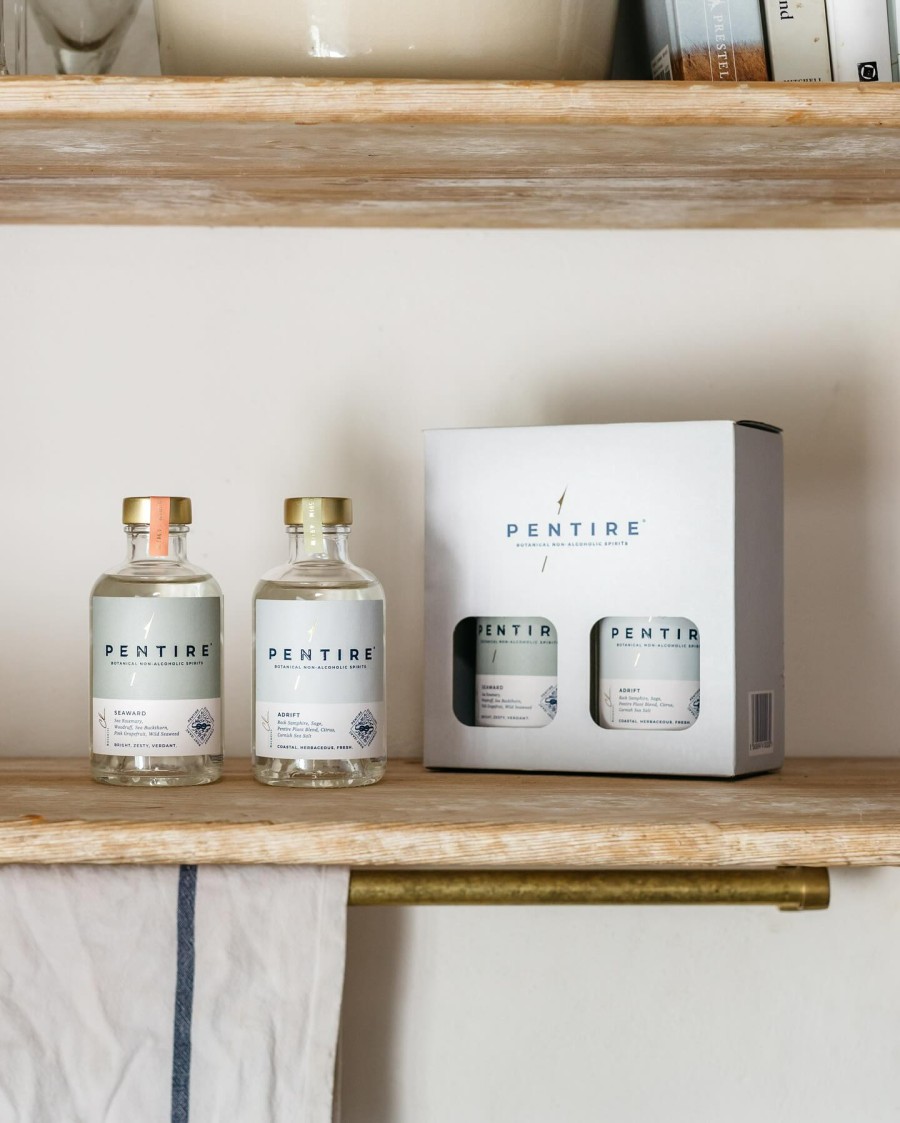
Pentire (Cornwall) is a botanical drink made by distilling sage and rock samphire. Ideal served with ice and tonic water, and garnished with lemon and rosemary. Made with seasonal ingredients and sold in sustainable packaging.
Often drinking alcohol is more of a habit. So if you switch to something similar that tastes the same, it can help to reduce or eliminate alcohol. Our site has many choices.
No drink can claim to be 100% alcohol-free (fruit, juice and rye bread all contain a little). But there are drinks that are nearly alcohol-free or lower alcohol.
Avoid tonic water for pregnancy/nursing and medical conditions (check medication before choosing grapefruit or rhubarb flavours).
No/Low Alcohol Wine Alternatives
- Thomas & Scott Noughty offers a no-alcohol organic vegan sparkling wine, with half the sugar of other brands and just 14 calories per glass, for a hangover free celebration. It also makes a nice no-alcohol red wine.
- Bottle Green Elderflower Cordial can be mixed with sparkling water, as a near-identical alternative to a white wine spritzer. Or look in stores for the ready-made pressé with Cotswolds water.
A Book to Help You Stay Sober

Going Dry is a no-judgement book for anyone who wants to cut down or give up drink, in a world and culture filled with booze. It may be a bumpy ride to go teetotal. Set short and long term goals, and learn to celebrate without booze. And enjoy better sleep, more money and free time.