Discovering Denmark: life in the world’s happiest country
Is England happy? Compared to Denmark, the answer would be a resounding no. According to many worldwide indexes, Danes are by far the happiest people on earth. And our Nordic friends have some very interesting lessons to teach us (interestingly, they pay high taxes and are protected from cradle to grave, very different to current political thinking in the UK).
What makes a country happy?
Is it the quality of life, a strong sense of community, beautiful surroundings, or simply having more time to enjoy the little things? Denmark has long been associated with happiness, and for many visitors, the country offers a fascinating glimpse into a different way of living.
From the colourful streets of Copenhagen to quiet coastal towns, Denmark combines modern design, natural beauty, social trust, and a relaxed pace of life. It is a country where bicycles are a normal part of everyday transport, where cafés become meeting places, and where spending time with family and friends is considered just as important as working hard.
But what is life really like inside the world’s happiest country?
A different pace of life
Although Denmark is relatively small, its landscapes are wonderfully varied. Like England, the country is surrounded by water with long coastlines, sandy beaches, islands and peaceful countryside.
Like England, Denmark has lots of beach huts. The doors face sideways (not the sea) and are ‘little castles’ with flowery curtains and chipped crockery. People go here, when the sun finally comes out!
Life in many Danish cities is never rushed like many in England. People still commute to work, raise families, meet friends and pursue their interests. But there is a strong emphasis on life-work balance.
This is closely connected to the Danish concept of hygge. Although there is no perfect English translation, hygge is often associated with comfort, warmth and enjoying moments with people you care about.
It might mean sitting around a table with friends on a winter evening, enjoying a coffee in a cosy café or simply relaxing with a good book. Hygge isn’t necessarily about expensive experiences. Instead, it celebrates the ordinary moments that make life feel comfortable and meaningful.
Compare that to England, where we have celebrity obsessions and online influencers, a need to ‘win the lottery’ in order to solve our problems, and often nasty media and politics.
Copenhagen (the world’s most walkable city)
Denmark’s capital, Copenhagen, is known for its colourful architecture, historic streets, canals and impressive modern design. Yet Copenhagen also feels remarkably liveable.
It used to be gridlock, until architect Jan Gehl gradually reduced cars and increased walking.
Cycling is one of the easiest ways to explore the city (helps that it’s flat like The Netherlands!) Dedicated cycle paths make bicycles a practical form of transportation rather than simply a weekend activity. On a typical day, you can see people cycling to work, taking children to school or carrying groceries.
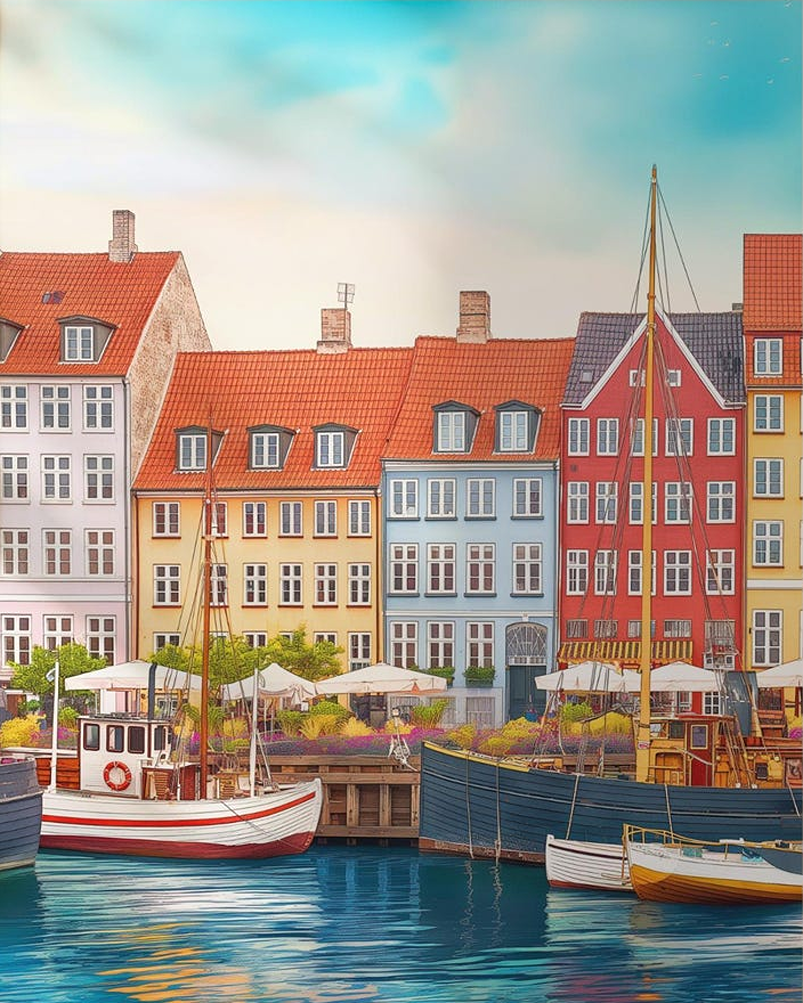
One of Copenhagen’s most recognisable areas is Nyhavn, with its colourful waterfront buildings and historic boats. It is an especially popular place for visitors, but beyond the famous sights, Copenhagen’s charm can be found in its neighbourhoods, parks and everyday streets.
Compare this to Englanad, where a day out is usually at a shopping mall.
The importance of community
Trust plays a significant role in Danish society. People generally have a high level of confidence in public institutions and in one another, and this can contribute to a strong sense of security.
They even trust their government! That’s why they don’t mind paying higher taxes. As they know that the money will go to vulnerable people, and not on government quangos.
Unlike England, in Denmark there is no celebrity obsession. A top footballer could take the metro and nobody would bat an eyelid. Could you imagine that happening in England?
Danes may not always be the loudest people in the room, but friendships and social relationships are valued deeply. And far more so than celebrity fodder.
It’s said that in Denmark it’s fine to own a luxury boat. But not to brag about it!
Danes also have respect for others. There is a joke that if you move next door to a Dane and invite them for dinner in six weeks, they will accept. Then respecting your privacy, you won’t hear back from them.
Six weeks later, you may think you have upset them. Then prompt as you like, they will ring the doorbell, expecting their supper!
Is Denmark really the happiest country?
Of course happiness is complicated, and this is just a general view, based on Happiness Index surveys carried out in the world. No country is perfect and Denmark has challenges like high living costs and depression caused by long dark winters which some people don’t like.
However, it’s very interesting that (apart from The Netherlands which apparently has the world’s happiest children), the ‘happy countries’ always tend to be in Scandinavia (and Iceland next door).
Why is this? When you look closer it’s obvious:
- Trusted governments
- Natural lifestyles
- Quieter unassuming people
- No celebrity culture
- No obsession with wealth
Financially protected through life (even if it means some people paying higher taxes to pay for it)
All of these combined result in countries that are not overly excited about everything (think of all the hoo-has and ding-dongs with our political world at the moment). These countries tend to be stable, peaceful, put meaningful relationships over mass media, take time to be in nature, have a healthy life-work balance and can enjoy everyday life, even if on a low income.
More on Denmark’s strong social safety net
This appears to be one of the main reasons behind Denmark’s collective happiness. And it’s very interesting to look at this, compared to current political policies in the UK (namely try to take as many people as possible off welfare benefits, even if they are old, sick or disabled).
This goes in the complete opposite direction of what the world’s happiest country does. So why are governments around the world trying to the opposite of what is proven to work? Surely the whole point of a government is to make its country’s residents happy?
Denmark’s welfare system is based on the principle that all citizens should have access to essential services and economic support, regardless of their income or social background.
Rather than relying primarily on private insurance or individual savings, Denmark provides extensive public services, funded mostly through relatively high taxes. The aim is to reduce poverty and inequality, while giving people security if they face unemployment, illness, disability or old age.
Compare this to say Reform UK’s recent policy of prioritising social housing to young married working British couples. So if you’re a young single mother fleeing for your life with your children (ie. very difficult circumstances), the party would put you on the scrap heap.
A universal approach to healthcare
Like the UK, the Danish healthcare system provides residents with access to doctors, hospitals and other essential medical services at little or no direct cost, at point of use. Again this is mostly funded through taxation, so people in financial hardship with serious illness are still helped.
Heavily subsidised public education
Students in Denmark receive financial support, with universities not usually charging tuition fees. The state also provides grants to help students cover living expenses. This reduces financial barriers to higher education.
And of course when they eventually start earning, they pay back via higher taxes to help the next generation.
Support for families with children
Unlike Reform UK plans, all families receive support, not just if you’re white, British and in a heterosexual marriage with 2.5 children!
In Denmark, parents receive various forms of help from child benefit to parental leave (with very generous time off to care for newborn children without losing their entire income).
Public childcare is also widely available and subsidised.
This not only helps families balance life and work, but encourages higher levels of females in the workplace, as they don’t have to choose between caring for young children and doing part-time work.
Danes also enjoy ‘flexicurity’ as they receive financial assistance and support in finding new employment, with training, education and job-search assistance programs. While still giving security if they lose a job.
Significant support for vulnerable people
The Danish public pension system ensures older citizens have a basic level of financial security on retirement. Older people on low incomes receive help for healthcare, housing and other needs, to reduce the risk of them falling into poverty (which of course ends up costing more, as many could become ill).
Likewise, good support is available for people with long-term health problems or disabilities.
Higher taxes and public trust = happiness
So in conclusion…
Danes do pay higher taxes. But they get a lot of wonderful benefits in return.
There are calls in England for a ‘wealth tax‘ (only Greens officially support it). Where those with over £20 million would pay a 2% levy (works out at around £20K each a year – most could pay this out of interest alone).
Collectively, this would raise around £25 billion a year, which could raise all our public services up to Danish levels, without hitting any of the most vulnerable in society (in fact the money would be used to protect them).
Again it comes down to trust. One wonders why (when most of the multi-millionaires in the UK are happy to pay a wealth tax) why all the other major political parties are against it. The old chestnut that they are frightened of a ‘brain drain’ does not fly.
We’re proud to pay and we’re here to stay. Julia Davies, British millionaire and impact investor