Simple Proven Ideas to Prevent Homelessness

England presently has around 250,000 homeless people (including rough sleepers, sofa-surfers and people living in bed-and-breakfasts). Also read how to help dogs that live with homeless people.
BillyChip is a safe and secure ‘currency’ that can be bought from participating shops in the community, to give to homeless people, so they can use them to ‘pay’ for a hot drink or meal, or even to buy food (and pet food) at participating outlets.
This enables communities to help feed homeless people and dogs, whilst still following official advice from councils and homeless charities, not to give cash to homeless people (in case it’s spent on drink or drugs, or puts homeless people at risk from robbery).
The idea was set up in memory of a young man (who died in a road accident) who used his time to volunteering, to help homeless people.
The scheme is free to operate for independent shops, as you get money back for distributing the tokens. So it costs nothing for you (you are only charged for the chips sold), but helps to support homeless people in your community, and even can help your business, by boosting your reputation, for doing good in the town or village you live and work in.
Just sign up to create a business account, and receive a welcome pack. The starter kit includes 25 Billy Chips, plus window decals and marketing materials.
Pubs and bars are not allowed to join, to discourage chips being used to buy alcohol. This is not to judge, simply to encourage homeless people who may have alcohol problems, to buy a hot drink instead.
You also get listed online, so local people can search for places to buy a BillyChip to enable local people to buy hot drinks, food and pet food.
General Advice to Help Homeless People
England presently has around 250,000 homeless people (including rough sleepers, sofa-surfers and people living in bed-and-breakfasts). Also read how to help dogs that live with homeless people.
Homeless people can claim benefits (usually Universal Credit), giving the address of a family member or friend, local hostel or job centre. This helps to pay for food (and pet food), job interview clothes and accommodation deposits.
People without bank accounts can use the government’s Payment Exception Service to collect benefits from a local post office or PayPoint outlet.
If you see someone sleeping rough, send a report to StreetLink, whose outreach teams visit rough sleepers at night, to alert them of support to find benefits and accommodation (if the person is under 18, call 999).
Pivot (recycled earrings to help homeless people)

Pivot is a social enterprise, which employs homeless people (paying a London living wage) to make earrings out of recycled metals or acetate (from a spectacle company), in geometric drop designs like triangles and circles. Profits from sales go back to community programmes.
Why Choose Recycled Metal Jewellery?
Millions of people in England wear jewellery, but most is from gold and silver (newly-mined, when there is enough mined metals on earth, to last for eternity). Mining often uses mercury and cyanide that creates run-ff that destroys aquatic life, and causes floods (harming donkeys who often are the ‘transport’ used near mines). Also choose smartphones made with recycled materials.
Yet there are many artisan brands that make lovely jewellery from recycled metals (or scrap materials like plastic waste). Let’s look at a few good brands to support, these also make lovely zero waste gifts.
Donate broken necklaces or odd earrings to Recycling for Good Causes (list your local animal shelter: they sell the metal and pass on funds). Send unwanted jewellery (and watches) to Animals Asia, where cash raised helps to rescue moon bears.
Reliance Bank (personal/business bank accounts)

Reliance Bank Ltd is a different kind of bank. Offering accounts for personal and business use, it shares profits direct with the Salvation Army, a Christian charity that helps thousands of people facing homelessness across the UK.
Thanks to Reliance Bank’s financial support, The Salvation Army can keep its doors open at hostels and life-houses nationwide. Salvation Army also helps people who struggle with trauma, mental health issues and substance abuse, as well as teaching people new skills and writing job CVs.
Just like any other regulated bank, your money is protected for money up to £85,000 or £170,000 (joint accounts) and you can switch in 10 minutes using the Current Account Switch Service. Just open your Reliance Bank account and request the switch in the app (or by phone/online) and the service will securely move your salary, regular payments and direct debits in seven days.
If you’re in debt, you can usually still switch your bank account, while paying off debt at the old bank. So don’t let that stop you switching.
This bank is regulated by the Financial Conduct Authority (FCA) and covered by the Financial Services Compensation Scheme. You get all the protection you’d expect from a high street bank, with the bonus of strong green ethics.

The best solution to help dogs that live on the streets is find stable accommodation for homeless people.
Around 10 to 25% of homeless people keep dogs as companion animals, and this can make it more difficult to find shelters, along with having to provide food and vet care. Also pets can be at risk, if their human guardians become ill or have to visit hospital.
It’s good not to judge (sometimes the human guardians have adopted dogs that themselves live on the streets, or have been rescued from abusive situations). Some also spend more time with their guardians, than other dogs who may be left at home all day, while their guardians work.
BillyChip (a token currency for pet food)
BillyChip is a token currency, that local shops can buy (at no cost, they are only charged for chips sold) to give to local people. They can then give these to homeless people, who can use them to buy a hot drink and food, but also pet food if wished.
This is a great way to help, while still following advice from councils, not to give cash to homeless people, in case some get robbed, or a few spend it on alcohol or drugs.
Organisations Helping Homeless People with Dogs
- Dog’s Trust Hope Project offers free vet care with participating vets (let local homeless people know about the scheme). Once signed up, the scheme also offers info on dog-friendly hostels (and also helps sofa-surfers and those at risk of eviction).
- Dogs on the Streets offers free vet clinics, food, and supplies in London and Manchester and other cities, with mobile vet teams.
- StreetVet offers volunteer teams to provide health checks, vaccinations, and urgent care on the streets. And can foster dogs, during hospital stays.
- Street Paws runs outreach sessions in towns across the UK, offering worming, flea treatment and microchipping. And also runs first aid training for hostels.
- Mayhew (London) offers preventative vet care (neutering, vaccinations, flea and worming treatments), food and leads/coats to keep dogs safe and warm.
Support Pet-Friendly Housing Initiatives
One reason why many people become homeless is unaffordable rents and a lack of pet-friendly accommodation (more than half of people in England live with pets).
Lets with Pets (run by Dogs Trust) offers advice for tenants (including referencing, higher deposits and offering end-of-tenancy deep-clean) and a free Good Practice Handbook for Landlords.
General Advice to Help Homeless People
England presently has around 250,000 homeless people (including rough sleepers, sofa-surfers and people living in bed-and-breakfasts).
Homeless people can claim benefits (usually Universal Credit), giving the address of a family member or friend, local hostel or job centre. This helps to pay for food (and pet food), job interview clothes and accommodation deposits.
People without bank accounts can use the government’s Payment Exception Service to collect benefits from a local post office or PayPoint outlet.
If you see someone sleeping rough, send a report to StreetLink, whose outreach teams visit rough sleepers at night, to alert them of support to find benefits and accommodation (if the person is under 18, call 999).
Help Dogs of Homeless People Abroad
Pets of the Homeless (US) offers free food and vet care (along with spay/neuter surgery, nail trimming and ear cleaning). It also provides free crates for shelters that don’t allow pets, to enable homeless people with dogs to find indoor accommodation for the night.
Project Street Vet (US) was founded by a Californian vet, and now works in a few states, providing free vet care (exams, vaccines, flea meds and other supplies) and end-of-life services if required.
WE Care Worldwide (Sri Lanka) works slightly differently, in that it helps the country’s huge population of street dogs, more akin to feral cats (they live in packs, and are best kept wild if looked out for). But due to no human guardians, volunteer vets use funds to heal injuries and illness. You can buy cotton t-shirts to support them.
In Delhi (India), locals have created a waterproof dog bed for street dogs that combines recycled dog food bags, with jute cover & reflective piping. What a great idea!
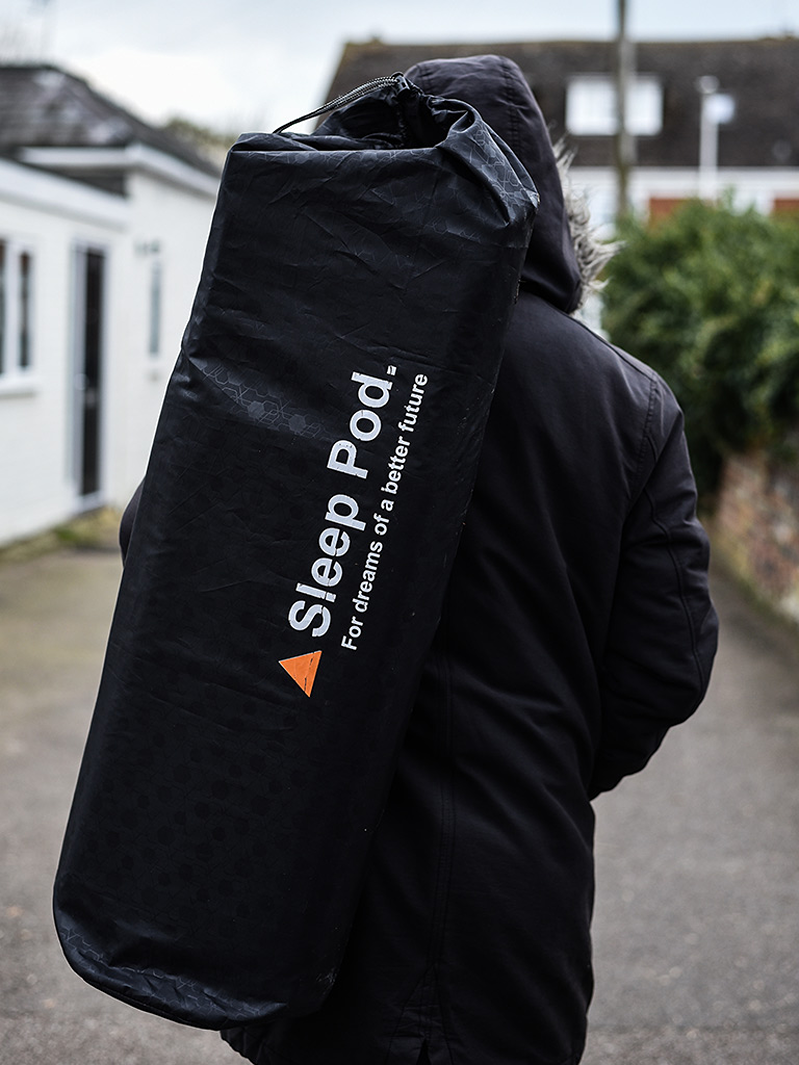
Sleep Pod is a £30 ‘sleeping tent’ that is resistant to rain and wind – it’s also insulated to protect against the elements, but lightweight & easy to carry.

People who use these tents say that they get the best night’s sleep they have had since living on the streets. They are designed especially for severe weather conditions, and far easy to carry around thank blankets, which can get wet and heavy, in poor weather.
Sheltersuit (a wind-waterproof jacket)

Sheltersuit is a wind-waterproof jacket with a large hood to shield the face from rain and streetlights, with a built-in mattress & pillow.
It was invented in The Netherlands, by the designer who had heard that the (homeless) father of a friend had died of hypothermia. Made from upcycled materials, it’s given out free to homeless people across the world.
Common risks to homeless people include:
- Exposure and hypothermia: Prolonged cold can drop body temperature dangerously low.
- Trench foot and frostbite: Wet or frozen feet cause pain, infections, and even permanent injury.
- Heatstroke: In summer, concrete gets blisteringly hot, adding sunburn and dehydration to daily threats.
- Chronic illness: Cold nights and wet clothes weaken the immune system, inviting respiratory problems.
General Advice to Help Homeless People
England presently has around 250,000 homeless people (including rough sleepers, sofa-surfers and people living in bed-and-breakfasts). Also read how to help dogs that live with homeless people.
Homeless people can claim benefits (usually Universal Credit), giving the address of a family member or friend, local hostel or job centre. This helps to pay for food (and pet food), job interview clothes and accommodation deposits.
People without bank accounts can use the government’s Payment Exception Service to collect benefits from a local post office or PayPoint outlet.
If you see someone sleeping rough, send a report to StreetLink, whose outreach teams visit rough sleepers at night, to alert them of support to find benefits and accommodation (if the person is under 18, call 999).

ShowerBox (London and Birmingham) run mobile showers in the two cities that have the highest percentage of homeless people.
The founder (a volunteer for homeless charities) heard that donating clothes to homeless people is virtually useless without showers, as the person needs to be clean, for the clothes to be clean and fresh too, for comfort and interviews etc.
Local people also benefit from hot drinks, free underwear and free use of hair clippers.
With enough support, this could become England’s version to ShowerUp, a US organisation that is sponsored by local businesses and churches, to provide mobile showers throughout several states, combined with volunteers (some also give haircuts).
We are not here to make ‘dirty people’ clean. We are here to give hopeless people HOPE!
Many councils in England charge to use public toilets (for residents and tourists). So where do homeless people visit the bathroom, if it’s illegal for them to pee or poo in the streets? If a child walks by, this can bring charges of indecent or even being classed as sex offenders. Councils need to sort this out.
The city of Miami has installed public toilets for homeless people, and even Pope Francis set up a free laundry for homeless people in Italy. Why are we so behind?
Lack of hygiene can lead to infections, skin issues and managing diabetes. Bad smells and stained clothes, also pushes homeless people further away from integration into society (getting job interviews to gain income and find accommodation etc).
Free Shower/Laundry Ideas for Homeless People
One Voice Mobile Showers (Australia) offers has vans that park in busy areas, where volunteers offer showers, towels and toiletries.
Orange Sky Australia has bright orange vans fitted with washers and dryers, so homeless people can wash their clothes for free, and enjoy a hot shower.
Pit Stop (San Francisco) offers free public bathrooms for homeless people with soap and hand towels, plus secure areas to dispose of dog poop (and needles, to avoid drug addicts littering public areas). The bathrooms are painted in bright colours by local artists, and interestingly, these are staffed by paid attendants, to boost safety and stop vandalism.
General Advice to Help Homeless People
England presently has around 250,000 homeless people (including rough sleepers, sofa-surfers and people living in bed-and-breakfasts). Also read how to help dogs that live with homeless people.
Homeless people can claim benefits (usually Universal Credit), giving the address of a family member or friend, local hostel or job centre. This helps to pay for food (and pet food), job interview clothes and accommodation deposits.
People without bank accounts can use the government’s Payment Exception Service to collect benefits from a local post office or PayPoint outlet.
If you see someone sleeping rough, send a report to StreetLink, whose outreach teams visit rough sleepers at night, to alert them of support to find benefits and accommodation (if the person is under 18, call 999).
Around 250,000 people in the UK are currently homeless. This includes rough sleepers, people staying in homeless hostels, people staying in temporary bed-and-breakfast accommodation and so-called sofa surfers (staying with friends, while they find somewhere more settled).
And of course, many homeless people have canine companions too. Read our post on how to help homeless people with dogs.
Our homelessness tag deals with solutions to help people who are homeless, or at risk. This post is more to encourage understanding and empathy, as there are so many myths on why people become homeless.
If we are going to prevent homelessness (and it can be done – Finland and Denmark have both almost reached their target of ‘zero homelessness), then it’s important to forget myths perpetuated by some politicians and parts of the media.
And learn the main reasons why people become homeless. As often they are not what you think. And possibly a lot closer to home, than you would like to think. We’re talking not about people who drink methylated spirits on the street. But more about rising rent costs, and lack of affordable accommodation.
Read They Just Need To Get a Job, a book of 15 myths to dispel, written by someone who works with homeless people, and wishes to counteract the wrong information, that most rough sleepers are there, due to causing their own problems.
Making it so you don’t have to look at homeless people, isn’t a solution to homelessness. Sara Luterman
Homelessness Is Not Always ‘Poor Choices’
Sometimes it could be. But often it’s due to life simply crashing down on someone. Being widowed or divorced, mental health issues or even escaping from domestic abuse.
Becoming ill or disabled can drain someone’s savings very quickly. Especially if health issues interrupt work and income.
Unaffordable Rent or Mortgage
This is a main issue. Today rents are sky-high, so people have to spend a far bigger portion of their income on paying for accommodation. This is often due to the landlords having sky-high mortgages (thanks to that budget a few years back).
Now in order for landlords to keep their own home, they sometimes have to charge a higher rent, to keep up with mortgage payments. If not, then they may not be able to afford the mortgages on their own homes. So it could end up with two people homeless.
Poor Rights for Renters
Unlike in Germany and Italy (where renting is the norm), in England there is little regulation to protect tenants from exploitative landlords.
Most are likely fine, but the housing charity Crisis wants a Local Housing Allowance, so tenants receive help to match higher rents. And get more protection from eviction.
No Help to Find Work
Apart from having to phone in to say they have searched for work, the system does not really offer much incentive or help homeless people. He or she will need help for travel costs, showers and interview clothes, even before applying for a job.
But if someone has no access to any of these, it’s unlikely that person is going to come off benefits, and get a job that pays enough to rent a home.
Not Claiming Benefits
Homeless people can claim benefits (usually Universal Credit), giving the address of a family member or friend, or a local hostel or job centre. Having this income helps pay for food (and pet food), interview clothes, and accommodation deposits.
People without a bank account can use the government’s Payment Exception Service to collect benefits from a local post office or PayPoint outlet.
The media make out that people claiming benefits are all sitting at home watching large-screen TVs. In fact, most unclaimed benefits are from the vulnerable in society who often don’t have access to the Internet – including homeless people, older and disabled people.
Homelessness Does Not Just Affect Single Adults
Many homeless people are entire families, children often hidden from the media soundbites of ‘the average homeless person’. Many of these families are escaping domestic abuse situations. Read our post on help for domestic abuse (including help for pets).
Sometimes you also have teenagers and young adults fleeing from unsafe homes. You can even have couples living in cars with full-time jobs, they just cannot afford local rent prices.
Homeless People Do Indeed Want Help
If you spent your nights on a freezing cold street with no money or food, no warmth or comfort – and people judging you, you would not want your life to continue like that. It’s cold, boring and dangerous.
Don’t believe that ‘homeless people choose to live this way’. Only a tiny minority do. Most would love to be given a helping hand to find a job, income and safe stable home.
Many homeless people are urinated on, get attacked or robbed, and are often shunned by society. Who would want to live this life?
Most homeless people in England, due in their late 40s. Some due to alcohol and drugs. But more due to hypothermia or other illness, or simply lack of self-care.
People who are homeless are not social inadequates. They are people without homes. Sheila McKechnie
Not All Homeless People are Addicts
We all hear that homeless people are sitting on the street, drinking a bottle of whisk. For a start, most people sleeping rough could never afford it. And if you were freezing cold on the streets, you likely would take a dram or two yourself, so never judge.
It is true that around a third of homeless people struggle with addiction or mental illness, or both. But nearly all of them would take up help, if offered.
Not everyone who’s homeless is a drug addict. Some are normal people who’ve been knocked down, and it can happen to you too. Sherrilyn Kenyon

The Big Issue (also in a version for northern England) stands as a powerful voice for those without a home. Since its launch in 1991, it’s given thousands of people a real way to work and rebuild their lives.
From humble beginnings to international impact, the magazine has created independent income and jobs for thousands of homeless people, and educated others too.
Read our post on helping rough sleepers that live with dogs.
Founder Lord John Bird grew up in poverty, and spent time in prison, before becoming one of England’s champions of preventing homelessness (he was once asked to stand as London Mayor – he refused, so they got Boris Johnson instead!)

The model of The Big Issue is ‘a hand up, not a hand out’. Vendors buy magazines for £2 and sell them on for £4, keeping the difference. This approach treats homeless people as entrepreneurs, not victims.
The magazine covers stories about poor housing, mental health, and low wages. It challenges policies that leave people struggling. And also starts conversations that reach politicians, businesses, and the public.
Instead of being anonymous, homeless people get to even write stories and talk of how they became homeless, to readers a window into lives shaped by struggle. And this breaks down the stigma of homelessness.
The movement is now international, with many street newspapers worldwide. MP,s charities often listen when Lord Bird speaks. From Australia to South Africa, street papers now help people out of poverty. The International Network of Street Papers, has been the end result.
People who are homeless face many barriers, when finding work:
- No fixed address: Job applications often ask for a current address. Without one, many get filtered out before an interview.
- Limited access to hygiene: Turning up to an interview clean and tidy isn’t always possible when living on the street, or in temporary hostels.
- Transport struggles: Getting to a workplace or interview means juggling bus fares or long walks, which can make holding down a job tough.
- Social stigma: Many employers turn away applicants due to bias.
Jobcentre Plus is the online version of the high street Job Centre. Unlike Indeed etc, you don’t have to always have fancy CVs, and can often find well-paid local jobs. Ask about the Flexible Support Fund, which can help with interview travel costs and work clothes.
Crowdfund Training for Homeless People
Beam (London) works by crowdfunding people who tell you their stories. Learn why they became homeless and what their dreams up, then pool together to help train them up. Recipients so far have become gardeners, beauticians, builders and support workers.
One recipient had a job as a trained security guard, but was living in an overcrowded tiny flat with his son, who had a two-hour journey to school.
Thanks to BEAM supporters, they now live in a spacious flat near shops, and there’s a bus stop nearby, so they both have to travel less, to reach work and school. He says he is immensely grateful (read the comments from supporters, it makes you realise that most people are good).
Donate Furniture and White Goods to Emmaus
Emmaus has nationwide shops where you can donate unwanted furniture and white goods, which are restored (and PAT-tested for safety) by homeless people who receive jobs, training, homes and income in return.
This charity was founded by a Catholic French priest, after he heard of a baby who had died on the cold Paris streets (and a young woman froze to death, clutching her eviction notice).
There has been recent controversy over homeless people being ‘removed’ from the city to house the Olympics. And also allegations of sexual abuse by the charity founder, which is leading to an upcoming change of name.
How to Help Homeless People in England
There are presently around 250,000 homeless people in England (this includes rough sleepers, sofa-surfers and people living in temporary bed-and-breakfast accommodation).
Homeless people can claim benefits (usually Universal Credit), giving the address of a family member or friend, or a local hostel or job centre. Having this income helps pay for food (and pet food), interview clothes, and accommodation deposits.
People without a bank account can use the government’s Payment Exception Service to collect benefits from a local post office or PayPoint outlet.
If you see someone sleeping rough, send a report to StreetLink, whose local outreach teams visit rough sleepers at night, to alert them of support to find benefits and accommodation (if the person is under 18, call 999).

The main cause by far of homelessness in England is lack of affordable housing (including sky-high rents, due to higher mortgage payments for property owners – a sad legacy of the short time in power of Liz Truss).
Also read our post on innovative affordable rental ideas.
Read our post on helping rough sleepers that live with dogs.
Something has obviously gone seriously wrong, especially compared to countries like Finland (which has reached almost zero homelessness thanks to non-profit landlord Y-Säätiö.

This works with councils to build on-demand furnished M2-Kodit homes (above and below) that are energy-efficient, with access to green space, public transport and laundries).

Unfortunately, the new Labour government has now taken this to knee-jerk reaction, and plans to destroy much of our countryside and wildlife, by relaxing planning laws, in order to build affordable homes.
We can easily build affordable houses on brownfield land, and there are way more innovative (and cheaper) ideas that give affordable homes, along with protecting nature.
City Pods in Seattle, USA

Seattle’s City Pods (above) are assembled in a few hours to convert vacant offices & warehouses into fully-furnished fire-compliant housing (designed to last 10 years).
In the UK, SoloHaus homeless pods are light and airy modular homes that are quick to build and easy to transport, and can be adjusted in size or added together, to accommodate homeless families.
They are delivered fully-furnished with fitted kitchens, low-energy white goods and cabling for broadband and TV.
Affordable Flat-Pack Homes from Italy

Another good ‘flat pack’ house company is Italy’s MADI (these can be built in 3 months, and are even earthquake-proof, so good to house homeless people abroad after natural disasters).
Transforming Old Buses into Cheap Homes
Many organisations are now using decommissioned buses to help homeless people. Buses 4 Homeless converts London double-deckers into areas for sleep, cooking, training and holistic support.
Blackpool also has its own Big Red Night bus that offers a warm safe place to at night with laundry & shower facilities.
Although Australia’s Sleepbus appears to no longer be in operation, it was a fantastic idea. It offered climate-controlled pet-friendly sleep pods with lockable doors and toilets (including a Pink Sleepbus to help families escape domestic violence).
The organisation has also recently launched Homepody, an affordable emergency accommodation solution that’s safe and cost-effective, with self-contained modular units with a capped accommodation fee and free electricity, WIFI and laundry facilities.
Update: this organisation is urgently raising funds, due to rising costs, to keep the service running. Hopefully it will continue, but remains a great idea to emulate.
How to Help Homeless People in England
There are presently around 250,000 homeless people in England (this includes rough sleepers, sofa-surfers and people living in temporary bed-and-breakfast accommodation).
Homeless people can claim benefits (usually Universal Credit), giving the address of a family member or friend, or a local hostel or job centre. Having this income helps pay for food (and pet food), interview clothes, and accommodation deposits.
People without a bank account can use the government’s Payment Exception Service to collect benefits from a local post office or PayPoint outlet.
If you see someone sleeping rough, send a report to StreetLink, whose local outreach teams visit rough sleepers at night, to alert them of support to find benefits and accommodation (if the person is under 18, call 999).
Alternatives to Hostile Architecture

Hostile architecture is a horrible idea, that is fast filling modern towns and cities. Designed to stop homeless people from sleeping in parks or on benches, or in bus stops.
Common examples are now found in bus stops (‘armrests’ in the middle to stop someone lying down) or narrow seats that ‘tip up’ if anyone tries to sit on them (which stops older and disable people resting, while waiting for public transport).
Architect James Furzer was so appalled at councils fitting metal bars and spikes to benches so homeless people can’t sleep on them, that he created ‘homeless pods‘ (modular shelters that affix to existing buildings and are warm, clean and safe).
James says homeless people are often victims of theft and violent crime, and 10% have even been urinated on. Made from scrap materials, these pods can even be made to match the colour of host buildings, with stowaway ladders when not in use.
Obviously it’s good to create communities where homeless people are looked after and have safe places to sleep. But to simply ignore the issue, and then ‘add spikes’ to stop someone getting some rest, is one of the worst ideas in town planning ever.
It sends a strong message that homeless people don’t matter, and they need to ‘move on’ -but to where?
Communities Don’t Like Hostile Architecture
Recently, 3000 people signed a petition protesting against Selfridges installing spikes outside its premises. The store said the measure was taken to stop staff smoking, but others believed it was to stop homeless people bedding down for the night in doorways.
A Tesco branch also had to remove deterrents, after complaints from local residents.
And a block of London luxury flats had to remove hostile architecture, after a petition reached over 100,000 signatures. All were angry that councils believe homeless people are not welcome and ‘a problem to move on’, rather than actually doing something practical to help.
In the city of São Paulo (Brazil), the council filled underpasses with large rocks. A local priest was dismayed, and dismantled them all, in a brave act of defiance.

Now here’s a question. If we have a country of around 250,000 homeless people (that includes people living in bed-and-breakfasts, rough sleepers, those staying in Travelodge and ‘sofa-surfers’), what are the churches doing?
Also read our post on helping dogs that live with homeless people.
There’s no doubt that small local churches do try to help. But we have the official (Church of England) that owns billions of pounds worth of properties and an income of around £900 million a year.
And the Catholic church (the other main religion) is one of the richest organisations in the world. Hello? Jesus Christ? Simple living?
Churches are often at the heart of neighbourhoods. And whether residents are religious or not, churches remain one of the few places where often you can find help, where there is no ulterior motive (to buy something, to vote for someone etc).
Local faith groups have both people power and compassion, to help prevent homelessness in towns and cities, something that most councils have failed at.
Understanding Root Causes of Homelessness
Unlike politicians or the media, most church leaders are compassionate towards the main causes of homelessness, and know that often it’s not a cause of ‘roll up your sleeves, get on your bike and find work’. Most homelessness in modern society is due to:
- Economic hardship: Lost jobs, low wages, and rising bills can leave people unable to pay rent or mortgage.
- Mental health challenges: Depression, anxiety, or addiction can push someone out of stable housing, if support isn’t available.
- Lack of affordable housing: With rents outpacing incomes, even working families can find themselves at risk.
- Relationship breakdowns: Family disputes or domestic abuse force people to leave home with nowhere to turn.
Providing Emergency Accommodation
Not all, but many churches open their halls on cold nights, to offer emergency shelter. They work with local councils and charities to make sure people have a safe place to sleep, while they get back on their feet. Many train volunteers to support and welcome guests.
Running Food Banks and Community Meals
When money’s tight, food becomes a worry. Churches can run food banks or weekly meals for people struggling to stretch incomes. These small acts give families breathing space while working towards longer-term stability.
Churches can collection food donations from parishioners and local shops (also reduces food waste). They can then organise meal nights in community halls.
Distributing Clothing and Hygiene Essentials
Clean clothes and basic hygiene can feel out of reach, during hard times. Churches often work with donors to run drives collecting coats, socks, toiletries, and more.
Note clean clothes usually only ‘works’ if homeless people also have access to regular showers and laundries.
Churches Investing in Homeless People
Green Pastures is a unique social enterprise run by Christians, that works a bit like an ethical investing firm. The difference here is that your savings are used for them to buy up properties, which are then used to house homeless people, and transform lives.
You eventually receive your money back (with interest). And you get to completely alter the course of someone’s life in a positive way. As well as a home, each homeless person receives ‘wraparound support’, to get their life back to one of stability and comfort.
You can invest from £1000 for one or more years, choosing to earn interest of up to 5% each year. Every £30,000 or so helps them to house someone in need. Investments are unsecured (so not secured by say a property).
There’s a calculator online, to estimate how much you would earn, and how you could help. For instance, if you invested £30,000 over 3 years at an interest rate of 3%, you would earn £2,700. While also helping to provide a home for at least one homeless person.
A big company that invested £500,000 over 1 year, would earn £15,000 in interest, and provide homes for 17 homeless people. Longer-term investments with lower interest rates, allow them to help more homeless people.
So far, Green Pastures has managed to buy up property and give homes to almost 2000 people nationwide (UK) and already has almost 2000 investors saving a collectively £50 million or so.
Two similar organisations are:
Hope into Action lets investors retain ownership of the house, who leases it for 5 years. This organisation then finds tenants to live in the house, and provides support and maintenance. This offers a 2% annual return on your investment, a method that has proven successful with tenants, churches and investors.
Church Homeless Charity is a tiny organisation that receives no funding from the Church of England (despite it having an income of over £900 million plus billions worth of property). So it asks churches to assist personal givers, to donate towards grants for homeless people.
Examples are new clothes for interviews, passports (so people can pass ID checks for jobs & homes), and furnishing/deposits on new homes.
And don’t believe all you read in the papers. This is a Christian charity that will help anyone, no matter their gender, sexuality, race or religion. Or for whatever reason they became homeless.
More Ways Churches Help Homeless People

The Salvation Army is our main ‘Christian charity’ that helps homeless people. As well as donating unwanted clothing in their charity banks, you can bank with Reliance Bank Ltd (which gives a lot of its profits to the Sally Army), as does SAGIC Insurance.
Donations also help this organisation to provide Nap Pads (emergency accommodation in small pods that are light & airy with a window, secure front door, bed, toilet, hand basin and storage area, plus connection to heat, running water and phone charging).
They even have sensors (similar to that preventing crib death) to alert people, if someone stops breathing.
Churches Don’t Open Doors Abroad
A recent experiment in the Pacific Northwest (which has similar cold rainy weather to us in England) asked local churches to open their doors to homeless people, during a very cold snap of weather.
The US states of Washington, Oregon and Idaho (along with British Columbia in Canada) were covered in snow, with freezing temperatures and high winds.
So the mayor of Washington asked 227 places of worship to consider temporarily housing homeless people, to stop them getting hypothermia. She expected that as they all worshipped Jesus Christ, they would say yes. Just four did.
Of course, they all made excuses. They were fearful of property damage or they had no liability insurance, or they feared local people would be upset. Despite reassurances from volunteers that each church would have 20 to 25 (vetted) homeless people, who would have people to keep watch.
In 2017, one of those millionaire mega-pastors (that travel on private planes while preaching the simple living of Jesus), refused to open its huge church during a major hurricane. Again it was due to ‘safety issues’.
How to Help Homeless People in England
There are presently around 250,000 homeless people in England (this includes rough sleepers, sofa-surfers and people living in temporary bed-and-breakfast accommodation).
Homeless people can claim benefits (usually Universal Credit), giving the address of a family member or friend, or a local hostel or job centre. Having this income helps pay for food (and pet food), interview clothes, and accommodation deposits.
People without a bank account can use the government’s Payment Exception Service to collect benefits from a local post office or PayPoint outlet.
If you see someone sleeping rough, send a report to StreetLink, whose local outreach teams visit rough sleepers at night, to alert them of support to find benefits and accommodation (if the person is under 18, call 999).
10 Ways Churches Strengthen Communities
Local churches have always played a strong role in building better neighbourhoods. Their impact often reaches far beyond Sunday services. Churches bring people together, offer practical help, and add hope where it’s needed most. Here’s how local churches support and uplift the communities around them.
Providing Food and Basic Needs
Many churches run food banks or help distribute groceries to families who are struggling. These programmes often include essentials like fresh fruit, tinned goods, toiletries, and clothing. Families facing hard times know they can count on their local church for support, turning worry into relief.
Running Youth and Children’s Activities
Churches often provide a safe place for children and teenagers. Sports clubs, homework help, music groups, and after-school programmes keep young people busy and supported. These groups build friendships and offer encouragement, especially for those who might not find it elsewhere.
Supporting Mental Health and Wellbeing
Trained volunteers and ministers offer someone to talk to when life feels tough. Churches host support groups for grief, addiction recovery, and stress. Many partner with mental health professionals or charities to help people access the care they need, showing every person matters.
Hosting Community Events and Social Gatherings
From summer fairs to Christmas markets, churches invite everyone to join in. These events connect neighbours, create fun memories, and strengthen the bonds that hold a town or village together. They help keep loneliness at bay and make newcomers feel welcome.
Offering Practical Help for the Elderly
Many seniors rely on their church for lifts to appointments, shopping runs, or a friendly visit at home. Churches often organise coffee mornings, meals, or day trips for older adults. This practical care makes ageing less lonely and keeps people independent for longer.
Promoting Volunteering and Community Service
Churches encourage their members to get involved in the wider community. This often means helping local schools, caring for green spaces, or joining clean-up days. By working together, they show what can be achieved by giving time and effort for others.
Providing Emergency and Crisis Support
When disaster strikes, churches respond fast. Whether it’s a house fire, flood, or loss of income, many churches distribute emergency funds or shelter. They partner with local councils or charities to meet urgent needs and help families recover.
Championing Education and Life Skills
Some churches run free classes in reading, English, digital skills, or financial advice. These programmes break down barriers and help people gain confidence. Parents, new arrivals, and jobseekers all benefit from practical learning right in their own neighbourhood.
Sharing Faith and Spiritual Guidance
Many turn to the church for comfort, prayer, or guidance in hard times. Churches offer a calm space for reflection and support, regardless of personal beliefs. Even those not attending regularly can find peace talking with a minister or joining a quiet moment of worship.
Standing Up for Justice and Community Needs
Churches often speak up for the most vulnerable, raising awareness of poverty, homelessness, or injustice. They organise petitions, host forums, and work with other groups to make local leaders pay attention. Their presence helps shine a light where it’s needed most.