Why (real) Christians Listen to Climate Science
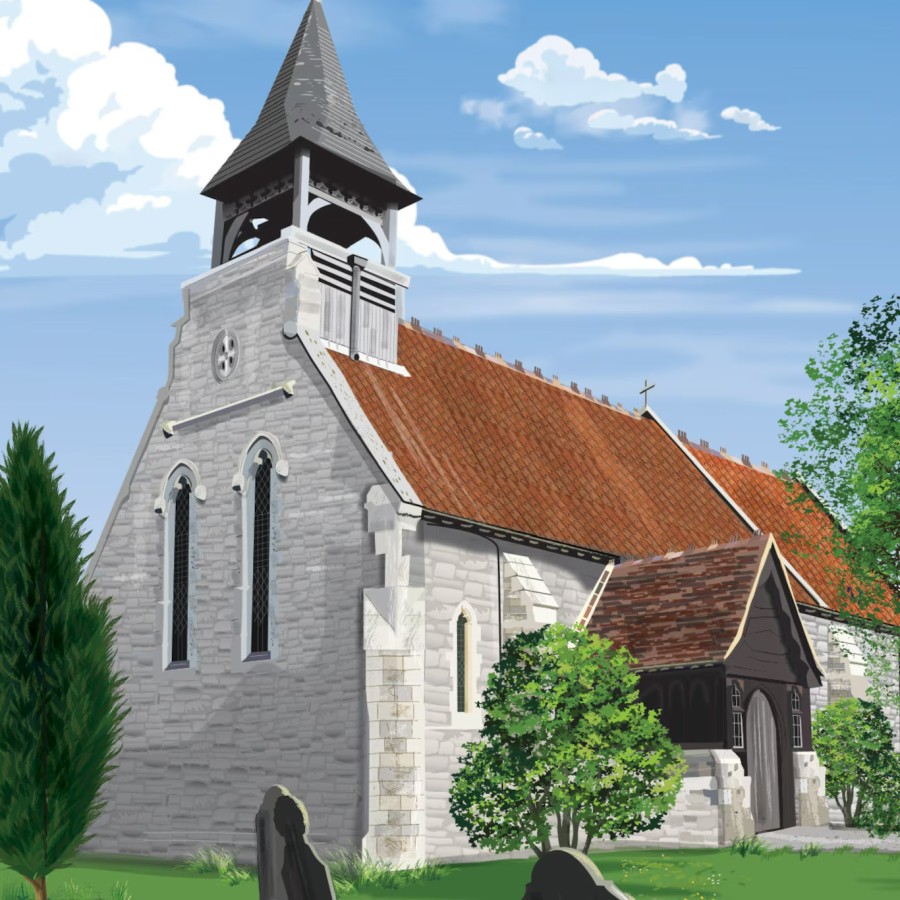
Churches are the heart of our communities. And whether residents are religious or not, they can do a huge amount of good for parishioners and the wider community (including native wildlife).
Also read how churches can provide home for bats and owls.
Ideas to Make Your Church More Sustainable
- Making Your Church Sustainable looks at how to develop a plan to suit your church in a world of pressure on budgets and soaring energy costs. Learn how to improve church maintenance practices, and find alternative ways to heat your church.
- Earn a certificate at Eco Churches, to also save a fortune on bills. The site has free books on green energy, wildlife-friendly lighting, boilers, heating and recycling.
Choose Soot-Free Church Candles
Most churches light candles, whether it’s for a service or for parishioners to light in memory of loved ones. Paraffin candles support the oil industry, and cause indoor air pollution.
Soot-free soy candles burn cleaner than paraffin ones. Choose unscented, due to allergies, pregnancy, babies and pets.
Follow candle safety tips. Before lighting, trim wick to 1/4 inch and keep free from trimmings and matches, and don’t burn for more than a few hours. Place candles on stable heat-resistant surfaces.
Switch Church Money to Greener Causes
JustMoney Movement has a free guide for churches to switch to greener banks and campaigns for a Wealth Tax of 1% to 2% on those with assets over £10 million (which could raise £50 billion).
An annual wealth tax of up to 5% on the world’s billionaires and multi-millionaires could raise enough money to lift 2 billion people out of poverty. Download an ethical buying guide for churches.
Looking After Churches (and residents!)
- Reduce your footprint with the free carbon calculator. This was developed by the son of ecological writer Satish Kumar, who once built his own solar-powered boat and sailed it around the British Isles. This should also reduce bills enormously.
- CosyGlazing is an affordable lightweight alternative to glass, which is approved for use on sash windows, to reduce heat loss by around 70%. It uses plexiglass (used in the aeronautical industry), and approved for listed buildings.
- Historic England has an extensive guide on how to maintain and repair ancient stained glass windows.
- Create a non-profit pop-up café. This not only gives local people somewhere to enjoy an affordable drink, but enhances community and friendship.
- Adopt an unused phone box. This scheme run by BT, lets you buy an old red phone box for £1, after approval. Communities use them for everything from installing community defibrillators to mini-book libraries (you could use it perhaps for religious books?)
- Host Climate Sundays. Instead of holding conventional services, inspire communities with free mass services on how to help our beautiful planet.
How to ‘Plant’ Your Own Wild Church!

Field Guide to Church of the Wild is a smashing book, which could do wonders, if all places of worship invested in a copy (or got gifted one!) Co-written by a spiritual guide and the founder of the worldwide Wild Church Network, it’s a guide for anyone who wishes to reconnect their spirituality with the natural world.
Also read of sustainable swaps for green churches, and how churches can provide homes for roosting bats and nesting owls.
Many of us love Nature and love God, and it seems in the modern world, some people seem to think they are separate from each other (drill the Arctic, destroy polar bear homes, then pray in church?)
This book has a different outlook, including prayers, stories and practical resources for any church who believed that we are guardians of the Earth that God created.
You’ll also meet leaders and participants of the Wild Church Movement, offering wisdom from the hundreds of wild churches that are now blooming across our planet.
Victoria Loorz is a wild-church pastor and Patreon writer. She has become a leading voice in the wild spirituality movement that regards respect for nature and loving God, as being on the same path.
Valerie Luna Serrels is co-founder and director of Wild Church Network. She holds a masters degree in peacebuilding and conflict transformation. Her own Wild Church (Virginia) meets in a forest, where the ‘teachers’ are trees, cardinals, finches and ancient lichen. How refreshing!
The website has a directory of inspirational churches. One is the fantastically-named Texas town of ‘Dripping Springs’, which commits to:
Growing our Faith
Honouring & Engaging Our Children
Being in Service to Our Community
Caring for God’s Creation
Valerie invites anyone in England (or anywhere) wishing to start a Wild Church community to contact her!

If God Were a Great Big Bear is a beautiful book, to celebrate God and his creations, in the form of nature. Ideal for all reader ages, the book revels in the joy of nature, and the One who made it all.
A rhythmic meditation on the nature of God in the world, this book invites you to imagine God creating each element of nature, especially for the benefit of all creatures and plants that He lovingly made:
If God were a mighty whale, she’d make vast, mysterious oceans, wouldn’t she?
If God were a wiggly worm, he’d make fallen leaves and rotting trees and rich earth, wouldn’t he?
God also made several natural scenes for us to appreciate and look after:
- Rushing streams
- Mountains with caves
- Sun to warm flowers
- Red and orange trees
- Seas full of marine friends!
God is in all of Creation, and in you and me. God made a perfectly balanced interconnected world, not just for humans (to drill oil, fish and pollute) but for all animals and plants to thrive in.
Paul Harbridge is an award-winning children’s book author in Toronto, Canada. Surrounded by beautiful lakes and forests. Illustrator Marta Dorado lives in Pamplona (Spain) where she enjoys exploring nature and the coast.
The Beauty of God’s First Sacred Text

The Book of Nature is a book to gift any Christian who does not see looking after the planet as high priority (think far-right evangelical Christians both here and in the US). Or to Christians (or anyone) who loves the planet, and sees it as a gift from God for us to look after.
For thousands of years, the natural world was our sacred text. By the Middle Ages, the text was given a name. But today when nature is damaged from disasters and human actions, we need again to return Nature as a place of refuge and retreat.
In this book, science and the wisdom of poets is weaved with a gentle spiritual practice, a framework of the Divine work of the Creator. God’s first revelation came to us through ongoing creations:
- The rumblings of the heavens
- The seasonal eruptions of earth
- The invisible pull of migration
- The tide and times of the oceans
- Celestial shiftings
Draw back into nature as a sacred encounter. We need look no further than the Divine to find Nature at its best.
I am attuned to the one who paints the dawn in tourmaline streaks and salts the night sky in chalky, sometimes brilliant flecks. The one who thought to quench the thirst of the migrating butterfly with mists of fog.
And remembered that baby birds might do well to memorise star-stitched tracings far, far above the nursery that is the nest.
Barbara Mahany is a writer whose work has been published in the Chicago Tribune for almost 30 years, mostly on nature, faith and family. She lives in Illinois, USA.
Permission to wonder, get curious and find God in the tiny details of a sprouting garden, a forest glade, birds in flight or the moon. Reminds us that there are different ways to encounter God all around us, beyond Scripture.
The Book of Nature is a book to gift any Christian who does not see looking after the planet as high priority (think far-right evangelical Christians both here and in the US). Or to Christians (or anyone) who loves the planet, and sees it as a gift from God for us to look after.
For thousands of years, the natural world was our sacred text. By the Middle Ages, the text was given a name. But today when nature is damaged from disasters and human actions, we need again to return Nature as a place of refuge and retreat.
In this book, science and the wisdom of poets is weaved with a gentle spiritual practice, a framework of the Divine work of the Creator. God’s first revelation came to us through ongoing creations:
- The rumblings of the heavens
- The seasonal eruptions of earth
- The invisible pull of migration
- The tide and times of the oceans
- Celestial shiftings
Draw back into nature as a sacred encounter. We need look no further than the Divine to find Nature at its best.
I am attuned to the one who paints the dawn in tourmaline streaks and salts the night sky in chalky, sometimes brilliant flecks. The one who thought to quench the thirst of the migrating butterfly with mists of fog.
And remembered that baby birds might do well to memorise star-stitched tracings far, far above the nursery that is the nest.
Barbara Mahany is a writer whose work has been published in the Chicago Tribune for almost 30 years, mostly on nature, faith and family. She lives in Illinois, USA.
Permission to wonder, get curious and find God in the tiny details of a sprouting garden, a forest glade, birds in flight or the moon. Reminds us that there are different ways to encounter God all around us, beyond Scripture.
The Story of a Planet-Friendly Christian
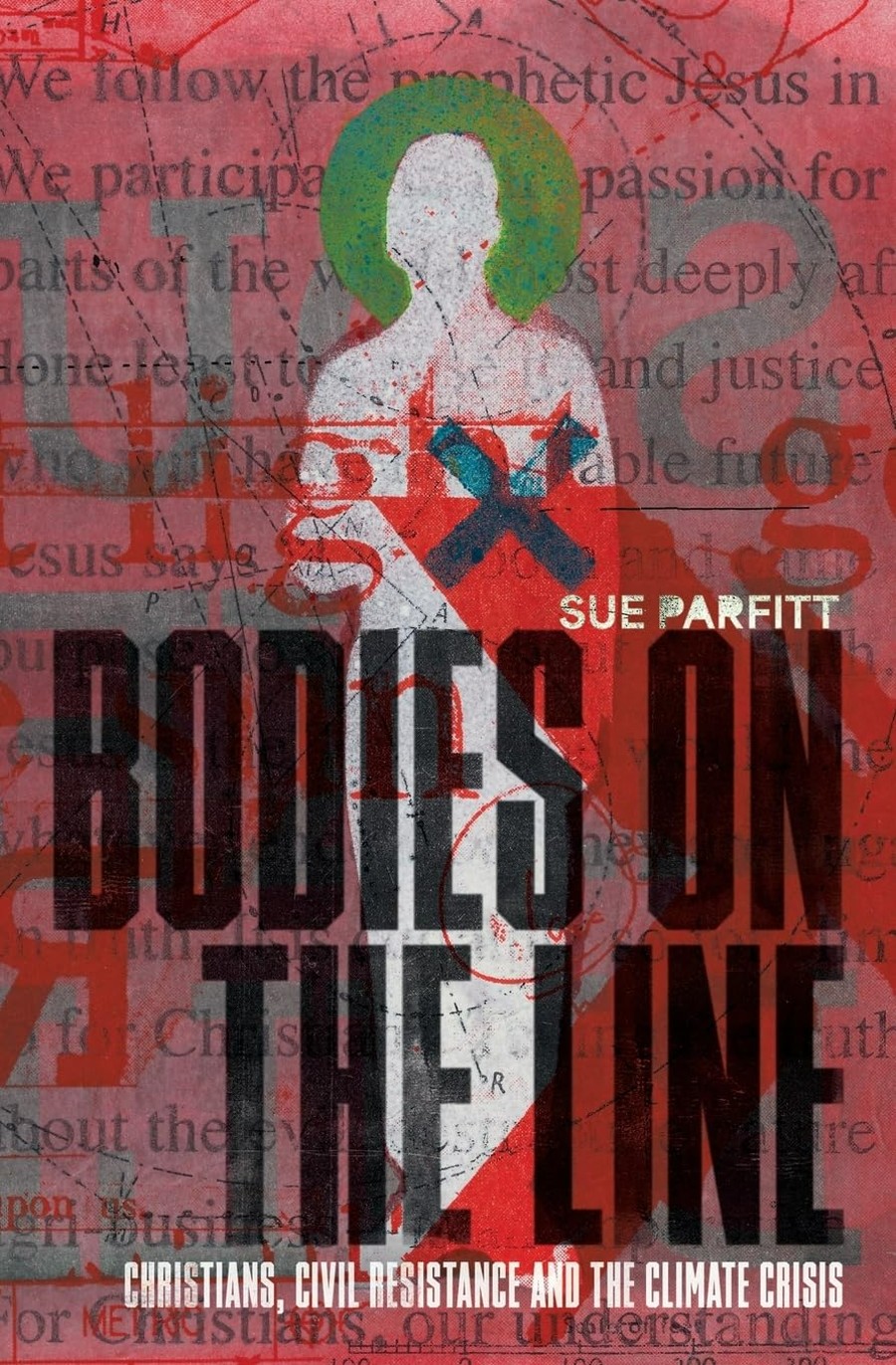
Bodies on the Line is the story on how Christians (many of whom have not got involved before, strange considering it’s God’s planet) are waking up to the climate crisis. And rediscovering the radical nature of the teachings of Jesus Christ. They are asking what God needs them to do to help, and putting their bodies on the line to do it.
Why are ordinary Christians now breaking the law? For the incredulous and inspired alike, the author describes the experience, as she surveys our ecological, emotional and spiritual crisis, with the blinkers off. You might want to be sitting down!
Bishop Laurie Green calls this book ‘astonishing’. Rev’d Jon Swales says ‘Read this book. Weep. Pray and act’.
Climate change awareness is hampered by the efforts of the fossil fuel industry with its huge worldwide interests in oil, coal and gas; by their lobbyists, and by the newspaper industry, who continue to undermine the truth of climate change.
In doing so, they help governments to avoid taking the draconian measures required to stop developing new coal mines and oil fields, fracking for gas or laying new pipe lines. Or indeed expanding airports, motorways, high-speed trains and the weapons industry.
Sue Parfitt is an 80-year old Anglican priest, who in October 2022 was arrested for peacefully holding up signs to ask governments to take the climate emergency seriously (like failing to insulate all homes, which would immediately cut wasted energy and make bills affordable).
She says ‘Jesus said I am the way, the truth and the life. Not being able to tell the truth undermines our faith’.
Her inspiration for this book came from Father John Dear (who writes the foreword), an American Jesuit priest and campaigner for peace and animal welfare, who was even turned away from one sector of the Catholic church, yet thankfully remains a priest in California. We need more like him.
Christians & The Climate Change Crisis
It’s odd that some of the most fervent climate-change deniers are people who profess to be those of strong faith (right-wing evangelical Christians in particular – Trump supporters for instance). The evidence is there.
Scientists’ best estimate is that roughly 100% of warming since the mid-20th Century is caused by human activity. The main producers of greenhouse gases are electricity generation and transport.
Current research finds that if humans weren’t around, the climate would actually be cooling slightly. To avoid the worst impacts, we need to stop burning fossil fuels and transition to renewable energy. Dr John Cook
So why on earth do we have MPs still obsessed by economic growth and fossil fuels? One big contract was recently awarded by Rishi Sunak’s government. He is Hindu, most of his former Cabinet are Christians. If they are people of faith, why were they destroying our planet?
In the USA, many Christians act like Donald Trump is the second coming of Christ, even though he’s a loose cannon who denies climate change and wants more fossil fuels to ‘make America great again’.
One religious leader who is taking climate change seriously is Pope Francis. Also a fan of animal welfare (hence why he took his Papal name after St Francis of Assisi), he appears to be on the side of environmentalists, promoting simple living.
But the Catholic church itself does not fare so well (The Vatican even takes $30,000 a month in rent from McDonald’s – a company that has huge criticism for policies on environment and animal welfare).
When he was Archbishop of Buenos Aires, Fr Bergoglio (as he was then known) frequently took the bus. He’s known to cook his own meals, wears normal clothes, and lives in a small apartment (refusing the grand palace rooms).
Yorkshire’s Stanbrook Abbey has solar panels, rainwater harvesting and a sedum (living) roof. Green Sisters is a wonderful book about ‘eco-nuns’ who drive around in electric cars, and replace manicured gardens to grow free food for parishioners. The best line comes from Mother Superior ‘anyone who saw the Divine in a potato, could never turn it into Pringles!’
Sr Dorothy Stang was an American nun, who lived with tribes in the South American forest, campaigning to keep their homes from loggers. She was eventually murdered by two men, apparently praying for their forgiveness as she died.
Do other religions protect the planet? You would think so, but not always the case. Surprisingly, India’s holy Ganges river is one of the most polluted in the world.
Even street dogs have turned blue, from drinking and bathing in water that suffers toxic run-off from dye used for the western denim jeans industry.
How Our Planet Came to Life

Becoming Earth is a book for the creationists to read, on the real story of how earth came into being, giving also a major shift on how to save our planet.
Earth is a vast interconnected living system that over billions of years, has transformed a lump of orbiting rock into our cosmic oasis, breathing oxygen into our atmosphere and turning rock into fertile soil and creating massive oceans.
This is a book that in the words of Steve Silberman ‘weaves science and history, with the grace of a poet’.
When I was a boy, I thought I could change the weather. On sweltering summer days in suburban California, I would draw a picture of blue rain and march around it on the lawn, splashing it with a potion of hose water and yard trimmings.
As I grew up, so did my understanding of meteorology. I learned how water evaporates from lakes, rivers and oceans.
Rain, I was taught, is an inevitable outcome of atmospheric physics – a gift that we and other creatures passively receive.
And due to long-term atmospheric ripple effects, the Amazon rainforest contributes to rainfall as far away as Canada. A tree growing in Brazil can change the weather in Manitoba.
Ferris Jabr is a contributing writer for The New York Times and Scientific America. He lives in Oregon (US). This is his first book.
This wondrous book reveals our living planet for the miracle that it is. Carla Safina
We tend to take our rare jewel of a home planet for granted. In his startlingly beautiful book, the author shows us exactly why we shouldn’t. Deborah Blum
A science writer with a poet’s soul, Ferris is among the few scribes worthy of serving as biographer for the life-encrusted rock we call home. Ben Goldfarb
There are times reading this book, when you feel like you are peering right down into the very heart of our living planet. It is quite simply, a work of genius. Robert Moor
Why Christians Should Speak Up on Climate Science
Some evangelical groups (in England, not just the USA) question or attack climate science, claiming a divine right to use nature as they wish. This attitude is not just harming the planet and other creatures, but already causing ‘natural disasters’ and famine for people worldwide – how does this denial align with the teachings of Jesus Christ?
Highlight churches that take real action to cut waste, protect green spaces, and support clean energy—following the Christian call to treat the Earth kindly.
Empower Young People and New Leaders
Climate scientist Prof Katharine Hayhoe says the ‘five flavours of climate denial’ (often used by right-wing political parties to ‘market to Christians’ are ‘It’s not real, it’s not us, it’s not bad, we can’t fix it and it’s too late’.
Such words were kind of mashed up and said in a different way recently by Reform UK’s Richard Tice. But his claims on climate (he has no climate science training) were rubbished by climate scientists.
Many young Christians are passionate environmentalists. Let young voices shape the future of green communities, making sure climate science wins out over out-dated, political data.
A YouGov study found 25% of under-30s said they would never vote Labour. In the year since the general election, Labour has gone from dominating the youth vote, to being a three-way race with Greens and Lib Dems. Reform (despite the headlines) isn’t even close. University of Exeter
The earth is the Lord’s and all that is in it. The world, and those who live in it. Psalm 24:1
Sue Parfitt is both a Christian and environmentalist. She became a nun soon after university and then a priest, and has been arrested around 28 times, for protesting peacefully on climate change and other issues.
We’re told by the scientists that even to slow the climate emergency down, to stop global warming by a fraction of a degree, will save millions of lives and huge amounts of suffering. That’s worth doing, isn’t it? Sue Parfitt
England’s churches stand at the centre of many towns and cities, visible reminders of our shared past. With their soaring towers and beautiful windows, many churches are both spiritual homes and pieces of living history.
Development pressures, though, put some of our finest buildings at risk. From threats of conversion to flats and offices, to rising traffic and noise, these sacred spaces face new challenges in a rapidly changing country.
Town Planning Laws and Their Impact
Planning laws are the first line of defence against insensitive building projects near historic churches. Local councils decide on new building work and changes of use, considering if the plans harm the character of an area.
In England, churches often benefit from tighter planning rules linked to their heritage importance. Even so, developers sometimes push for exceptions. Strong planning rules help protect both the sightlines and peace around these precious sites.
The Power of Local Campaigns
Communities can be strong defenders of their churches. Residents join local campaigns when they see plans for nearby developments that might harm their church. These groups can raise awareness, collect signatures, and lobby councillors to rethink plans for new flats, offices or roads that would spoil the setting.
Local newspapers and social media sites help get more people involved. Persistent, well-organised campaigns have stopped many unwelcome projects in their tracks.
The Role of Churches in History
Churches are more than just buildings. They hold the stories of their parish, reflect changes in society, and often keep important archives and monuments. From medieval times through the centuries, they’ve hosted everything from market days to concerts.
The engraved stones and stained glass tell vivid stories about local families and major events. Losing a church to new development would mean losing links to these fascinating layers of history.
Cathedrals as National Icons
Cathedrals like Canterbury, Salisbury, York Minster, and St Paul’s (London) show the very best of our architecture and craftsmanship. These buildings are known all across the country, drawing in millions of visitors every year.
Their sheer size and beauty demand respect. Cathedrals also act as visual anchors for towns and cities. Any development that spoils their settings or blocks their views would not only ruin the skyline but also affect tourism and local pride.
Threats from Commercial Developments
Converting old churches into luxury flats or glossy office blocks is tempting for developers due to their central locations and striking features. These changes can gut the interiors, rip out pews and altars, and erase centuries of history. Increased noise from new residents, heavy traffic, and commercial uses can also disrupt quiet church yards and peaceful services.
Without firm rules and public support, some churches risk being lost to high-end housing and business schemes.
Listed Building Status: A Shield for Heritage
Many churches are protected by listed status, which means they’re recognised by law as important historic buildings. This status limits what changes can be made and ensures that major work needs proper permission.
Listed status covers key features like towers, windows and even walls surrounding the churchyard. Local planning officers and Historic England inspect proposed developments to check they won’t harm the character or setting of these buildings.
Conservation Areas Offer Wider Protection
Some churches sit within conservation areas, where special rules limit new development and big changes. Conservation area status not only helps churches but also protects trees, old walls, and the surrounding neighbourhood look.
Development in a conservation area faces tough checks compared to other parts of town. This extra layer of protection means churches aren’t singled out but safeguarded as part of a wider historic scene.
Community Action and the Future
Churches that stay active and open to all tend to have a better future. When a church doubles as a venue, food bank or youth club, it gets support from more people. Volunteers and church friends often keep graveyards tidy and buildings in good repair.
Flexible use helps a church stay at the heart of community life, which makes it much less likely to fall into disrepair and risk redevelopment. Well-loved churches attract both funding and campaigners ready to fight for their future.
How are Churches Funded Abroad?
The days of asking people to put a tenner in the pot is soon to be over. Many people these days don’t use cash (either because it’s a hassle or due to boycotts as they are made with animal fat). And people increasingly see churches with a lot of wealth asking people on the breadline for money, not popular with all the abuse scandals.
Almost cashless Sweden is different in that people pay an optional church tax. This means that if the church does not use the money wisely, payments can be taken away.
It seems to work, and restores trust in givers too. The same happens in Germany where church tax is usually automatically collected, and then you have the option to opt out.
Around Britain (by Church)

Steeple Chasing is a book by an award-winning writer who decides to tell the story of Britain, by visiting church steeples that remain landmarks in our towns, villages and cities. Even if their influence and authority have waned, they contain art and architectural wonders – a gallery scattered (like jewels) across these isles.
Join Peter as he visits the unassuming Norfolk church with a disturbing secret and London’s mighty cathedrals with their histories of fire and love. Meet cats and bats, monks and druids, angels of oak and steel.
The book celebrates churches for their beauty and meaning, but also for the tales they tell. It is about people as much as place, flesh and bone (not just flint and stone). From the painted hells of Surrey to the holy wells of Wales, consider this a travel book … with bells on.
Exploring England’s Forgotten Churches
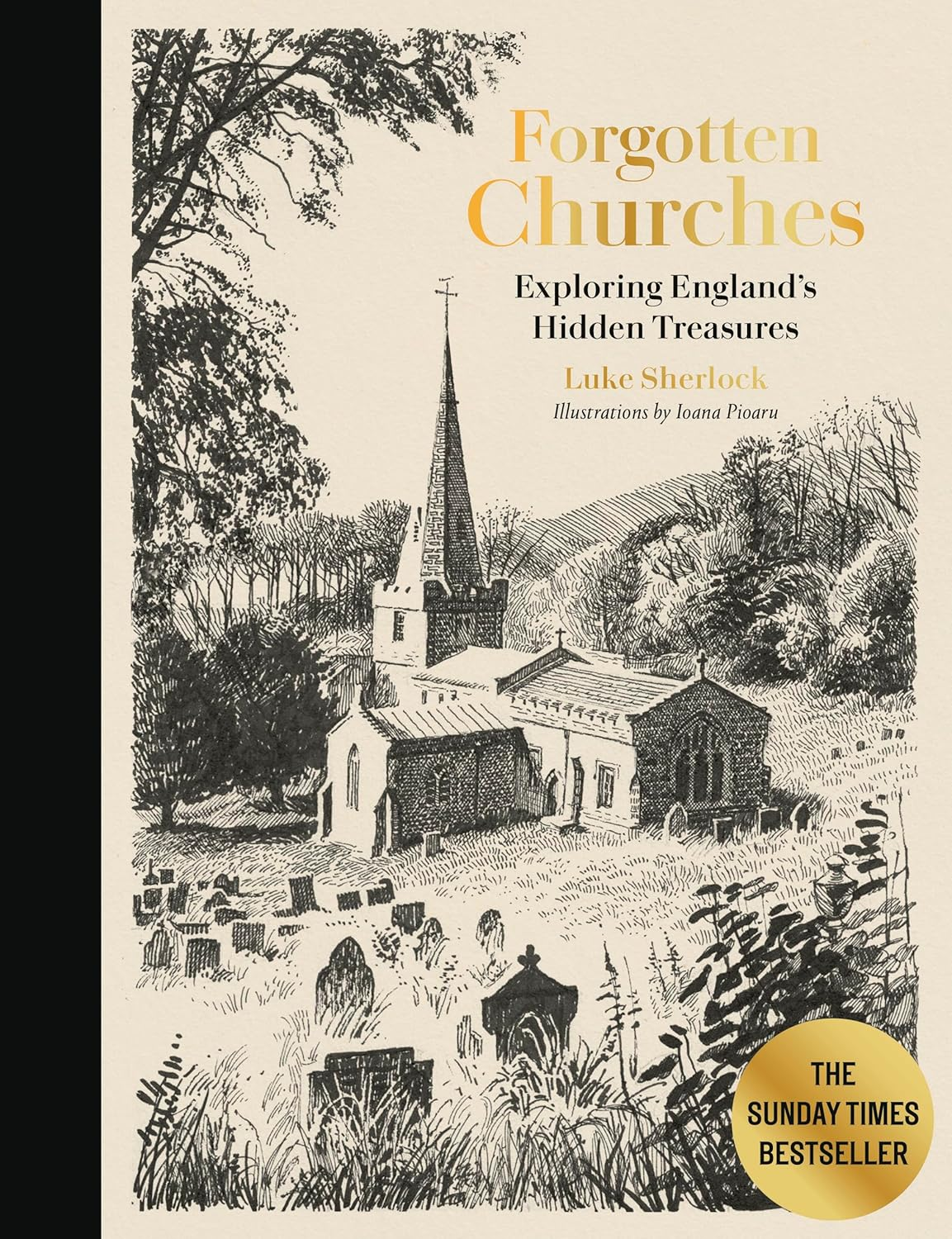
Forgotten Churches is a unique look at England’s most beautiful and overlooked churches, hidden treasures that need to be protected.
For centuries, England’s churches have stood as quiet witnesses to history, filled with remarkable craftmanship, untold stories and layers of cultural heritage.
Yet many of these extraordinary buildings remain overlooked – until now.
Luke Sherlock (the ‘English pilgrim’) has spent years travelling across England to uncover hidden architectural gems and sharing their beauty with thousands of people online.
Now in book form, he invites you on a journey through 70 of our most atmospheric churches, from 1000-year old Saxon chapels and striking Gothic landmarks, to hidden Romanesque sanctuaries and ornate Victorian treasures.
From the remote landscapes of Northumberland and Cornwall to the Norfolk fens, Yorkshire Dales and Somerset hills, he reveals their stories – of of local communities, master builders, and the shifting tides of history.
Whether you love history, architecture, or simply the charm of England’s rural landscapes, this book will appeal.
Luke Sherlock is a writer, pilgrim and bookshop owner, with a love for heritage and art. There’s little he loves more than throwing on a backpack, heading off down an unknown footpath to explore a hushed, ancient church.
The drawings are by Romanian-British artist Ioana Pioaru.
A Stonemason’s Guide to British Churches
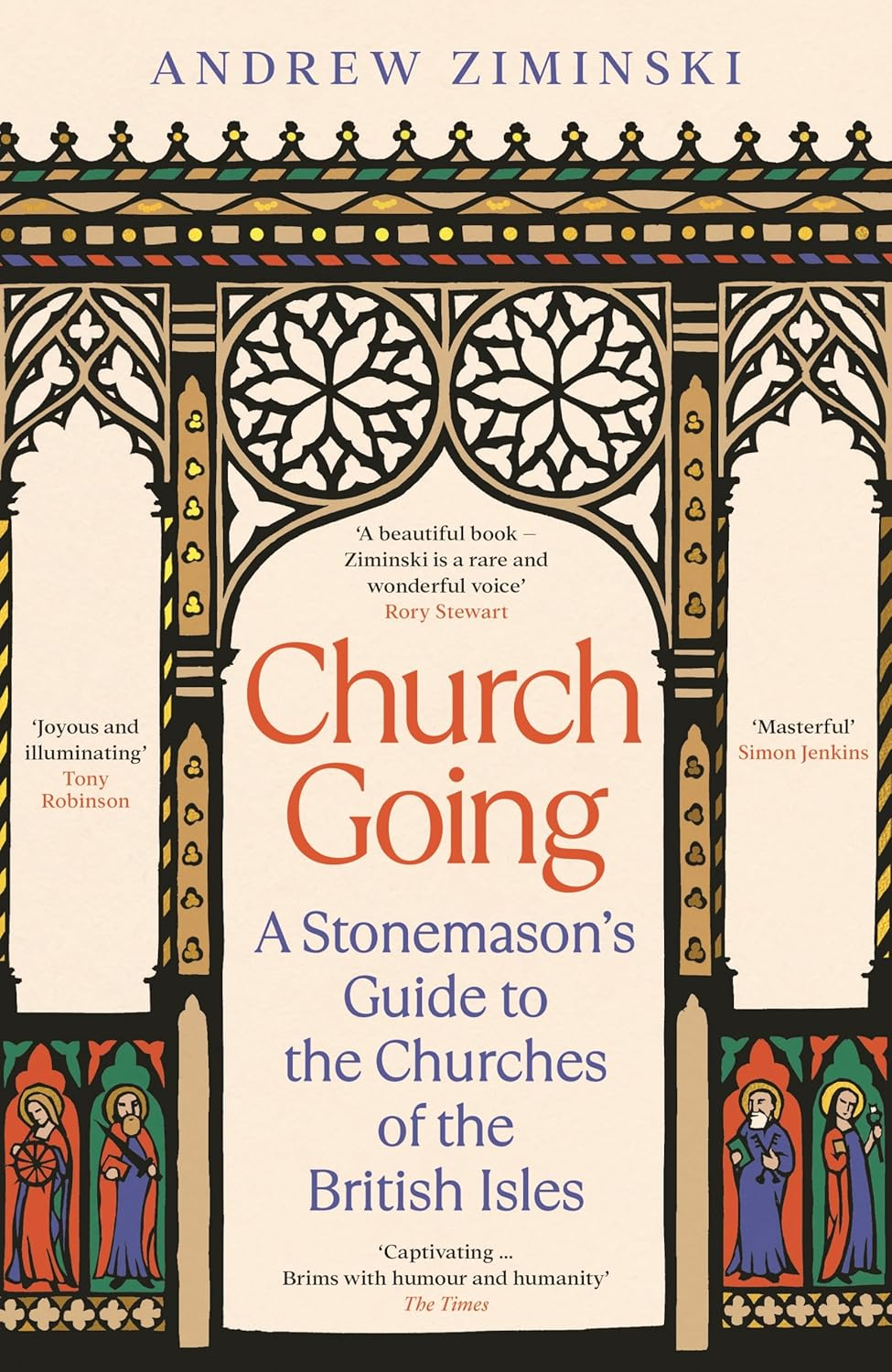
Church Going is an illuminating exploration of our glorious ancient churches. Discover the history of your local parish church, for a glimpse into craftsmanship of old.
The author look at beehives in church walls to bullet-holes in weathervanes, in this glorious bedtime read for religious and architectural peeps.
Churches are not just place of worship, but also vibrant community hubs, and oases of calm reflection. To know a church, is to hold a key to the past, which unlocks an understanding of our shared history.
Andrew Ziminski has spent decades as a stonemason and church conservator, often acting as an informal guide to curious visitors. This is his handbook, which reveals their fascinating histories, features and furnishings. Beautifully written and richly illustrated, it’s a celebration of British architectural history.