
Demand Clean Water: Campaign for Healthy Wild Swimming

England’s seas and rivers are now so polluted, that just 60% are deemed safe for swimming, compared to over 80% in mainland Europe.
Old sewage networks struggle to cope with litter, microplastics and farm chemicals, which are ending up in our seas due to everything from sunscreens to laundering synthetic fabrics. In 2024 alone, there were 400,000 sewage discharge reports, leading to demand for action.
Use the map at Surfers Against Sewage to check for swim water quality. SAS says that ‘if the water is brown and smells like shit’, it probably is. You can report raw sewage.
Read where to find greener swimwear.
England now has the unenvious title of being ‘the dirty man of Europe’. High counts of E.coli, intestinal enterococci and other pathogens raise the risk of stomach bugs, ear infections and skin rashes. Cuts are more likely to get infected. And even ‘clean’ water can be unsafe in reality.
Even stretches of The Thames now have ‘no-swim notices, after heavy rain. Cornish beaches report contamination after storms, and Lake Windermere has issues with sewage pollution. One youngster recently reported ‘feeling sh*t’ while swimming in England’s largest body of water.
Polluted waters also harm fish, birds, otters and whales. Instead of ‘petrichor’ (the lovely earthy smell after rain’, we get odd smells, and red/amber warnings, which has knock-on effects on public health and tourism.
Other Polluters: Plastics and Farm Run-off
Microplastics from litter and washing synthetic clothing also pollute (a reason to use microfibre filters in washing machines). And fertiliser, pesticides and slurry wash off feeds in rain, feeding algal blooms and lowering oxygen. A reason to support organic farming.
Campaigners want stringent targets for the Water (Special Measures) Bill, especially for storm overflows (and meaningful fines for repeated breaches). It also wants major investment in storage tanks, pipe upgrades and green infrastructure (like reedbeds and wetlands).
People-powered action delivers quick wins. From volunteer beach cleans to river test kits, this brings about more pressure for stronger public reporting and for businesses and councils to do more. The Rivers Trust works with communities and farms to reduce runoff (that ends up in the sea) and restore habitats. Report pollution to the Environment Agency.
Only in England would you find people who would go wild swimming early on Christmas morning, then go back inside to enjoy tea and cake! Wild swims are popular nationwide, but it’s important to do it right, as obviously there are not lifeguards, plus hazards from bad weather to rocks, glass and jellyfish.
Also read where to find greener swimwear.
Keeping Safe on Wild Swims
Read How to Wild Swim which includes safety tips:
- Know the water: Check depth, flow, temperature and currents.
- Weather watch: Rain, storms, or high winds can change conditions.
- Swim with others: It’s safer and more fun.
- Stick to public spots. Look out for local signs and advice.
- Water shoes: Protect feet from sharp stones and rocks. Scuff/stamp your feet, to let creatures know you’re approaching.
- Waterproof bag: To store your phone (no lifeguards).
- Carry waterproof plasters, a whistle and foil blanket.
If caught in a rip current, wade (don’t swim) parallel to the shore, raise hand and shout for help. A tow float (and bright swim hat) helps.
If phone is out-of-range, call 999 and 112 (diverts to a signal). Download RYA SafeTrx app (with an Irish version) to alert contacts.
Dogs and Wild Swimming Safety
- Dogs may be at risk of currents and cramp (dogs will follow you, even if they are tired). Read more on keeping dogs safe by the seaside.
- Although quick sea swims for dogs are fine (rinse saltwater off with lukewarm water and dry with towel, dogs could be at risk from attacks by seals.
- Other dangers are seaweed (expands in the stomach as it dries) and blue-green algae. If you take them, go with friends and have someone ‘dog-sit’ nearby.
- Never swim near marine creatures like seals, you could spook pups into the water, before they are ready to swim.
Keep Away from Stinging Jellyfish
Jellyfish can sting (even when dead). In England, stings can be painful but are rarely serious, unless stung by sea urchins, stingrays, weever fish and Portuguese man-of-war. If so, leave water to warn others and lifeguard, then rinse with seawater.
Remove spines with tweezers (or edge of a bank card), soak in warm water for at least 30 minutes (or use hot towels/flannels) and take painkillers. Do not cover/close wound.
For severe pain (or if stung on the face/genitals or from a stingray, visit minor injuries. For breathing difficulty, chest pain, vomiting, loss of consciousness, seizures or severe swelling/bleeding, call 999. Report jellyfish stings (this helps to monitor ocean health).
If dogs are at the beach with you, lion’s mane jellyfish and Portuguese man o’war in particular can be dangerous. If your dog is stung, rinse area with sea water, remove tentacles/barbs and seek immediate vet advice.
Keeping Warm On (and after) Wild Swims
- Rapanui (Isle of Wight) makes organic cotton changing robes and surf towels for men and women. Launder with a microfibre filter (contain recycled polyester).
- Finisterre wetsuits (also for women and rental) are made from recycled materials. Again they have some synthetic material, but are the greenest options so far.
The Clean Waters of Croatia’s Coast

Croatia (which used to be part of Yugoslavia) has a beautiful coast that borders Italy on the Adriatic Sea. The country is ranked first for the quality of its swimming water by European Environmental Agency. It’s also home to the Danube (Europe’s second longest river) and even has its own ‘Lake District’ with cascading waterfalls, with pure waters coloured turquoise and mint.
Some people remark that this seas here are so clean, they look like glass. Most beaches have visibility below 30 metres on clear days, and 95% of sites meet bathing water standards.
So how has Croatia excelled, where England hasn’t? It’s due to councils upgrading wastewater systems, with regular monitoring. Resorts are cleaned daily of litter, and small harbours restrict discharges.
Croatia also has a deposit return scheme for bottles and cans (our pending legislation has been delayed in England, because the government does not want to include glass, for some baffling reason). Introducing one would mean less floating cans and bottles (which leach microplastics into seas and rivers).
Best Spots for Wild Swimming in England
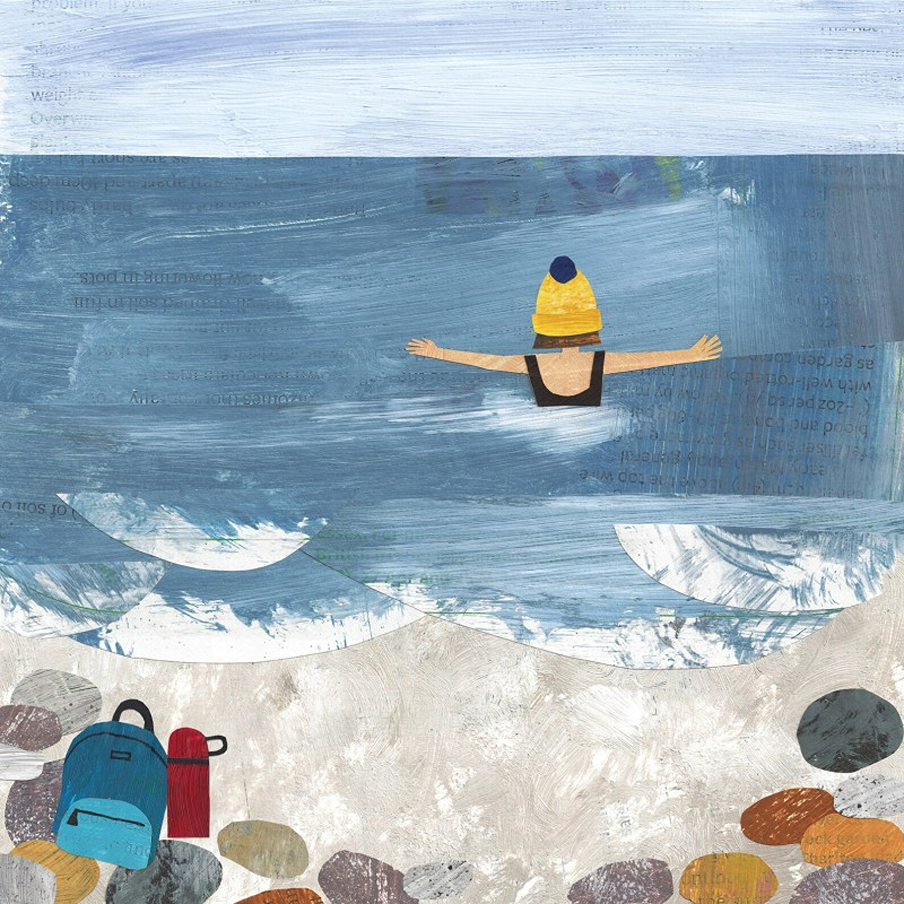
The Ripple Effect is a celebration of whacky wild swimming communities. From student dippers to menopausal mermaids to addiction recovery groups, learn what makes wild swim groups tick.
Wild Swimming Walks: Exmoor & North Devon (2024) is the latest in a series of popular books. Sophie Pierce is author of Green Hill, on how wild swims helped her cope with grief, after the sudden death of her 20-year old son. Co-author Matt has swam from the mainland to the Isle of Wight and from Sicily to mainland Italy.
England’s Ultimate ‘Wild Swim’
Swimming the channel is obviously only for experts. No longer are people smothered in goose fat. And times are getting shorter, as people get fitter. It’s still pretty dangerous, as you are crossing the world’s busiest shipping route. And you still need your passport (carried by boats) when you arrive in France!
The first attempt at the cross channel swim was by 23-year old J.B. Johnson in 1872. He hired a brass brand in Dover who played for three hours, before he set off. He swam for 45 minutes before downing some brandy, swam for another hour before having another brandy. After another 1 hour and 20 minutes, the cold water was too much, and he boarded the boat!
The first successful crossing was in 1875, when Paul Boyton wore a rubber suit designed for passengers on sinking ships. The first woman to complete the swim was American Gertrude Ederle, in 1926 (it took her just over 14 hours). Soon Amelia Gade Corson followed suit (her husband rowed alongside her, supplying her with hot chocolate, crackers and sugar lumps!)
Good Tuesday’s Eco Wild Swimming Journal
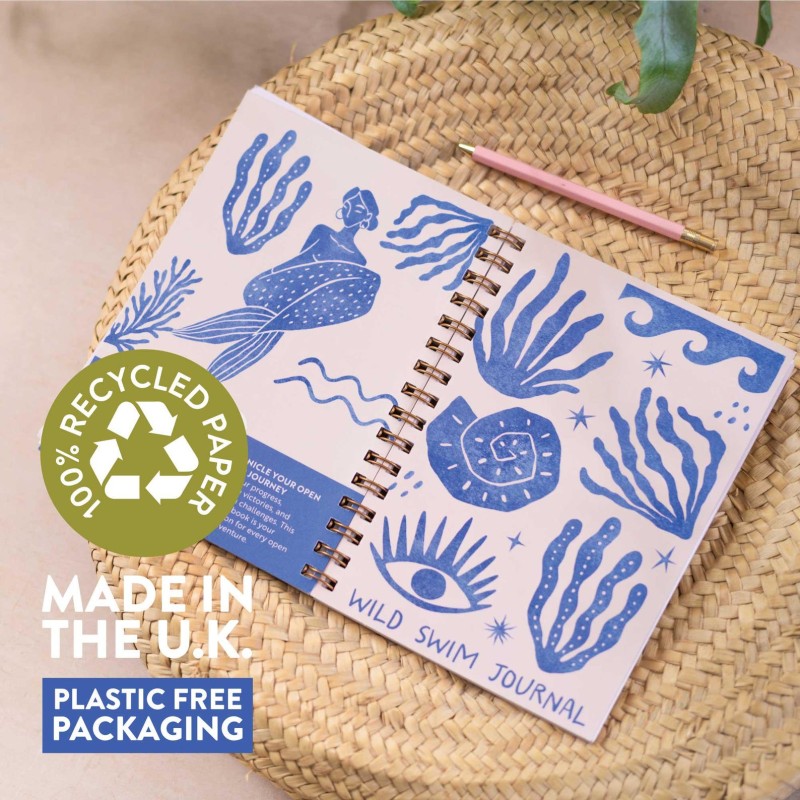
This wild swimming journal makes a great gift for people who brave the cold waters to swim in the great outdoors. Keep a track of all your adventures in this spiral-bound journal log book, with colourful pages throughout and striking deep blue ocean artwork on the cover..

Inside you’ll find a kit checklist, swim trackers and log pages for 120 swims – record the environment, conditions, duration, star rating and swim buddies on each outing.
Everything at Good Tuesday is printed on recycled paper, sent in plastic-free packaging, made in the UK and beautifully designed.
Choosing recycled paper is better than FSC-certified paper, as that still requires fast-growing trees with pesticides (instead these products ‘close the loop’ and use up unwanted waste that would otherwise end up at landfill, emitting methane gas).