Black Gold: Making or Buying Garden Compost
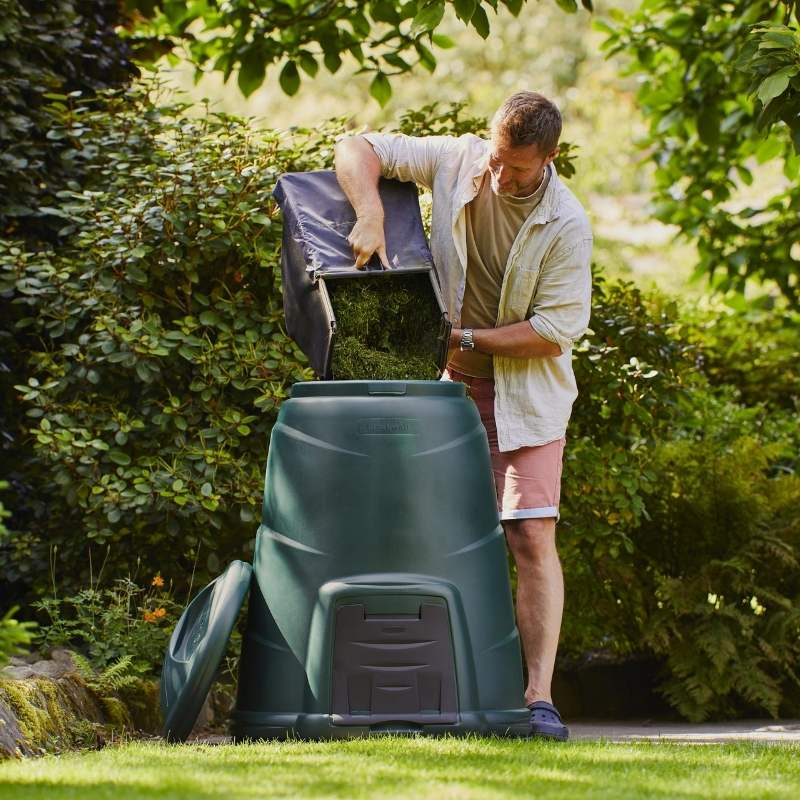
Blackwall compost bins are made from recycled plastic, and some councils also sell them at discounts, so check before you buy online.
This is England’s best-selling compost bin, with an ample 330 litre capacity (or a compact 220L for small gardens) that retains heat to encourage moisture and produce a healthy mix of microorganisms.
Avoid ‘hot composters’ as these ‘cook’ garden creatures that fall in, as there is no earth to keep them cool. Leave wormeries to the experts (worms for compost bins are different to earthworms, and many die when transferred to soil or get lost in the post.
Sold with a 5-year guarantee, it’s UV-stabilised and includes a wide aperture for easy filling. You can also buy an optional base plate to place on solid surfaces to increase ventilation and improve drainage and replacement hatches.
Composting is the process of breaking down organic matter into a dark, crumbly texture that resembles soil. It involves the natural decomposition of materials like food scraps and garden clippings. But what makes it work?
At the heart of composting lies the work of microorganisms—tiny life forms that feast on your waste, breaking it down efficiently. This process creates heat, which speeds up decomposition and kills off any unwelcome seeds or plant diseases.
Making your own compost is a wonderful way to convert food waste into rich soil for your garden, and avoid buying peat, which supports habitats of endangered wildlife.
Learn how to create pet-friendly gardens and wildlife-friendly gardens. Also learn how to stop birds flying into windows.
Never fork compost piles, just gently prod as many creatures including hibernating hedgehogs can often be found inside.
What not to compost: latest research suggests to just bin citrus, rhubarb, tomato and alliums (onion, garlic, leek, shallots, chives) as acid could harm compost creatures – same with tea/coffee grounds due to caffeine.
You have to be a real expert to balance out the acids, to avoid harming compost creatures. Also bin soap nuts (natural insecticide could harm compost bin creatures).
Tips for outdoor compost bins
- Keep fresh compost away from pets, as it contains mould.
- Always gently disturb (don’t fork) compost piles before handling/moving, as frogs and hedgehogs often sleep or hibernate in or underneath compost bins.
- Avoid rodents by siting compost bins near footfall and not adding animal foods (it’s illegal to sell food made with composted animal foods). Also ensure you add more ‘greens’ (rodents are attracted to dry compost with too many ‘browns’).
Know your ‘greens and browns!’
A good compost bin is made up of a roughly equal mix of greens and browns. Too many greens (like grass cuttings) will make your compost slimy, and too many browns (like leaves and cardboard) will make it too dry to turn into compost.
Try to tear up things like cardboard for faster composting. You can usually leave grass clippings on the lawn (if you have a lot of them, try a tumbling compost bin instead).
Green materials are rich in nitrogen. Think of grass clippings, fruit and vegetable scraps, and coffee grounds. They provide the moisture and proteins microorganisms need for growth.
Brown materials are high in carbon. These include dried leaves, twigs, and newspaper. They offer the energy microorganisms require to decompose waste effectively.
Greens include:
- Fruit & veg peelings (not alliums, tomato, rhubarb, citrus – just bin)
- Fresh grass clippings
- Egg shells
- Chicken, cow or horse manure
- Seaweed (keep away from pets)
- Dead flowers
- Cut-up plastic-free cleaning sponges
- Cut hair & pet fur (not with flea medicine etc)
Browns include:
- Fallen leaves (or use a leaf bag and sit in the corner of the garden and it will turn into leaf mould in a year or two).
- Shredded newspaper & cardboard (no magazines, due to inks)
- Sawdust or woodchips, straw or hay (in small amounts)
- Pine needles
- Cornstalks (after harvesting) if cut up
- Old paper packaging (shredded)
- Egg boxes
- Untreated wood chips
- Plant-based cut up fabrics (cotton or linen)
- Bamboo toothbrushes
An odour-free kitchen compost bin
Lomi is a clever kitchen composter, to stop food waste. It stops smells and waste and is a good industrial composter for kitchens (it costs a few hundred pounds). Used by 100,000 people, it simply turns food scraps into nutritious compost.
Just push the button to turn your food waste into plant-friendly dirt! No ants, fruit flies or maggots. It sits on the kitchen countertop and is small enough to store in a cabinet. Ideal for anyone in a city apartment to a huge mansion.
The sensors simulate and accelerate the natural process to produce compost in as little as 4 hours. You can put yard and food waste in this, but also animal foods if you eat them, along with bread and grain products and Lomi-approved compostable packaging. It’s around the same size as a bread maker and uses little electricity.
Japanese bokashi compost bins
Bokashi composting bins were created by a Japanese professor and unlike conventional compost that uses oxygen, these use lack of oxygen instead, using a bokashi bran that you add to food waste, then close the lid and leave for 14 days to produce compost to add to your outdoor bin.
The resulting liquid can be drained off using the tap to use as plant feed (dilute with water 1:200). You buy two, so there is always one on the go. All you need buy after that are bran refills.
Bokashi bins can accept other fruit/vegetable waste, bread, dead leaves & withered flowers and used compostable dish sponges. Unlike outdoor compost bins, Bokashi bins can take most animal products if you eat them (not large bones) due to Bokashi bacteria helping to destroy pathogens.
Don’t compost cooking oil or pour down drains (use a cooking oil recycling container).
Community community bins
Some councils offer community compost heaps. Brighton Community Compost Scheme prevents 100 tons of food going to waste each year, by setting up local compost boxes with monitors.
Councils may have an industrial compost scheme, for things like ‘biodegradable plastics’ that usually only degrade in such systems.
Make your own leaf mould
Make your own leaf mould from old rotting leaves in autumn. This is a great soil improver, to replace peat.
Again, keep leaf mould away from pets, as it harbours bacteria and fungi that could produce toxic mycotoxins . Read more on giving dogs baths, if they come into contact with damp leaves. And contact your vet for advice.
Enrich the Earth is a campaign to get more councils to collect green waste (millions of tons are discarded each year). This could be used to make green compost, another good nutrient-rich peat alternative.
Reasons not to buy peat compost
Peat is basically a soil made from dead and decaying matter, mixed with clay and rocks. It takes ages to form (around 1mm a year) yet is immensely important (and England contains most of the world’s peat bogs – they are like our ‘rainforests’).
Formed over thousands of years in low-oxygen environments, you’ll find natural peat bogs across England in bogs, mires (wetlands) and fens. England’s most extensive peat bogs are found in the Pennines, North York Moors, and parts of the Lake District and south west England.
Peat bogs absorb water (so prevent floods), stop release of greenhouse gases (so reduce climate change) and also support habitats of many endangered birds (like plovers and curlews) and dragonflies – most live in peat bogs).
But instead of leaving them where they are, industry moves in and removes them – to grow plants for garden centres. Most stores now don’t sell peat compost (there is an upcoming Bill to ban the sale of peat for horticultural use, but it will take years). But a lot of peat is ‘hidden’ (in pot plants or plug plants etc).
You wouldn’t like it if a bulldozer came into your home and upturned your entire life, leaving you homeless and without food and shelter. Yet that is exactly what is happening, in the peat industry to our most precious wildlife, many of them endangered species.
Using peat in your garden is a sign of environmental vandalism. f
The government is running out of time to fulfil its promise to ban the seal of peat to gardeners. Peat belongs in bogs, not bags. Whenever a peatland is dug up, a natural habitat is destroyed, with appalling consequences for wildlife and our climate. Alison Steadman (actress and wildlife campaigner)
Peatlands have the power to help lock up carbon, alleviate flooding and help wildlife recover. So why on earth are we still allowing them to be dug-up? It has to stop. Iolo Williams, wildlife expert
Peatlands is a book on the value of peat bogs by award-winning garden writer Alys Fowler. She calls for us to sink deep into the dark black earths of these rugged places, and take a look at the birds, animals, plants and insects, that live within them.
Living in Wales (nestled between bogs) makes this book both personal and illuminating. Her odyssey takes her from the Peak District to Ireland, creating an intimate picture of these magical places and the people who care.
The Book of Bogs is an anthology of stories and poetries from various writers, looking at threatened landscapes like bogs and other peatlands. Like peat, this book is full of living things: scientific study, archaeological discovery; personal stories of suffering and growth. Not just in England but abroad, like the peatlands of Papua New Guinea.
Choose Peat-Free Whisky
Most brands of whisky are made with peat. Read our post on peat-free whisky!
The Hunting Industry Burns Peat Bogs
Peat burning often occurs on land used for grouse shoots, by burning vegetation (that lays on top of peat), usually purple moor grass or heather. This provides new heather shoots for grouse (so they are easier to find and shoot).
A voluntary ban by government a few years ago did not work, with Greenpeace reporting fires on peatlands, in northern England’s national parks.
The peat bogs on a grouse shooting estate were on fire. The burning of peatlands is likely to exacerbate floods downstream. Towns in the Calder Valley such as Todmorden, Hebden Bridge and Mytholmroyd have been flooded repeatedly. George Monbiot