From Cromer to Wells: Protecting Norfolk’s Beautiful Beaches
Although it’s important to live simple sustainable lifestyles and not drop litter, it also helps to know why we’re doing it! So let’s get to know about the little beautiful corners of England!
The Norfolk coast runs along the North Sea (the coldest in the world) in Eastern England, and is home to many popular resorts (busier ones like Great Yarmouth) and quieter less touristy sites.
The Norfolk Coast Path starts here, travelling through Wells-next-the-Sea and Cromer, passing through flocks of birds and grey seals at Cley Marshes and Blakeney Point. The Peddars Way ends at Holme-next-the-Sea and begins 49 miles away in Suffolk.
Always follow the Countryside Code to keep all creatures safe. Keep dogs away from steep banks, mushrooms (and toxic plants/trees) and on leads near birds, barnyard friends and wild ponies.
If at the coast, keep away from nesting birds and never walk on sand dunes. Learn how to keep dogs safe by the seaside (check beach bans before travel). Join the campaign to ban flying rings, to help local seals.
No matter who dropped it, on public land councils are responsible for picking up litter. You can report to Fix My Street. For private land, councils can serve litter abatement orders (and issues fines or invoices if not compliant).
Hunstanton (‘Sunny Hunny’) that faces west
Hunstanton is a Victorian seaside town that faces west across the 20-mile bay of the Wash (a large square estuary that serves as the collective mouth for four major English rivers that drain The Fens into the North Sea). So while you can be the first in England to watch the sun rise near Lowestoft, here you can watch the sun set directly over the sea looking west towards Lincolnshire.
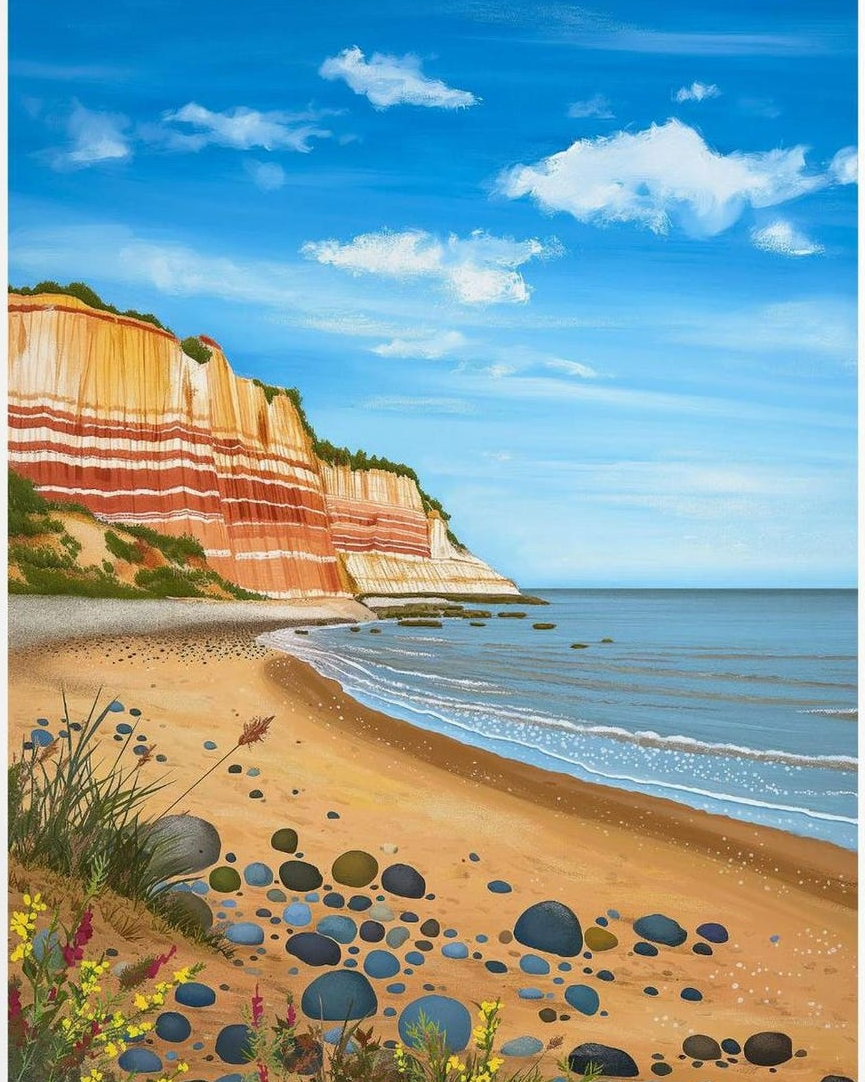
Hunstanton cliffs have distinct horizontal bands of orange-brown carrstone, alongside red and white chalk. Some say these cliffs look like a ‘layered cake’, ‘baked’ around 90 million years ago from compacted shells of microscopic marine organisms. The red hue is from iron oxide (rust) that washed into the sea when chalk was forming, and the dark orange/brown sandstone is rich in iron minerals.
Wells-next-the-sea
Wells-Next-The-Sea (named to avoid confusing it with England’s smallest city of Wells in Somerset) is a lovely place with pastel beach huts a mile away on the sand, and pretty pine woods set back from the beach. Barbecues are banned on beaches and local woods.
During summer, a warning ‘hide tide’ siren sounds for four hours, to keep visitors safe.
You can take a four-mile steam train trip to Walsingham (England’s Nazareth) on Wells & Walsingham Light Railway that sits on land home to over 300 species of wildflowers (some rare) and forms a protective wildlife corridor between the coast. The chalk soil is also important for coastal birds, birds of prey and reptiles.
Volunteers here refuse to ‘manicure the space’ on the journey, to let wildflowers and butterflies thrive in their natural habitat. They don’t ‘carbon offset’ but instead use smokeless coal and say that running the train for 9000 miles a year, still generates less carbon than one return flight to New York.
Dogs are welcome (and travel for free) on the short journey. But are requested to sit in closed carriages, as there are a few chickens outside on the route.
The 1953 Great Flood killed many people on the East coast. Local police officers Charles Lewis and Leonard Deptford received George medals for heroic rescues, including a bedridden elderly couple, and a local dog.
Sheringham (a shingly beach and independent shops)
Sheringham, Norfolk is a Victorian town on the North Norfolk coast, known for its sandy/shingle beach and lying just offshore is Europe’s longest chalk reef (marine alternatives to freshwater chalk streams), providing ideal habitats for many local marine creatures.
A few years back, there was a goliath 13-year battle in the Norfolk town of Sheringham, to stop Tesco building a big supermarket, in one of the towns left without one. When Paul Kingsnorth covered the story in his book Real England, the battle was ongoing.
Things looked hopeful, when a local entrepreneur offered to fund an independent supermarket, even hosting cooking classes above it. And yet the council (the council!) received the proposal, then voted to give planning permission to Tesco.
Today (many locals are likely unaware of the history) it’s a busy supermarket, and of course Tesco ‘gives back’ to the community. But many independent shops there have now gone under, there are no ‘blue tokens’ in the box to help them. A community has been half-destroyed.
And now this beautiful little seaside town has another hit: after the council (this time) refused a licence for Domino’s pizza (the town already has 40 indie food outlets), the national government’s Planning Inspectorate overrode the decision, and it’s due to open in summer 2026.
So now the town will be littered with white plastic sauce pots, and money will go out of the town, and up to head office of Domino’s (in Michigan, USA).
How on earth has it been allowed to open, when both local people AND (this time) the council have both refused permission? Their decision stamped on by national quangos who don’t even live there.
Sheringham Park (like so many areas, owned by the National Trust) is an expansive estate that features rolling parkland and miles of woodland trails, with the viewing towers offering panoramic view of the coast.
Read their page for dog guardians. Dogs must be kept on leads in the park between 1 March and 31 July, to protect ground-nesting birds. Only assistance dogs are allowed in some areas.
The park also has ticks (check dogs and yourself after walks), cattle and adders (from February to November). Adders (England’s only venomous snake) can bite dogs, if disturbed.
- Dog-Friendly Cornwall has tips on when to avoid walking (‘safe hours’ were previously before 9am and after 7pm). But climate change has adapted temperatures, so this does not always follow.
- If you think an adder has bitten your dog, call a vet immediately (read more on how to avoid & treat adder bites).
The Wild Garden covers 50 acres and includes mostly rhododendrons (which are toxic to pets anyway) and was developed around a base planting of Scots pine and oak,with specimens brought from Asia by explorer Ernest Wilson in the early 20th century.
The home was owned in the 19th century by Charlotte Upcher, a campaigner to abolish slavery, with her son Henry completing work on the house and garden. She also funded Sheringham’s very first lifeboat The Augusta, named after her daughter.
Cromer: a pleasant Victorian resort
Cromer is a pleasant Victorian coastal resort on the North Norfolk coast. It’s not as swanky as say Sheringham (or Southwold in Suffolk). But its faded seaside charm and better affordability makes it all the more sweeter!
The town has a beautiful sandy beach that stretches for miles, overlooked by cliffs and a town full of old buildings. It’s mostly known for its seaside pier and lifeboat museum, mostly dedicated to local hero Henry Blogg (more on him below).
Cromer was not always a seaside resort. It was a small village, which during the Second World War, held medical corps (like the TV series MASH!) to help civilian and military casualties in the immediate district, who had suffered local bombs and shrapnel injuries.
From the 50s, the town’s beaches and nice weather made it a popular holiday destination for people living inland. Like many coastal resorts, the arrival of the railways a few decades before had brought previously inaccessible places within reach.
Doctors would recommend the ‘Cromer air’ for patients with bad lungs or needs, and Jane Austen even praised the town in her 1815 novel Emma.
Holkham: a pretty seaside village
The beach here is home to a national Nature Reserve, and many rare species of flora and fauna. The vast sands are also backed by pretty pinewoods, and behind the shore is a semi-circular basin that at high tides, fills to create a shallow lagoon.
The main building here is Holkham Hall, an 18th century Palladian house on a vast 25,000 acre estate, home to the Earl of Leicester. Unfortunately the estate holds regular shooting parties for birds that are just enjoying life by the sea (like shy woodcocks, pheasants and partridges). It also hosts the royal family for private shoots.
But thankfully the beach is still not in private hands, so is available for the public to visit.
Great Yarmouth (a nice town blighted by litter)
Years ago, Great Yarmouth was a popular resort thanks to its wide sandy beach. However in recent years it has had so many litter problems that the local council has now quadrupled fines, with severe fines also for flytipping. It now has a policy of targeting ‘yobs, litter louts and drunkards’ in a major crackdown.
The town is of course at present in the news, as the constituency of Restore leader Rupert Lowe.